


 https://orcid.org/0000-0002-8383-4099

Abstract
Giant uterine leiomyomas (>10 cm) are uncommon in the modern imaging era and may mimic ovarian malignancy due to their size and heterogeneous appearance, posing a diagnostic and therapeutic challenge. A 34-year-old nulliparous woman presented with progressive abdominal distension and pelvic pressure. Imaging revealed a 19 × 14 cm multinodular uterine mass with heterogeneous features and preserved surrounding fat planes. Given the patient’s strong desire for uterine preservation, an open abdominal myomectomy was performed. A highly vascular, multicompartmental leiomyoma arising from the uterine body was successfully enucleated with vasopressin-assisted hemostasis and meticulous multilayer myometrial reconstruction. Estimated blood loss was 1000 ml without transfusion. Histopathology confirmed a benign leiomyoma. The postoperative course was uneventful. This case highlights that, despite their size and complexity, giant multicompartmental leiomyomas can be safely managed with uterine-preserving myomectomy in carefully selected patients. Adequate preoperative assessment, intraoperative vascular control, and advanced reconstructive techniques are critical to guide surgical decision-making and optimize outcomes.
Introduction
Uterine leiomyomas are the most common benign tumors of the female reproductive tract, arising from smooth muscle cells of the myometrium and typically diagnosed in women of reproductive age [1]. Although most are small and asymptomatic, a minority may grow to considerable size and are classified as “giant” when exceeding 10 cm or producing significant mass effect [2, 3]. Despite widespread use of pelvic imaging and routine gynecologic surveillance, rare cases of giant leiomyomas continue to present with important clinical and surgical implications [2, 3].
Epidemiologically, uterine leiomyomas affect up to 60%–70% of women of reproductive age, although only 20%–30% become clinically symptomatic [4]. In contrast, giant leiomyomas are distinctly uncommon in contemporary practice and are predominantly reported as isolated case reports or small case series. Importantly, there is no universally accepted definition of “giant leiomyoma” in the literature. While many authors adopt a size-based criterion (typically >10 cm in diameter), others propose weight-based definitions, classically referring to tumors exceeding 11.4 kg (25 pounds), with more recent reports suggesting lower thresholds such as >1 kg [5]. This lack of standardization contributes to heterogeneity in reporting and clinical interpretation.
Due to their size and heterogeneous appearance, giant leiomyomas may mimic ovarian or other pelvic neoplasms on imaging, complicating preoperative assessment [6]. Additionally, marked distortion of pelvic anatomy and increased vascularity elevate the technical complexity of surgical management and the risk of intraoperative hemorrhage [2, 3].
While hysterectomy is often considered definitive treatment for large symptomatic fibroids, uterine-preserving myomectomy remains a valuable option in women desiring fertility when adequate surgical expertise is available [6].
We report a case of a 19 cm multicompartmental uterine leiomyoma successfully managed with uterine-preserving myomectomy, highlighting the diagnostic challenges and surgical considerations in this rare presentation.
Case presentation
A 34-year-old nulliparous woman was referred to our surgical service with a 12-month history of progressive abdominal enlargement associated with pelvic pressure and intermittent dull hypogastric pain. She denied abnormal uterine bleeding, dysmenorrhea, urinary or bowel symptoms, and constitutional complaints. There was no history of previous abdominal surgery or relevant comorbidities. The patient had a body mass index (BMI) 25.6 kg/m2, she reported regular menstrual cycles (28–30 days).
On examination, the abdomen was distended by a firm, non-tender mass extending ~5 cm above the umbilicus, mobile transversely and suggestive of pelvic origin. Bimanual examination confirmed a markedly enlarged uterus with preserved cervical mobility and no palpable adnexal masses.
Laboratory tests showed normal hemoglobin (14.5 g/dl), leukocyte and platelet counts, and tumor markers (CA-125 and carcinoembryonic antigen) within reference ranges.
Contrast-enhanced abdominopelvic computed tomography (CT) demonstrated a markedly enlarged uterus (19 × 12 cm) containing a large heterogeneous, lobulated, multinodular solid mass (Fig. 1).
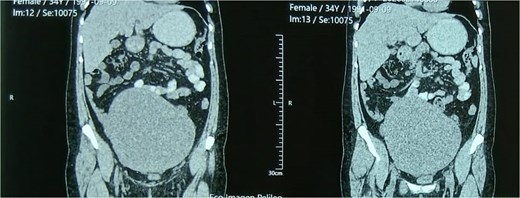
Contrast-enhanced coronal CT demonstrating a markedly enlarged uterus measuring ~19 × 12 cm, occupied by a large heterogeneous multinodular solid mass with lobulated contours. The lesion displaces adjacent bowel loops superiorly without evidence of invasion.
Focal low-attenuation areas suggested degenerative changes. Bowel loops were displaced superiorly and laterally, and the urinary bladder was compressed anteriorly without invasion. Fat planes were preserved, with no ascites, lymphadenopathy, or radiologic signs of malignancy (Figs 2 and 3).
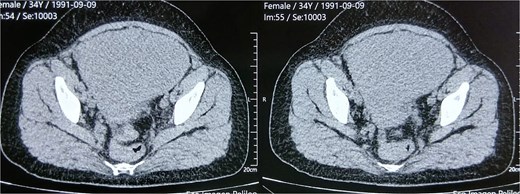
Axial pelvic CT showing a bulky intramural uterine mass with heterogeneous attenuation and multinodular architecture. The urinary bladder is displaced anteriorly, and preserved fat planes suggest absence of local infiltration.
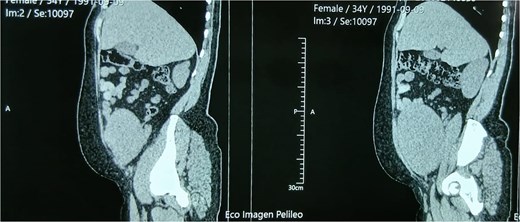
Sagittal reconstruction of contrast-enhanced CT illustrating the cranio-caudal extension of the uterine mass into the lower abdomen, with distortion of normal pelvic anatomy but no radiological signs of extrauterine spread.
Contrast-enhanced CT was selected for preoperative evaluation due to its availability and its ability to adequately assess tumor size, anatomical relationships, and potential extrauterine disease. Although magnetic resonance imaging offers superior soft tissue characterization for uterine masses, CT was considered sufficient in this case given the absence of radiologic features suggestive of malignancy and the need for timely surgical planning.
Given the patient’s desire for uterine preservation and future fertility, an open abdominal myomectomy was planned.
A midline infra- and supraumbilical laparotomy was performed under general anesthesia to ensure adequate exposure. Intraoperatively, a markedly enlarged multinodular uterus occupying the pelvis and lower abdomen was identified. The mass originated from the uterine body and consisted of multiple coalescent intramural leiomyomas forming a single conglomerate tumor measuring ~19 cm in maximum diameter. Both ovaries and fallopian tubes appeared macroscopically normal, and no peritoneal implants or extrauterine disease were observed.
Diluted vasopressin was prepared as 20 units diluted in 100 ml of normal saline (0.2 U/ml), and ~10–15 ml was infiltrated into the myometrium at multiple sites around the planned incision to achieve local vasoconstriction. A longitudinal uterine incision was made over the fundus, and the tumor was enucleated using combined sharp and blunt dissection along the pseudocapsule plane. Due to increased vascularity, multiple feeding vessels were individually identified and ligated with absorbable sutures. The endometrial cavity was not breached. In the event of entry into the endometrial cavity, standard practice would include closure of the endometrium with fine absorbable sutures followed by layered myometrial reconstruction to reduce the risk of intrauterine adhesions and ensure uterine integrity for future fertility. Estimated blood loss was ~1000 ml, and no blood transfusion was required. Total operative time was 120 min. No additional blood conservation techniques such as preoperative GnRH analogues, tranexamic acid administration, or intraoperative cell salvage were employed. Hemostasis was achieved through vasopressin infiltration, meticulous surgical technique, and selective ligation of feeding vessels.
Following tumor removal, the myometrial defect was reconstructed in multiple layers using delayed-absorbable sutures to restore uterine anatomy and integrity. Hemostasis was confirmed, and the abdomen was closed in standard fashion.
The excised specimen was multinodular, firm, and well circumscribed, measuring ~19 × 14 cm and weighing 1.6 kg (Fig. 4).
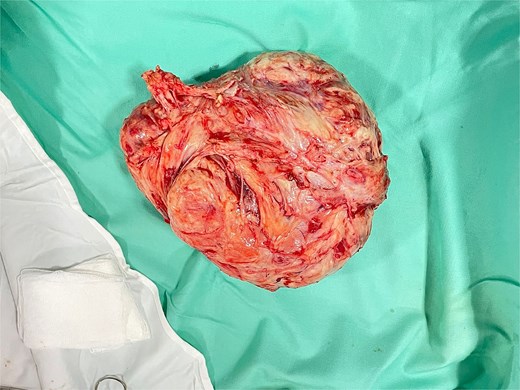
Macroscopic surgical specimen following enucleation, demonstrating a multinodular, well-circumscribed leiomyoma measuring ~19 × 14 cm and weighing ~1.6 kg.
The postoperative course was uneventful. The patient resumed oral intake on postoperative day 1, ambulated early, and was discharged on postoperative day 3 in stable condition. No postoperative complications were recorded.
Histopathological examination demonstrated a benign uterine leiomyoma composed of intersecting bundles of uniform smooth muscle cells, without cytologic atypia, coagulative tumor cell necrosis, or increased mitotic activity, confirming the absence of malignancy.
The patient reported progressive abdominal enlargement over a 12-month period prior to presentation. Initial clinical evaluation and imaging were performed at the time of referral. Surgical management was scheduled electively within 4 weeks after diagnosis. Postoperative recovery was uneventful, with discharge on postoperative day 3. Follow-up evaluations were conducted at 2 weeks, 3 months, and 6 months postoperatively, with no evidence of recurrence or complications.
Discussion
Giant uterine leiomyomas constitute an uncommon but clinically significant subset of fibroids, generating diagnostic uncertainty and technical surgical challenges. Although most leiomyomas are currently detected at smaller sizes due to widespread imaging availability, tumors exceeding 10 cm—and even 15–20 cm—continue to be reported, particularly in settings of delayed consultation or limited access to gynecologic care [6, 7]. Our case (19 × 14 cm; 1.6 kg) falls within this spectrum of large but surgically manageable tumors.
Clinically, giant leiomyomas often manifest with progressive abdominal distension and compressive symptoms rather than abnormal uterine bleeding, as observed in our patient. Similar patterns have been described in recent reports, where mass effect predominated and laboratory findings remained unremarkable [6, 8]. The absence of anemia or constitutional symptoms in our case further supported a benign etiology despite the tumor size.
Preoperative imaging is crucial, as large leiomyomas may mimic ovarian malignancies due to heterogeneous features, cystic degeneration, and displacement of adjacent organs [6, 9]. In some reports, suspicion of adnexal neoplasm led to more extensive surgical exploration [10]. In our case, contrast-enhanced CT showed preserved fat planes, no ascites, and no lymphadenopathy, supporting a uterine origin and enabling fertility-preserving surgical planning.
However, differentiating benign leiomyomas from uterine leiomyosarcoma remains a critical challenge, as no imaging modality can reliably exclude malignancy preoperatively. Magnetic resonance imaging may improve diagnostic accuracy by identifying features such as irregular margins, heterogeneous signal intensity, and areas of necrosis; nevertheless, significant overlap exists, and definitive diagnosis relies on histopathological evaluation. This limitation should be considered when opting for conservative surgical management [11].
The optimal surgical approach remains debated. While hysterectomy is often considered definitive treatment for tumors >15–20 cm, increasing evidence supports uterine-preserving myomectomy in selected patients [11, 12]. Nevertheless, many comparable cases in the literature were managed by hysterectomy due to concerns regarding hemorrhage and distorted pelvic anatomy [6, 7]. In contrast, our case demonstrates that even markedly enlarged, multicompartmental leiomyomas can be successfully enucleated when malignancy is reasonably excluded and meticulous surgical technique is applied.
Comparative studies suggest that hysterectomy offers definitive symptom resolution and eliminates the risk of recurrence; however, it is associated with loss of fertility and potential long-term pelvic floor consequences. In contrast, myomectomy preserves reproductive potential but carries risks of intraoperative bleeding, recurrence, and the need for reintervention. Therefore, surgical decision-making should be individualized, balancing patient age, reproductive goals, tumor characteristics, and surgical expertise [13].
Key technical factors included vasopressin infiltration, systematic vascular control, dissection along the pseudocapsule plane, and careful multilayer myometrial reconstruction. Despite an estimated blood loss of ~1000 ml—comparable to similar reports [6, 9]—no transfusion was required, and no perioperative complications occurred. Minimally invasive approaches have been described for large fibroids; however, tumors approaching 20 cm remain technically demanding, and open abdominal myomectomy continues to represent a safe and reproducible option in cases with significant anatomical distortion [4].
Regarding reproductive outcomes, available evidence suggests that myomectomy can significantly improve fertility, particularly in women with symptomatic or cavity-distorting fibroids. Pregnancy rates after myomectomy have been reported between 40% and 60%, although outcomes may be influenced by fibroid size, number, and surgical complexity. Data specifically addressing giant leiomyomas are limited, but successful pregnancies have been described following extensive uterine reconstruction, supporting the role of conservative surgery in selected patients [11, 13].
Histopathology confirmed a benign leiomyoma without atypia, coagulative necrosis, or increased mitotic activity. Given the need to exclude leiomyosarcoma, thorough radiologic and histologic evaluation is essential for safe conservative management.
This case demonstrates that giant (>15 cm) uterine leiomyomas do not necessarily require hysterectomy. With careful patient selection, appropriate preoperative assessment, and meticulous surgical technique, uterine-preserving myomectomy is both feasible and oncologically safe in selected cases.
Conclusion
Giant uterine leiomyomas are surgically challenging due to their size, vascularity, and anatomical distortion. Careful preoperative imaging is crucial to confirm uterine origin and reasonably exclude malignancy.
This case shows that even a 19 cm multinodular leiomyoma can be safely managed with uterine-preserving myomectomy in selected patients. Precise pseudocapsule dissection, effective vascular control, and multilayer reconstruction are essential to limit blood loss and preserve uterine integrity.
When malignancy is unlikely and surgical expertise is available, uterine conservation should be considered in women seeking future fertility.
In practical terms, surgical decision-making should be guided by a structured assessment including patient age, reproductive goals, tumor size and location, radiologic features suggestive of benignity, and available surgical expertise; in this context, open myomectomy remains a safe and reproducible approach for large or complex leiomyomas when minimally invasive techniques are not feasible.
Conflicts of interest
None declared.
Funding
None declared.


