


Abstract
Angiomatoid fibrous histiocytoma (AFH) is a rare soft tissue neoplasm predominantly occurring in the extremities of children and young adults. This report presents an 8-year-old girl with AFH involving the superficial femoral vein. The patient was successfully managed with complete tumor resection and vascular reconstruction. No local recurrence or distant metastasis was detected during the 12-month follow-up. To our knowledge, this is the first reported case of AFH with direct vascular invasion. Our findings suggest that complete surgical resection remains the primary treatment, and vascular involvement may not necessarily indicate a malignant phenotype in AFH.
Introduction
Angiomatoid fibrous histiocytoma(AFH) accounts for ~0.3% of all soft tissue tumors, which is slowly growing with intermediate malignant potential [1]. AFH usually arises in the lower extremities of children and young adults forming a well circumscribed subcutaneous nodule [2]. The rate of local recurrence after operation is 11% and the metastasis occurs in less than 1% of all cases [3]. Tumor invasion into deep fascia or adjacent muscle is considered relevant to local recurrence and distant metastatic behavior [4]. Extension surgical resection is the most common management which can effectively control local recurrences and metastases [3].
Although the clinical and histological findings of AFH have been well-described in large series of patients, there is no information about the vessel invasion by AFH in the literature, particularly in children. Herein, we present a case of an 8-year-old girl suffering from AFH involving the superficial femoral vein, who was successfully treated by complete tumor resection combined with vascular reconstruction. To the best of our knowledge, this is the first reported case of AFH invading adjacent vessels.
Case presentation
An 8-year-old girl was admitted to our hospital complaining of the swelling of the left thigh for 3 months. Upon physical examination, the left lower limb was markedly swollen, and an ovoid, painless mass with tenacious texture measuring 1–2 cm was found located in the interior front of the left thigh. No paresthesia and ischemia was detected in the lower extremities. Blood routine, urine routine, liver and kidney function tests did not reveal any abnormality. A computed tomography (CT) angiography revealed that the superficial femoral vein was compressed by a 2 × 1 cm abnormal soft tissue mass (Fig. 1).
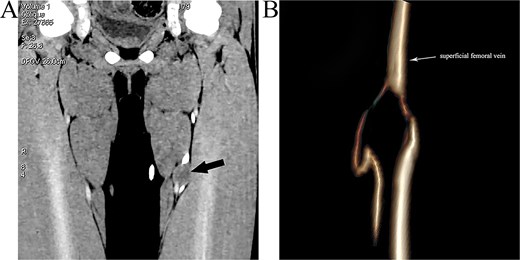
(A, B) CT images before the operation revealed a 2 × 1 cm nodule soft mass in the left thigh of the patient and the superficial femoral vein was compressed by it (the arrow indicates the tumor).
To restore the venous drainage, a tumor resection was performed. During the operation, a nodular tumor with incomplete capsule was found closely adhering to the superficial femoral vessels (Fig. 2A). After systemic heparinization, the superficial femoral vessels were blocked and the tumor was carefully dissected along the superficial femoral artery. However, the tumor could not be separated from the superficial femoral vein because of dense adhesion between them (Fig. 2B). To completely remove the tumor, the invaded venous wall was resected with the tumor simultaneously. A segment of the contralateral great saphenous vein was used as vascular patch to reconstruct the superficial femoral vein (Fig. 2C). Considering the age of the patient, interrupted suture was adopted to avoid future stenosis.
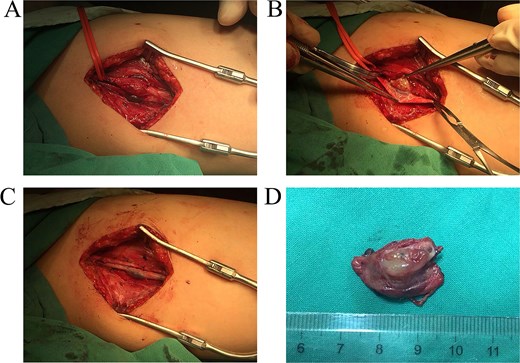
(A) During the operation, the tumor was found located between the superficial femoral vessels and closely adhering to them. (B) The tumor could not be separated from the superficial femoral vein because of dense adhesion and the tumor can be found inside the affected venous. (C) The superficial femoral vein was reconstructed by a venous patch after the tumor and part of the vessel wall were resected. (D) The tumor measured about 20 mm in greatest diameter and the venous wall was infiltrated.
On gross examination, the tumor measured 20 mm in greatest diameter and the venous wall was infiltrated (Fig. 2D). On histological examination, the margins were negative for tumor invasion and the tumor was surrounded by lymphocytes infiltration with formation of lymphoid follicles. Nests of round, oval tumor cells were detected without obvious karyoschisis. Pseudovascular blood filled spaces were present in the center of the tumor without endothelial cells lining (Fig. 3A–C). The tumor cells were positive for desmin, GFAP, and EMA of a focal area; negative for smooth muscle actin, CD34, F8, S-100, and CKpan. EWSR1-CREB1 fusion transcript was detected by real-time RT-PCR and EWSR1-ATF1 fusion transcript was undetectable.
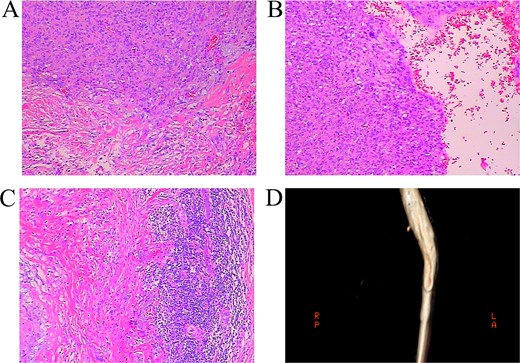
(A–C) HE staining revealed typical characteristic of AFH: nests of round, oval histiocyte-like cells; pseudovascular blood filled spaces without endothelial cells lining; lymphocytes infiltration and fibrous pseudocapsule. (D) CT angiography showed that the superficial femoral vein kept patent without stenosis one year after the operation.
After the operation, low molecular weight heparin was used to prevent deep vein thrombosis. The swelling of the left extremity was alleviated soon, and no local recurrence and distant metastasis of the tumor was detected during the follow-up of 12 months. Postoperative computed tomography (CT) angiography showed that the superficial femoral vein was patent without stenosis (Fig. 3D).
Discussion
AFH was first reported as “a malignant tumor” by Enzinger in 1979 [5]. However, according to the revised World Health Organization classifications of soft-tissue tumors, AFH belong to “tumors of uncertain differentiation” [6]. Most AFHs are relatively indolent, but there are no reliable clinical or histologic parameters that can indicate the malignant behavior so far. The images of the tumors by either ultrasound or magnetic resonance imaging are inconsistent and nonspecific, and also helpless to differentiate benign and malignant behavior [7, 8]. The tumors with infiltrative margins and those invading into deep fascia or adjacent muscle is thought more likely to recrudesce or metastasize [4, 9]. The metastases appeared 5 months to 16 years after resection of the primary tumor, and the median time to metastasis from initial surgery was about 15 months [4].
Most of the time, AFH presents as a superficial subcutaneous painless mass and is often misdiagnosed as lymphadenopathy or a benign cyst on physical examination [10]. Sometimes, the symptoms related to the anatomic site are the major clinical manifestations and the tumor is detected during the examination [11]. Some patients may present with systemic symptoms, such as fever, anemia, malaise, and weight loss, which may be related to the cytokine produced by the tumor [11, 12].
Typical AFH is characterized by three histological findings: solid arrays or nests of histiocyte-like cells, pseudovascular spaces, and prominent peripheral inflammatory cells cuff or fibrous pseudocapsule [6]. Nevertheless, there is a significant morphologic spectrum of AFH and no specific immunophenotypic marker has been confirmed. Tumor cells of AFH are usually positive for EMA, desmin, CD68, and CD99, but negative for S-100 protein, CD21, CD35, and CD34 [13]. The results of histological examination has no significant prognostic implications, and the degree of mitotic activity and atypia also show no correlation with risk of recurrence in previous studies [14, 15].
AFH is associated with 3 characteristic gene fusions: EWSR1-CREB1, EWSR1-ATF1, and rarely FUS-ATF1. EWSR1-CREB1 appears to be the most frequent gene fusion in AFH, which has been described in more than 90% of cases [14]. Thway et al. reported a metastatic AFH case with EWSR1-CREB1 gene fusion, and they considered this fusion gene may be related to metastatic behavior of AFH [15]. However, the correlation with tumor behavior and type of gene fusion has not yet been demonstrated definitely.
Meta-analysis findings indicate that wide local excision can effectively control local recurrences and metastases, which is usually sufficient for majority of the patients. For the patients with local recurrences or distant metastases, curative effect can still be achieved by another complete local resection combined with metastatic lymph nodes excision. If the clear margins cannot be achieved for special anatomic location, adjuvant radiotherapy may be helpful. However, there is no evidence to prove the effectiveness of radiation and/or chemotherapy. Our patient underwent resection of both the tumor and the invaded venous wall, and surrounding adipose and connective tissue were also removed. Given the age of the patient, only part of the venous wall was resected to avoid future stenosis or occlusion after the complete resection and reconstruction of the superficial femoral vein.
To our knowledge, this is the first report of AFH with the adjacent vessel invasion. No tumor recurrence and distant metastasis was detected during the follow up although the vessel was invaded. Performing complete surgical excision to obtain negative margins is the first choice of treatment, and closely postoperative surveillance is essential for the patients with AFHs to ensure no signs of tumor recurrence and metastasis. The follow-up period of this case is not long enough, however, we considered that the vessel invasion of AFH might not be the feature of malignant phenotype and we hope that our case will provide some experience for the treatment of similar cases.
Acknowledgements
The authors thank Dr. Yuanhu Jing for providing the pathology images for this case presentation.
Author contributions
Yuanhu Jing and Xiaowen Wan wrote the original manuscript. The operation was performed by Weichao Liu. Radiology image reporting was performed by Fei He. All authors read and approved the final manuscript.
Conflicts of interest
None declared.
Funding
The authors declare that no funds have been received.
Data availability
The availability of the data and materials concerning the case report is related to the diagnostic examinations that were recorded during patient hospitalization. The publication of these data was authorized by the Huaihe Hospital of Henan University.
Ethics approval and consent to participate
The Ethics Committee of the Huaihe Hospital Of Henan University approved this study. The patient’ parents reported in this study provided written consent.
Consent for publication
Written informed consent was obtained from the patient’s parents for publication of her clinical details.
Reference
Author notes
Yuanhu Jing and Xiaowen Wan contributed equally to this work and are co-first authors.


