


 https://orcid.org/0000-0001-8329-3205

Abstract
Gingival recession is a condition characterized by the apical displacement of the gingival margin relative to the cementoenamel junction; it is commonly associated with esthetic concerns and dentin hypersensitivity. We present a clinical case of a 49-year-old female patient presenting with multiple gingival recessions linked to vigorous toothbrushing and dental malposition. In the first phase of periodontal treatment, coronal scaling was performed, and oral hygiene instructions were provided. In the second phase, surgical procedures for root coverage were carried out using a connective tissue graft, a coronally advanced flap (CAF) combined with enamel matrix derivative, and CAF associated with platelet-rich fibrin. Postoperative follow-up was conducted at 6 months, during which the stability of root coverage was confirmed. An accurate diagnosis and proper treatment planning in the management of gingival recessions are essential to achieve successful root coverage through various techniques.
Introduction
Gingival recession is the apical displacement of the gingival margin relative to the cementoenamel junction [1]; etiological factors include brushing habits, orthodontic treatment, frenum position, etc. The patient experiences sensitivity or esthetic concerns [2]. Two classifications of gingival recession are primarily used: Miller’s 1985 [3] and Cairo’s 2011 [1]. The choice of technique depends on the type of recession, tooth position, and bone crest height [4]. Root coverage surgery procedures have been used for the treatment of gingival recessions [5].
Predictable coverage of gingival recessions still represents a challenging situation due to several factors such as anatomy and position of the teeth and depth and width of the recessions; the teeth may be rotated or misaligned within the dental arch, and the gingival papilla does not fully cover the interdental spaces; therefore, root coverage in these cases is limited [6].
The recommended techniques for root coverage are coronal advanced flaps (CAFs) and coronal advanced tunnels [5, 6]. CAF techniques can be applied for the treatment of single or multiple recessions [5].
In conjunction with surgical techniques, elements that promote tissue healing have been used, such as enamel matrix derivatives (EMDs) [6] and platelet-rich fibrin (PRF) [7]. Evidence has demonstrated that EMD influences the behavior of many cell types involved in tissue regeneration [6].
PRF has also been widely utilized as a bioactive matrix in numerous studies for root coverage of gingival recessions; this fibrin matrix contains factors which act on promoting the proliferation and differentiation of different cells [7].
The purpose of the article is to present a clinical case of a patient to perform root coverages with different surgical techniques and biomaterials.
Case presentation
A 49-year-old female patient presented to the Periodontics Clinic of the University of Guadalajara due to teeth sensitivity. She reported vigorous toothbrushing and a previous visit to a periodontist, who prescribed toothpastes with sodium fluoride; however, the sensitivity persists. During anamnesis, the patient did not report any relevant medical history, including the absence of systemic diseases.
Multiple gingival recessions were observed in all quadrants and an isolated one in tooth #32, all with a keratinized gingival band >2 mm, calculus, and dental malposition (Fig. 1). The periodontal evaluation was performed (Fig. 2). Radiographic examination revealed generalized bone loss with a horizontal pattern extending to <15% of the coronal third (Fig. 3). Based on the information, the diagnosis was Miller class III gingival recessions on teeth #16, 17, 25, 26, 27, 32, 36, 37, 44, 45, and 46 due to dental malposition; teeth #16, 25, 26, and 32 were both rotated and extruded, and 17,27, 36, 37, 44, and 45 were rotated.
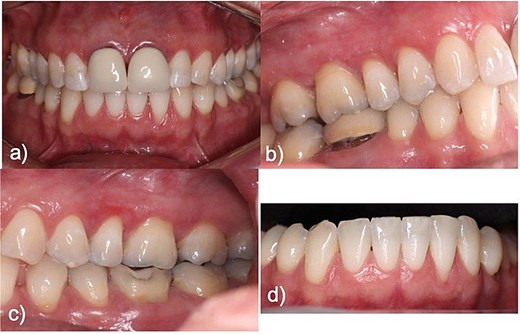
Initial photographs; (a) inter-occlusal view; (b) right side view; (c) left side view; (d) lower anterior sextant.
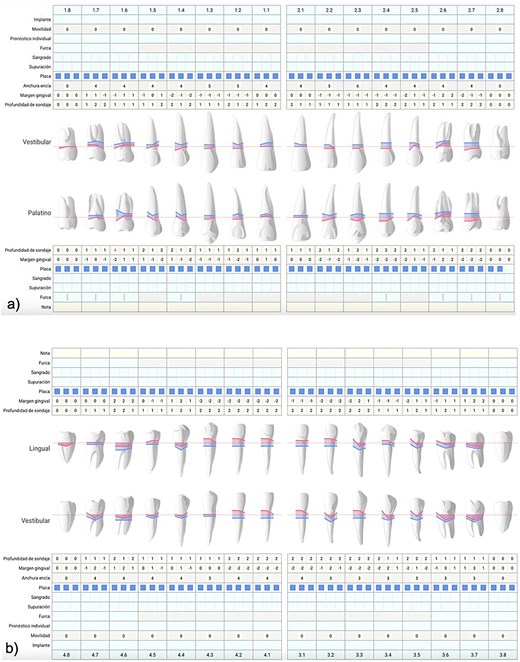
Periodontal charts; (a) upper; (b) lower.
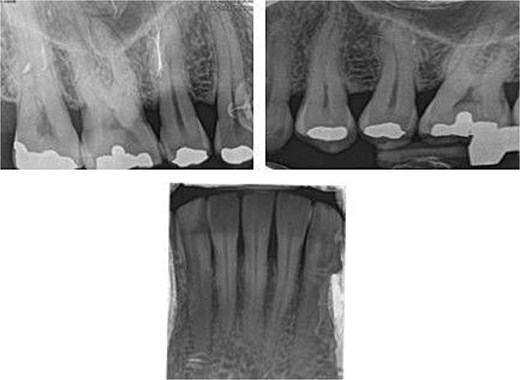
Peri-apical radiographs of the teeth included.
The first periodontal phase began with generalized supragingival debridement, subgingival debridement on tooth #16, and corrective instructions on hygiene protocol, which consisted of advising the patient on dental brushing and the use of dental floss.
Root coverage surgery was performed on teeth #16 and #17 using the tunnel technique. Following local anesthesia (articaine 4%), root planning of the exposed root surfaces was performed by Gracey curettes. Intrasulcular incisions at treated teeth were made using sclerotomes blades and extended one tooth mesially. Using tunneling instruments, a full-thickness flap was raised and prepared beyond the level of the mucogingival junction, leaving the interdental papillae intact. Attaching muscles and inserting fibers were removed using Gracey curettes until tension-free coronal mobilization was obtained. A connective tissue graft (CTG) was harvested from the palate, and it was immobilized at the cementoenamel junction by two single sutures (Polyglycolic acid 4.0). The tunnel flap was advanced coronally to completely cover the graft and the recessions using three sling sutures (Fig. 4). The patient’s healing was reviewed at 2 postoperative weeks, when the sutures were removed (Fig. 5).
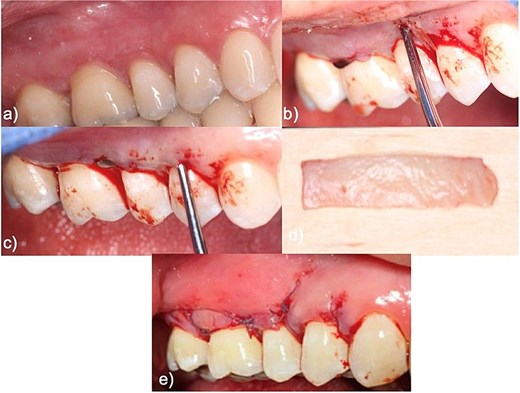
Surgical phase quadrant I tunneling technique teeth #16 and #17; (a) initial photograph; (b) preparing the flap; (c) tunneling technique; (d) connective tissue graft; (e) postoperative photograph.
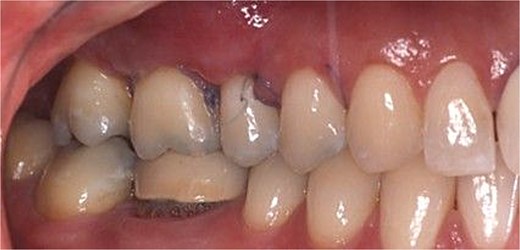
Healing at postoperative 2 weeks.
In quadrant II, surgery was performed on teeth #25 and #26 with CAF technique and EMD. The flap design consisted of a horizontal incision with a 15 C blade extended to include one tooth on each side of the recessions. This incision consisted of three interdental sub marginal incisions which, together with an intrasulcular incision at the mesial-distal margins of the recession defects, form the surgical papillae of the envelope flap. The flap was raised using split-full-split approach, and a CTG was harvested from the palate. The papillae were de-epithelized with Lagrange scissors, then the exposed root surfaces were conditioned for 2 min with 24% ethylenediaminetetraacetic acid (EDTA; Pref Gel Straumann) to remove the smear layer. The EDTA residues were removed by rinsing, and EMD (Emdogain) was applied to the root surfaces. The graft was then sutured with two single sutures (Polyglycolic acid 4.0), and the flap was advanced coronally and sutured with three sling sutures (Nylon 6.0) (Fig. 6). The patient’s healing was reviewed at 2 postoperative weeks, when the sutures were removed (Fig. 7).
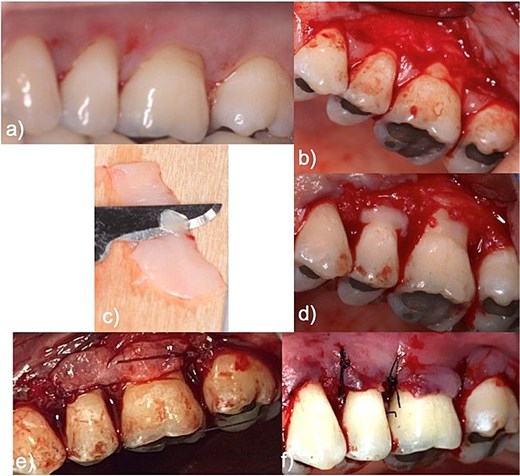
Surgical phase quadrant II CAF + EMD in teeth #25 and #26; (a) initial photograph; (b) preparing the flap; (c) connective tissue graft; (d) EMD on root surface; (e) suturing the graft; (f) postoperative photograph.
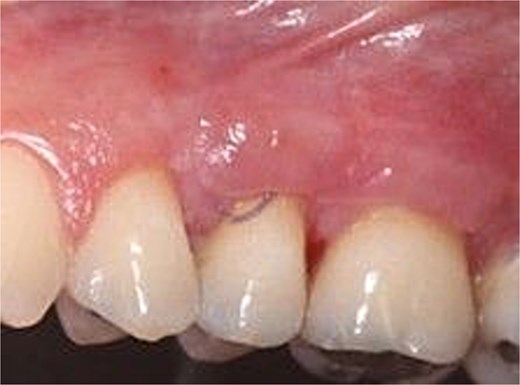
Healing at postoperative 2 weeks.
Two weeks later, surgery was performed on teeth #32 with CAF + PRF. A blood sample was taken from the patient and centrifuged in an Intra Spin centrifuge at 3000 rpm for 12 min. The flap was designed using two horizontal beveled incisions made with a 15C blade, each approximately 3 mm in length, positioned mesial and distal to the recession defect and located 1 mm from the tip of the anatomical papillae. Two vertical oblique beveled incisions were then performed, starting at the ends of the horizontal incisions and extending into the alveolar mucosa. The resulting trapezoidal-shaped flap was elevated using a split-full-split approach in a coronal-apical direction. The surgical papillae were elevated in split thickness. The elevation continued split and ended when the flap moved in a coronal direction. All muscle insertions were eliminated with Gracey curettes and a 15 C blade. The anatomic papillae were de-epithelized with Lagrange scissors. A CTG was harvested from the palate and sutured in the root with two single sutures (Polyglycolic acid 4.0). PRF was applied to the graft and the flap using a syringe. The suture of the flap was made with two single sutures (Nylon 6.0) in the vertical releasing incisions and proceeded coronally with other single suture (Nylon 6.0) (Fig. 8). The patient’s healing was reviewed at 2 postoperative weeks, when the sutures were removed (Fig. 9).
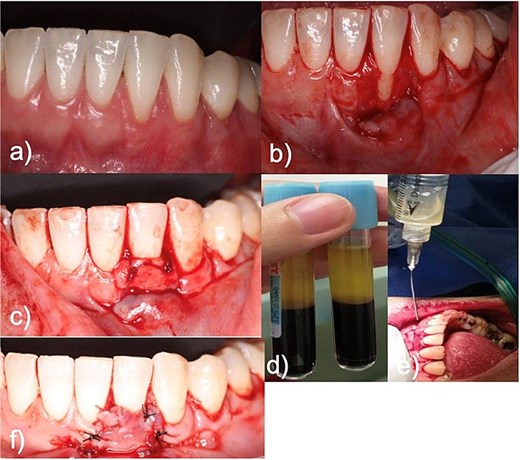
Surgical phase tooth #32 CAF + PRF; (a) initial photograph; (b) preparing the flap; (c) suturing the graft; (d) centrifuged sample to obtain PRF; (e) PRF application; (f) postoperative photograph.
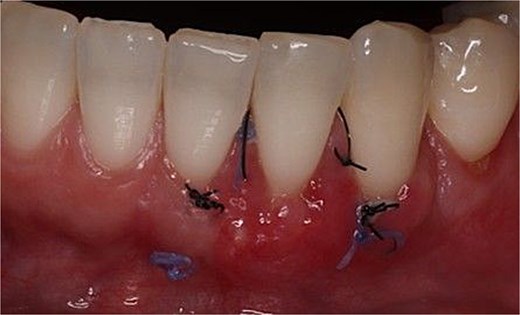
Healing at postoperative 2 weeks.
For each surgery, the patient was prescribed 400 mg of ibuprofen, 10 mg of Serratiopeptidase (Danzen) for 3 days, and 0.2% chlorhexidine gel for 15 days.
Six months after the surgical phase, tissue stability was evaluated. Root coverage was generally observed, and better results were seen in the recessions treated with EMD and PRF (Fig. 10). With regard to clinical periodontal parameters, improvements were obtained in probing depths and gains in keratinized gingiva were observed in teeth treated with EMD and PRF (Fig. 11).
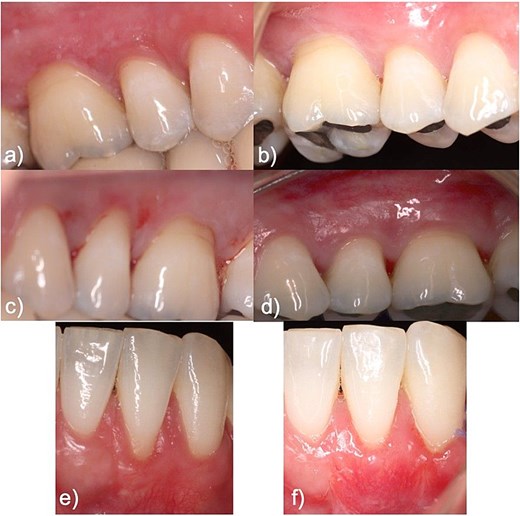
Comparative photographs; (a), (c), and (e) tissue conditions when the patient attended the periodontics clinic; (b), (d), and (f) tissue status 6 months after treatment.
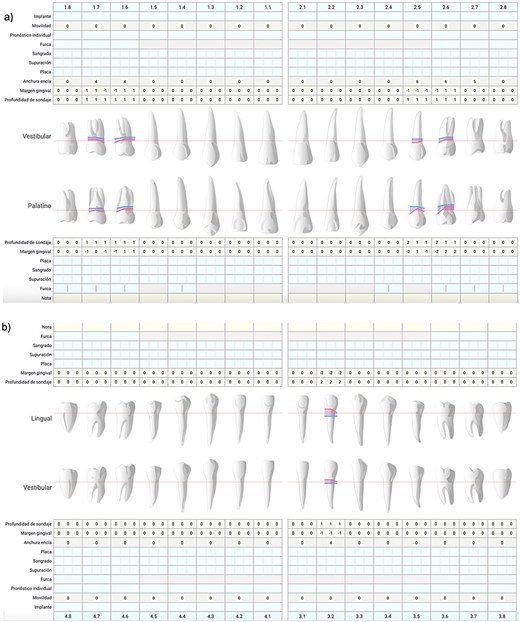
Periodontal charts following root coverages showed improvements in probing depths and a gain in keratinized gingiva in the included teeth.
Discussion
This article presents a clinical case with different surgical techniques and biomaterials for the treatment of gingival recessions. Better results in terms of root coverage and keratinized tissue gain were observed in recessions treated with EMD and PRF.
EMD has been introduced as an approach to regenerative therapy. The material mimics the function of enamel matrix protein; it consists of several enamel matrix-derived proteins, primarily amelogenin, which is harvested from embryonic porcine teeth [8].
Several clinical studies have investigated the use of EMD in treating gingival recessions in conjunction with CAF. In most studies, the additional application of EMD resulted in increased keratinized tissue and more stable clinical outcomes compared to CAF alone [6].
PRF was therefore developed as an improved formulation of the previously utilized platelet-rich plasma, PRF is obtained simply by centrifugation without anticoagulants and is therefore strictly autologous. This fibrin matrix contains platelets and leukocytes, as well as a variety of growth factors and cytokines [7]. Once blood is collected, samples must be centrifuged, a process in which fibrinogen is concentrated at the top of the collection tube until the circulating thrombin transforms it into a fibrin network [7].
These results are consistent with the studies conducted by Agarwal et al. [9] and Padma et al. [10]. They compared the use of CAF with CAF + PRF and found that PRF induced a significant increase in root coverage. Keceli et al. [11] compared CAF + CTG with CAF + CTG + PRF and found a significant increase in root coverage for the combination utilizing CTG with PRF. Cueva et al. [8] reported significant increases in root coverage and keratinized tissue in gingival recessions (Miller III) treated with CAF + EMD compared to CAF alone.
Conclusion
Proper diagnosis and surgical management of gingival recession allow the correction of defects in the morphology, position, and quantity of soft tissue, as well as the prevention of esthetic and sensitivity issues.
Author contributions
Giovanna Victory-Rodríguez: Writing—review and editing, Writing—original draft preparation, Visualization, Validation, Supervision, Resources, Methodology, Investigation, Formal analysis, Data curation, Conceptualization. Mariluz Muro-Jiménez: Writing—review and editing, Writing—original draft preparation, Visualization, Validation, Supervision, Resources, Methodology, Investigation, Formal analysis, Data curation, Conceptualization. Mario Alberto Alarcón-Sánchez: Writing—review and editing, Writing—original draft preparation, Visualization, Validation, Supervision, Software, Resources, Project administration, Methodology, Investigation, Formal analysis, Data curation, Conceptualization. Artak Heboyan: Writing—review and editing, Writing—original draft preparation, Visualization, Validation, Supervision, Software, Resources, Project administration, Methodology, Investigation, Formal analysis, Data curation, Conceptualization. Sarah Monserrat Lomelí-Martínez: Writing—review and editing, Writing—original draft preparation, Visualization, Validation, Supervision, Methodology, Formal analysis, Conceptualization.
Conflicts of interest
All authors report no relevant conflicts of interest for this article.
Funding
None declared.
Data availability
The data supporting the findings of this study are available from the corresponding author upon reasonable request.
Patient informed consent
The study participant provided informed written consent prior to study enrollment.
CARE Checklist (2016) statement
The authors have read the CARE Checklist (2016), and the manuscript was prepared and revised according to the CARE Checklist (2016).


