


Abstract
Acute appendicitis is the most common non-obstetric surgical emergency in pregnancy. We report a 30-year-old primigravida at 25 weeks’ gestation who underwent laparoscopic appendectomy for appendicitis with localized peritonitis. Thirteen days later, she represented with worsening lower abdominal pain, vomiting, leukocytosis, vaginal bleeding, and uterine contractions. Ultrasound showed a right lower abdominal collection and a viable 27-week fetus. Magnetic resonance imaging demonstrated a peri-cecal abscess adherent to the uterus with associated intraperitoneal fluid suspicious for purulent peritonitis. After obstetric management and tocolysis, emergency surgery confirmed diffuse purulent peritonitis and a residual abscess adjacent to the prior appendectomy site. Drainage, lavage, and drain placement achieved maternal stabilization. No recurrent postoperative complication occurred, and the pregnancy progressed uneventfully to 39 weeks. Cesarean delivery resulted in a healthy 3200 g neonate with normal Apgar scores. This case highlights vigilance for delayed postoperative infection in pregnancy and timely imaging escalation with definitive source control.
Introduction
Appendicitis during pregnancy remains a diagnostic and therapeutic challenge because physiologic leukocytosis, nausea/vomiting, and the gravid uterus may obscure typical symptoms and physical findings [1]. Delayed diagnosis increases the risk of complicated appendicitis and postoperative infectious sequelae, which can threaten maternal–fetal outcomes [2]. Ultrasonography is typically the first-line imaging modality; however, sensitivity may decline with advancing gestation, prompting escalation to magnetic resonance imaging (MRI) when clinical suspicion persists [2, 3]. Laparoscopic appendectomy is commonly performed in pregnancy when expertise is available, but intra-abdominal abscess is a recognized complication—particularly after complicated appendicitis or localized peritonitis—and may provoke uterine irritability, vaginal bleeding, and threatened preterm labor [4, 5]. We present a case of delayed residual intra-abdominal abscess nearly 2 weeks after laparoscopic appendectomy in the second trimester, highlighting the need for early recognition, appropriate imaging, multidisciplinary obstetric involvement, and urgent surgical source control.
Case report
A 30-year-old primigravida at ~25 weeks’ gestation presented with 2 days of right-sided abdominal pain and fever. Laboratory tests showed leukocytosis (WBC 15.17 × 10³/μl). Abdominal ultrasound demonstrated an enlarged appendix (~11–12 mm in diameter) with wall thickening, intraluminal fluid, and periappendiceal fat infiltration consistent with acute appendicitis; mild bilateral hydronephrosis was also noted (Fig. 1). She was diagnosed with acute appendicitis with localized peritonitis in pregnancy and underwent laparoscopic appendectomy. Postoperative ultrasound showed no free intraperitoneal fluid, and she was discharged in stable condition.
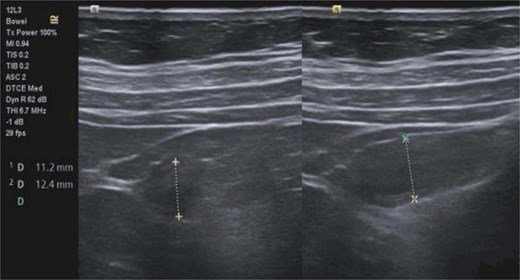
Preoperative abdominal ultrasound showing enlarged inflamed appendix (~11–12 mm) with periappendiceal inflammatory change; mild bilateral hydronephrosis is present.
Thirteen days after surgery, she represented with progressively worsening suprapubic/right lower abdominal pain, vomiting, and vaginal bleeding with uterine contractions. She appeared systemically unwell with marked right-sided abdominal tenderness. Laboratory testing revealed leukocytosis (WBC 13.76 × 10³/μl) with neutrophilia (93.1%). Ultrasound demonstrated a heterogeneous right lower abdominal fluid collection with prominent surrounding fat infiltration (Fig. 2). Obstetric ultrasound confirmed a viable intrauterine pregnancy of ~27 weeks with fetal heart rate ~169 bpm (Fig. 3).
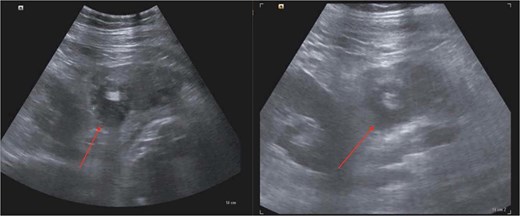
Ultrasound at representation (postoperative day 13) showing heterogeneous right lower abdominal fluid collection with surrounding fat infiltration.
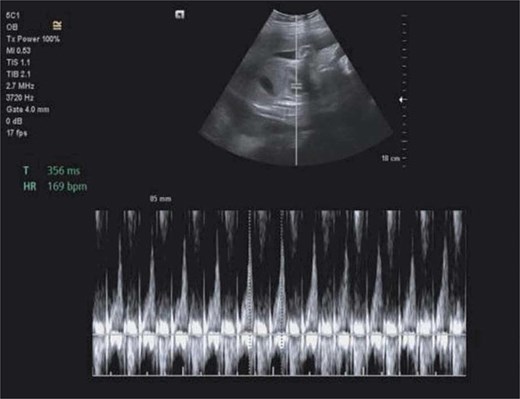
Obstetric ultrasound confirming viable intrauterine pregnancy at ~27 weeks with fetal heart rate ~169 bpm.
Given persistent concern for postoperative intra-abdominal sepsis, MRI with intravenous contrast was performed. MRI demonstrated a right lower abdominal abscess adjacent to the inferior cecal region, closely abutting/adherent to the gravid uterus, with imaging features consistent with pus (including diffusion restriction and rim enhancement), as well as associated intraperitoneal fluid suspicious for purulent peritonitis (Fig. 4).
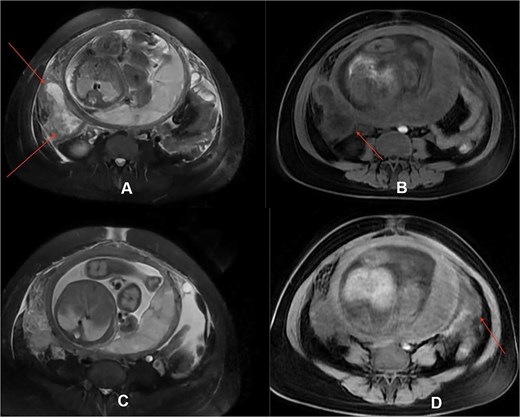
Contrast-enhanced MRI demonstrating right lower abdominal peri-cecal abscess closely abutting/adherent to the uterus (A and B) with associated intraperitoneal fluid suspicious for purulent peritonitis (C and D).
Multidisciplinary obstetric consultation diagnosed threatened preterm labor at ~27 weeks in the setting of residual intra-abdominal abscess following appendectomy. The patient received fetal-directed management per obstetric protocol (including corticosteroids for lung maturation as indicated) and tocolysis. Owing to ongoing symptoms and imaging consistent with intra-abdominal sepsis, she underwent emergency surgery shortly after imaging.
Intraoperatively, turbid purulent fluid was found diffusely throughout the abdomen. A residual abscess cavity adjacent to the previous appendectomy site was identified, densely adherent to the right adnexa and uterus. The abscess was drained and the abdomen irrigated extensively until clear effluent was obtained; drains were placed to the abscess cavity and paracolic gutters. Postoperatively, she stabilized clinically with only mild uterine activity; fetal movement was preserved and vaginal bleeding resolved. Follow-up ultrasound demonstrated mild residual inflammatory change with
minimal loculated fluid tracking along the right paracolic gutter and a viable intrauterine pregnancy of ~28 weeks. She was discharged with planned obstetric follow-up. Thereafter, she remained clinically stable, with no further postoperative complication or recurrent intra-abdominal abscess. The pregnancy subsequently progressed uneventfully to 39 weeks of gestation. She underwent cesarean delivery at 39 weeks, giving birth to a 3200 g neonate with Apgar scores within normal limits.
Discussion
This case illustrates a delayed, clinically significant residual intra-abdominal abscess after laparoscopic appendectomy during the second trimester, presenting with threatened preterm labor. Although laparoscopic appendectomy is commonly used in pregnancy, postoperative infectious complications remain possible, particularly when appendicitis is complicated by localized peritonitis, microperforation, or contamination that may not be fully eliminated at the index operation [6]. The seemingly reassuring early postoperative course in our patient—no free fluid on ultrasound and discharge—highlights that abscess evolution can be delayed and may manifest after a latent period as bacterial load increases within a localized cavity [7].
The second presentation contained features that should prompt urgent evaluation for intra-abdominal sepsis rather than attribution to obstetric causes alone: progressive abdominal pain, vomiting, leukocytosis with neutrophilia, and a focal collection on ultrasound [8]. In pregnancy, peritoneal inflammation and sepsis can provoke uterine irritability, contractions, and vaginal bleeding, creating a time-sensitive situation in which maternal stabilization and fetal support must proceed simultaneously [9].
Imaging escalation was pivotal. Ultrasound rapidly identified the postoperative collection and confirmed fetal viability, but can be limited in defining the extent of peritoneal contamination [10]. MRI clarified the diagnosis by demonstrating an abscess adjacent to the cecum, closely related to the uterus, with associated intraperitoneal fluid suspicious for purulent peritonitis, strengthening the indication for urgent operative source control [11].
Management required multidisciplinary coordination. Obstetric measures (tocolysis and fetal optimization) were important, but definitive control of maternal infection was essential because ongoing sepsis would likely worsen uterine activity and endanger both mother and fetus [12]. Emergency surgery achieved source control through drainage and extensive peritoneal lavage, resulting in maternal stabilization and preserved fetal viability, with improvement confirmed on follow-up ultrasound [13].
Clinically, the key message is vigilance: recurrent or worsening abdominal pain with systemic inflammatory signs after appendectomy in pregnancy—particularly when accompanied by uterine activity or bleeding—should trigger a low threshold for repeat imaging and urgent surgical assessment. Timely diagnosis and decisive source control may prevent progression to diffuse peritonitis and reduce the risk of preterm delivery.
Conclusion
Residual intra-abdominal abscess can present in a delayed fashion after appendectomy during pregnancy and may precipitate threatened preterm labor. Prompt recognition, imaging escalation, multidisciplinary obstetric–surgical management, and urgent surgical source control are critical to optimize maternal and fetal outcomes.
Consent
Written informed consent for publication of this case report and accompanying images was obtained from the patient.
Conflicts of interest
None declared.
Funding
None declared.
Data availability
All relevant clinical details are included in this article.


