


Abstract
Symptomatic loss of meniscal tissue combined with anterior cruciate ligament (ACL) insufficiency is difficult to manage, particularly after previous failed surgery. We report a 22-year-old man with pain, recurrent effusions, and functional limitation after two prior arthroscopic procedures on the right knee, including failed bone–patellar tendon–bone (BTB) ACL reconstruction and subtotal meniscectomy. Preoperative magnetic resonance imaging and diagnostic arthroscopy demonstrated severe deficiency of both the medial and lateral menisci together with ACL insufficiency. The patient underwent single-stage combined medial and lateral meniscal allograft transplantation using fresh-frozen allografts and concomitant revision BTB ACL reconstruction. At 6 months, the knee was stable, range of motion was 0–130°, International Knee Documentation Committee score was 92, Lysholm score 90, and there were no effusions, inflammatory signs, or graft-related complications. This case illustrates a joint-preserving single-stage option for young patients with bicompartmental meniscal deficiency and ACL insufficiency.
Introduction
Meniscal deficiency after subtotal or total meniscectomy may lead to persistent pain, recurrent effusions, impaired load distribution, and early cartilage degeneration. When anterior cruciate ligament (ACL) insufficiency is present at the same time, the mechanical environment of the knee is further compromised, and combined meniscal allograft transplantation (MAT) with ACL reconstruction has been associated with improved stability and clinical outcomes in published series, and recent systematic reviews support favorable mid- to long-term outcomes after combined MAT and ACL reconstruction [1–4]. Combined medial and lateral meniscal transplantation in the same knee has also been described, although it remains uncommon [5].
In young patients with high functional demands, a joint-preserving strategy that restores both meniscal function and knee stability may be preferable to repeated partial resections or delayed reconstructive procedures. We present single-stage combined medial and lateral meniscal allograft transplantation together with revision bone–patellar tendon–bone (BTB) ACL reconstruction in a young patient with symptomatic bicompartmental meniscal deficiency of the right knee.
Case report
A 22-year-old man presented with persistent right knee pain, recurrent swelling, and progressive functional limitation after two previous arthroscopic procedures. He had previously undergone ACL reconstruction using a BTB autograft, which later failed, and subtotal meniscectomy with subsequent loss of meniscal tissue. Despite prior treatment, he continued to experience chronic symptoms and recurrent effusions.
Preoperative magnetic resonance imaging (MRI) of the right knee demonstrated marked bicompartmental meniscal deficiency, joint effusion, and postoperative changes after the previous ACL reconstruction. The imaging findings, together with the clinical examination, supported ACL insufficiency, and severe post-meniscectomy changes in both compartments (Fig. 1).
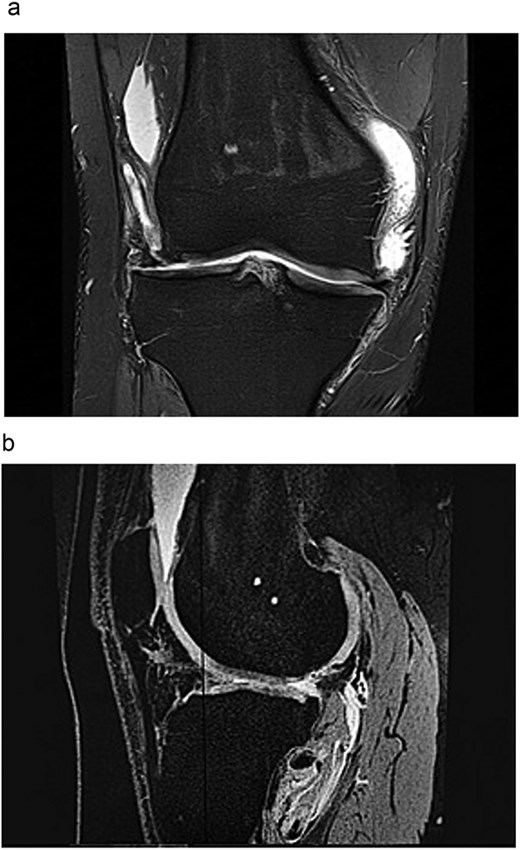
(a) Coronal PD fat-suppressed MRI of the right knee demonstrating marked bicompartmental meniscal deficiency, joint effusion, and postoperative changes after previous ACL reconstruction. (b) Sagittal T2-weighted MRI of the right knee demonstrating severe meniscal deficiency in the imaged compartment, joint effusion, and postoperative changes after previous ACL reconstruction.
Diagnostic arthroscopy confirmed the extent of intra-articular damage. The lateral compartment showed near-complete absence of native meniscal tissue with exposure of the lateral tibial plateau. The medial compartment demonstrated severe residual meniscal deficiency consistent with a post-subtotal meniscectomy state, again with exposed tibial cartilage (Fig. 2a and b). In view of the patient’s age, high functional demands, and failure of previous treatment, single-stage combined medial and lateral meniscal allograft transplantation with revision ACL reconstruction was indicated.
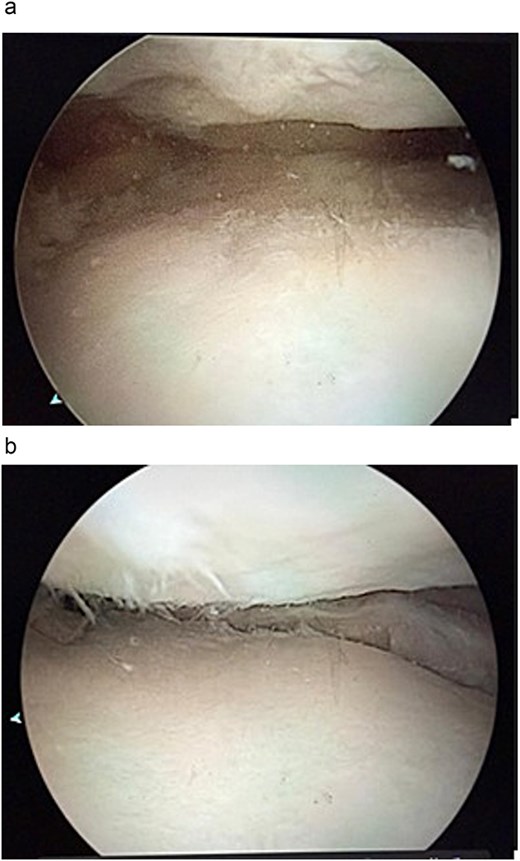
(a) Lateral compartment after subtotal meniscectomy. (b) Medial compartment after meniscectomy.
Surgery was performed under general anesthesia through standard anteromedial and anterolateral portals. Fresh-frozen meniscal allografts obtained from a certified tissue bank were prepared using a soft-tissue technique. The total operative time was 3 h and 20 min, with no intraoperative complications.
The lateral meniscal allograft was implanted first. Root fixation was performed transtibially and secured with a 5.5-mm SwiveLock anchor. The anterior horn was fixed intra-articularly with a 3.5-mm BioPushLock anchor. Peripheral fixation was completed with three all-inside sutures and one outside-in centralization stitch. Arthroscopy demonstrated restoration of congruity of the lateral compartment and coverage of the lateral tibial plateau (Fig. 3a).
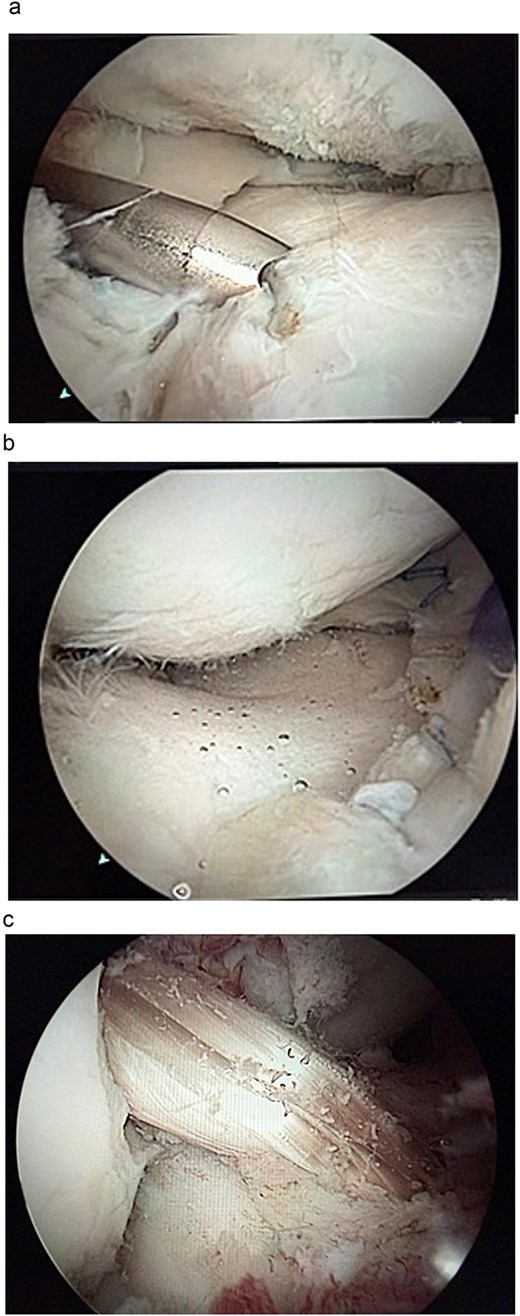
(a) Lateral compartment after lateral meniscal allograft transplantation. (b) Medial compartment after medial meniscal allograft transplantation. (c) Anterior cruciate ligament reconstruction using allograft tissue.
The medial meniscal allograft was then implanted using the same fixation principle. The posterior root was fixed transtibially and secured with a 5.5-mm SwiveLock anchor, the anterior horn was anchored with a 3.5-mm BioPushLock, and peripheral fixation was completed with four all-inside sutures and one outside-in suture. The graft showed appropriate contour and anatomic positioning within the medial compartment (Fig. 3b).
Revision ACL reconstruction was subsequently performed using a BTB allograft. The previous femoral and tibial tunnels were judged to be in malposition and were revised. A new femoral tunnel was created anatomically through the anteromedial portal, and a new tibial tunnel was created in an anatomic position. Notchplasty was performed, and the graft was fixed with two titanium interference screws. Final arthroscopic assessment confirmed satisfactory position and tension of the graft in the intercondylar notch (Fig. 3c).
The patient remained in hospital for 4 days and was discharged with a knee brace for 4 weeks, partial weight-bearing with crutches for 6 weeks, and pharmacologic thromboprophylaxis. On postoperative day 7, a sterile knee effusion was aspirated (40 mL); the patient was afebrile, reported moderate pain (VAS 4), and had range of motion from −10° extension to 40° flexion. On postoperative day 12, sutures were removed, 25 mL of recurrent effusion was aspirated, pain had decreased to VAS 1, and range of motion improved to −5° extension and 60° flexion. No evidence of infection or other complication was observed.
At 6 months, the patient was fully weight-bearing with range of motion 0°–130°, no swelling or effusion, negative Lachman, pivot-shift, and anterior drawer tests, and favorable functional scores (International Knee Documentation Committee score 92, Lysholm 90).
Discussion
This case illustrates a demanding joint-preserving scenario in a young patient with bicompartmental meniscal deficiency and failed ACL reconstruction. A single-stage approach was chosen to restore both load distribution and knee stability while avoiding staged surgery. In general, MAT is best considered in young symptomatic patients after subtotal or total meniscectomy, whereas advanced cartilage damage, uncorrected malalignment, and persistent instability remain important limiting factors or contraindications [6].
Several technical points were critical. MRI and arthroscopy confirmed bicompartmental meniscal deficiency and the indication for surgery. Stable fixation was achieved using transtibial root fixation, anchor fixation of the anterior horns, and circumferential peripheral suturing, while lateral centralization improved graft position. Revision tunnel planning and notchplasty were also essential because the previous ACL tunnels were malpositioned; this is particularly important in combined MAT and ACL reconstruction, where careful socket-tunnel planning may reduce tunnel overlap and facilitate anatomic graft placement [7].
At 6 months, the patient showed a favorable short-term clinical and functional outcome; however, longer follow-up is still required because early improvement does not exclude later graft-related failure or degenerative progression [8]. The case shows that combined medial and lateral meniscal allograft transplantation with revision BTB ACL reconstruction is technically feasible in a carefully selected young patient.
Acknowledgements
The author thanks the operating room staff and radiology team for their assistance in the clinical management of this case.
Conflicts of interest
None declared.
Funding
This research did not receive any specific grant from funding agencies in the public, commercial, or not-for-profit sectors.


