


 https://orcid.org/0009-0002-3576-2585

Abstract
This report describes an exceptional paediatric case of a ganglioneuroma arising in the pancreatic topography, a rare condition that may mimic more aggressive neoplasms and hinder appropriate management selection. A previously healthy 7-year-old girl presented with a non-specific acute febrile syndrome, prompting an expanded diagnostic evaluation. Imaging studies revealed a well-defined solid mass adjacent to the pancreatic head, accompanied by minimal and non-contributory laboratory abnormalities. Given the persistent aetiological uncertainty and the intimate relationship of the lesion with major vascular structures, a surgical approach was indicated. Intraoperative histopathological assessment confirmed the diagnosis of ganglioneuroma, enabling conservative resection with adequate anatomical preservation. The postoperative course was uneventful, culminating in satisfactory recovery. This case highlights the importance of a structured multidisciplinary approach for guiding precise decision-making in the management of paediatric pancreatic masses.
Introduction
Ganglioneuromas are the rarest neuroblastic tumours of the sympathetic nervous system, accounting for ~10%–20% of localized neuroblastic tumours [1, 2]. They constitute the most differentiated form of neural crest-derived tumours and are benign in nature [3, 4]. Histologically, they are composed of well-differentiated mature ganglion cells embedded within a Schwann cell-rich stroma [3, 5].
From an epidemiological standpoint, ganglioneuromas affect all age groups, although the majority are diagnosed in adults; a female predominance is observed in the general population, yet paediatric series demonstrate a more balanced sex distribution [4, 5]. These tumours typically follow an indolent and asymptomatic clinical course, and 24%–47% of cases are identified incidentally on imaging studies performed for unrelated indications [1, 4].
Herein, we report the case of a 7-year-old girl with a ganglioneuroma adjacent to the pancreatic head — an uncommon neoplasm arising in an exceptional topography [3–5]. The following account describes the diagnostic workup and surgical approach, followed by a discussion of current evidence on incidental detection, histopathological assessment, and therapeutic strategies.
Case presentation
A 7-year-old white female presented with intermittent fever of indeterminate aetiology, with no response to initial empirical therapy, prompting further investigation through imaging studies. Contrast-enhanced abdominal computed tomography revealed a well-defined, lobulated, solid retroperitoneal mass measuring 4.6 × 3.4 cm, adjacent to the pancreatic head, with no evidence of invasion into neighbouring structures.
Given the imaging findings, the patient was referred to a specialized oncology centre for further evaluation. On detailed history-taking, she denied abdominal pain, influenza-like symptoms, and weight loss, and reported preserved urinary and bowel habits. Past medical history and family history were unremarkable. Physical examination was unremarkable except for mild tenderness in the right hypochondrium, with no palpable masses.
Laboratory studies showed: haemoglobin 10.93 g/dL, haematocrit 34.4%, leucocytes 9594/mm3, platelets 633 500/mm3, aspartate aminotransferase 28.7 U/L, alanine aminotransferase 9.97 U/L, total bilirubin 0.15 mg/dL, amylase 56 U/L, lipase 30.3 U/L, lactate dehydrogenase 220 U/L, carbohydrate antigen 19–9 87 U/mL, prothrombin activity 77%, international normalized ratio 1.18, activated partial thromboplastin time 25 s, and C-reactive protein 11.82 mg/L. Immunoglobulin G and immunoglobulin M serologies for cytomegalovirus and Epstein–Barr virus were non-reactive. Remaining laboratory parameters were within normal limits.
Abdominal magnetic resonance imaging demonstrated a solid retroperitoneal mass measuring ~3.8 × 3.1 × 3.5 cm (estimated volume 21.9 cm3), located at the level of the pancreatic head. The lesion showed high T2 signal intensity with thick septations, mild heterogeneity, hypovascular contrast enhancement, and restricted diffusion (Fig. 1). The mass was in intimate contact with the pancreatic parenchyma, superior mesenteric vein, and portal vein. The liver exhibited regular contours, preserved dimensions, and no evidence of infiltration or secondary lesions. Regional lymph nodes were unremarkable.
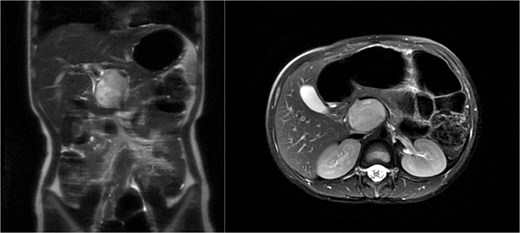
Well-defined solid expansile lesion located in the anterior retroperitoneum, at the level of the pancreatic head. The mass demonstrates high signal intensity on T2-weighted sequences, measures ~3.8 × 3.1 × 3.5 cm (estimated volume of 21.9 cm3), and displays mildly heterogeneous internal content, with hypovascular contrast enhancement and restricted water-molecule diffusion. It remains in close contact with the pancreatic parenchyma, superior mesenteric vein, and portal vein, whilst preserving the surrounding planes.
Given the imaging findings, the patient was referred for surgical evaluation under the presumptive diagnosis of pancreatoblastoma. Intraoperative biopsy with sequential histopathological analysis was performed to establish a definitive diagnosis and guide surgical management. The proposed strategy included lesion resection with lymphadenectomy, with the possibility of extending the procedure to a pancreatoduodenectomy (Whipple procedure), depending on intraoperative and histopathological findings.
Surgical access was obtained through a Makuuchi incision, complemented by a Kocher manoeuvre, providing broad exposure of the retroperitoneal mass, which measured ~4 cm and was closely associated with the pancreatic head and portal vein. A core biopsy was performed, and frozen-section analysis revealed a ganglioneuroma—a benign neoplasm of the sympathetic nervous system (Fig. 2) [3, 4].
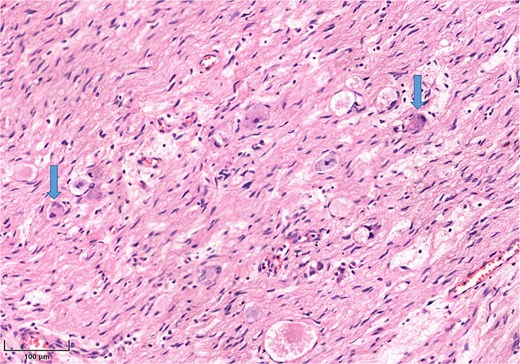
High-magnification photomicrograph showing a solid proliferation predominantly composed of Schwann cells, with elongated, spindle-shaped nuclei, associated with a sparse population of maturing ganglion cells (arrows). No neuroblastic component is observed. The specimen corresponds to an enucleated nodular fragment from the pancreatic head/coeliac trunk region, measuring 4.5 × 3.5 × 2.8 cm and weighing 28 g. Haematoxylin and eosin stain.
After multidisciplinary discussion, complete excision of the lesion was selected as the management approach. The procedure continued with exposure of the tumour, followed by identification and isolation of the major vascular structures, including the coeliac trunk and its branches. En bloc resection of the lesion was performed, and draining regional lymph nodes were excised for histopathological evaluation (Fig. 3). Postoperatively, the patient was admitted to the intensive care unit in stable haemodynamic condition and was extubated 6 h later. Her clinical course remained uneventful, with transfer to the ward on postoperative day 3 and discharge on postoperative day 7. At 1-year follow-up, the patient remains well, with no evidence of recurrence or complications.
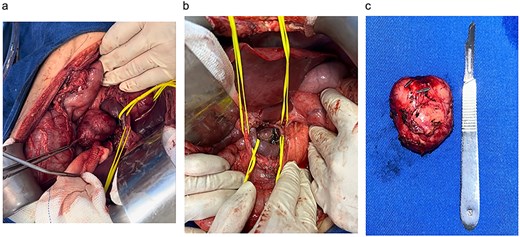
(a) Intraoperative view showing a mass measuring ~4 cm, adjacent to the pancreatic head and abutting the portal vein. (b) Isolation of the coeliac trunk arteries using vessel loops, with ligation of the gastroduodenal artery. (c) En bloc removal of the specimen.
Discussion
Ganglioneuromas arise predominantly in regions rich in sympathetic ganglia, including the posterior mediastinum, retroperitoneum, and adrenal glands [3–5]. These tumours are characteristically asymptomatic or produce compressive symptoms, and up to 47% of diagnosed ganglioneuromas in paediatric series represent incidental findings on imaging studies performed for unrelated indications [1, 4]. The increasing utilization of high-resolution imaging modalities has substantially expanded this mode of detection, placing these lesions within the context of incidentalomas [4]. In this setting, the mere identification of an abnormality does not, in itself, constitute an indication for intervention; unlike symptom-driven clinical practice, detection arising from non-directed investigation imposes a more rigorous standard of decision-making, management must be supported by evidence that it can significantly alter the natural history of the disease [4–7].
Within the spectrum of neuroblastic tumours, ganglioneuroma represents the fully differentiated form, which may arise de novo in the absence of an identifiable malignant precursor, or result from the spontaneous maturation of neuroblastomas, which exhibit heterogeneous clinical behaviour ranging from spontaneous regression to aggressive disease [3–5, 8]. In this context, comprehensive histopathological assessment—encompassing both adequate tissue sampling and thorough evaluation of the resected specimen—is indispensable, as only pure ganglioneuroma exhibits a benign character; morphologically similar tumours may harbour immature components with significant prognostic relevance [9, 10]. Evidence demonstrates that in 39% of cases, the final surgical pathology differs from the initial biopsy findings, and in 12%, reclassification to neuroblastoma or nodular ganglioneuroblastoma occurs—categories requiring distinct management [10].
The natural history of ganglioneuroma supports a selective and, in many cases, conservative approach. Evidence demonstrates an indolent course, a high frequency of incidental diagnosis, and an absence of recurrence or metastatic dissemination in primary tumours, although rare cases of regional lymph node involvement (~8%) have been reported without apparent prognostic impact [4, 11]. In this setting, active surveillance has been shown to be safe in asymptomatic patients with a reliable diagnosis [9, 10, 12]. When intervention is indicated, the literature favours excision limited to the primary tumour, reserving more extensive approaches for situations of diagnostic uncertainty, tumour progression, or anatomical constraints. Subtotal resection appears to constitute sufficient treatment, and survival is not influenced by the extent of tumour resection [1, 2, 9, 10].
Pancreatic involvement by ganglioneuroma constitutes an exceptionally rare presentation [13, 14]. Preoperative characterization is exceedingly difficult owing to radiological overlap with potentially malignant pancreatic lesions; in the present case, the mildly elevated carbohydrate antigen 19–9 (87 U/mL) further compounded this diagnostic uncertainty [13, 14]. The operative strategy—tumour excision with retrieval of draining regional lymph nodes—was therefore predicated upon the requirement for definitive histopathological characterization and oncological safety. Intraoperative frozen-section analysis proved decisive, enabling de-escalation of the initially planned pancreatoduodenectomy to a conservative resection; current evidence supports the view that, once the diagnosis is established, such strategies are, in the majority of cases, sufficient [2, 9, 10, 12].
Conclusion
This case underscores the diagnostic challenge posed by neuroblastic tumours arising in atypical locations, where imaging alone cannot reliably exclude malignancy. Intraoperative frozen-section examination proved decisive, establishing the diagnosis of ganglioneuroma and permitting de-escalation to organ-preserving surgery. This experience reinforces that, for paediatric abdominal masses lacking definitive preoperative characterization, meticulous tissue sampling remains the cornerstone for balancing oncological safety with minimal surgical morbidity. This case report was prepared in accordance with the SCARE 2023 criteria [15].
Author contributions
João Victor Risso: Conceptualisation, methodology, literature review, data acquisition, analysis and interpretation, drafting of the original manuscript and coordination of revisions. Guarantor.
Lattes: http://lattes.cnpq.br/2115003874710469
Carmem Maria Costa Mendonça Fiori: Conceptualisation, data acquisition, literature review, clinical data interpretation, methodological and scientific supervision, and contributed to the writing and revision of the manuscript.
Lattes: http://lattes.cnpq.br/2308844011192131
Gabriel da Rocha Bonatto: Acquisition, analysis and interpretation of surgical data, contextualisation of operative findings, and contributed to the writing and revision of the manuscript.
Lattes: http://lattes.cnpq.br/3830955106009928
Matheus Takahashi Garcia: Acquisition and interpretation of surgical data, analysis of operative findings, and contributed to the writing and revision of the manuscript.
Lattes: http://lattes.cnpq.br/4434591181308692
Carlos Floriano de Morais: Histopathological analysis and interpretation, anatomoclinical correlation of findings, and contributed to the writing and revision of the manuscript.
Lattes: http://lattes.cnpq.br/1663022777963616
Conflicts of interest
The authors declare no conflicts of interest.
Funding
This study was fully funded by the authors themselves, without institutional or external financial support.
No external funding was received for this study.
Ethics approval and consent to participate
This study was approved by the research ethics committees of the responsible institutions (CAAE: 91488125.5.0000.5219).
Consent for publication
Written informed consent was obtained from the patient’s legal guardian for publication of this case report and accompanying images.
Affiliated Institution: Hospital do Câncer de Cascavel – UOPECCAN (União Oeste Paranaense de Estudos e Combate ao Câncer), Rua Itaquatiaras, 769, Santo Onofre, Cascavel, Paraná 85806-300, Brazil. Phone: +55 (45) 2101-7000.


