


Abstract
The aim of this case report is to spotlight the effectiveness of the Perez protocol for chemical leeching in rescuing a large pedicled anterolateral thigh fasciocutaneous flap endangered by diffuse venous congestion. A review of the case file, clinical photographs, radiological, and histopathological studies of the patient was conducted. Venous congestion was detected on the 2nd postoperative day in a 51-year-old woman who had pedicled anterolateral thigh flap coverage of a massive post-tumour resection full-thickness abdominal wall defect. The Perez protocol was initiated immediately and continued for 14 days. A slight modification of the dosage was necessitated by the volume of flap tissue involved. Partial salvage of the flap was achieved by the 14th postoperative day with no visceral exposure. The residual granulation on the flap was resurfaced with a meshed split-thickness skin graft. We affirmed the reliability of Perez’s protocol as a reliable guide for managing flap venous congestion.
Introduction
Venous congestion is a fairly common complication following pedicled or free flap transfer and constitutes an emergency that must be managed with optimal, careful, and effective clinical attention to avoid flap morbidity or loss [1]. Venous insufficiency in a flap can be of mechanical origin, from external obstruction to venous outflow by compression, kinking, or twisting of the flap pedicle. In other situations, microvascular lesions may develop within the flap’s venous vascular channels, impairing venous drainage. In either case, arterial inflow is impaired, resulting in irreversible flap ischaemia and inevitably leading to necrosis and flap loss [2]. Various methods have been adopted for the clinical management of flap venous congestion, among which Hirudotherapy, the use of medicinal leeches, has proven to be the most successful [1–5]. In resource-constrained centres of sub-Saharan Africa, these are seldom available promptly. Coupled with the low or non-existent skill for their use, medicinal leeches are rarely the pragmatic options presented to the Surgeon. Chemical leeching with low-molecular-weight heparin, though tedious, has been shown to be equally effective and serves as a useful alternative pending the availability and establishment of medicinal leech therapy [6]. In a systematic literature review by Boissiere et al. [1], detailing published studies on options for flap venous congestion, none were found from Africa. This work aims to highlight our recent experience with the Perez protocol for flap venous congestion in an African setting, to share lessons learned, and to offer recommendations to improve clinical outcomes.
Case report
A 51-year-old woman noticed a small swelling just above a vertical midline scar in the central anterior abdominal wall 20 years prior to presentation. Clinical features were suggestive of an advanced soft-tissue malignancy, with a differential diagnosis of Dermatofibrosarcoma Protuberans, to keep in mind metastasis to the abdomen from unknown primaries (Fig. 1a). Radiological investigations confirmed non-involvement of the peritoneal cavity (Fig. 1b and c). She had an en bloc, wide local excision with a 3 cm gross tumour-free margin, a combined pedicled anterolateral thigh (14 × 24 cm in dimension) and right-sided abdominal rotational flaps, done under General Anaesthesia. The flap pedicle length was 14 cm. Intraoperative finding was a fungating, exophytic, anterior abdominal wall mass occupying the central 4/5th of the anterior abdominal wall, with serous exudate. The mass extended to but did not breach the peritoneum. The intra-abdominal cavity was uninvolved, and all pelvic organs were grossly normal (Fig. 1d). Flap venous congestion was noted on the 2nd postoperative day and was managed with the Perez protocol for chemical leeching in the absence of medicinal leeches (Fig. 2a–d). The residual granulating surface of the flap was covered with a meshed split-thickness skin graft on the 28th post-operative day (Fig. 3a–d). Histopathological and immunohistochemical studies confirmed the diagnosis of Syringocystadenocarcinoma papilliferum.
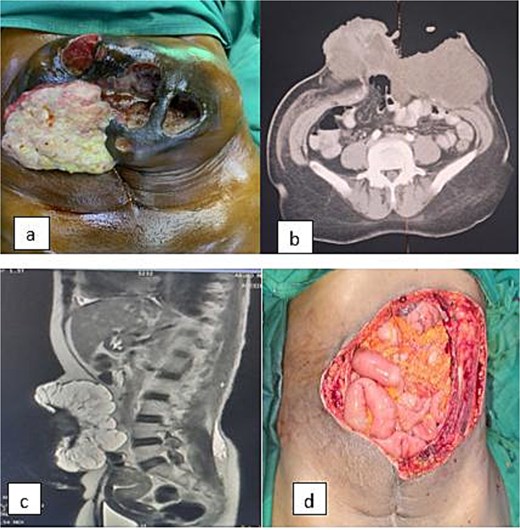
(a) advanced skin adnexal malignancy with histopathological confirmation of Syringocystadenocarcinoma papilliferum. (b) Abdominal computed tomography scan, transverse section showing well-defined lobulated heterogeneously enhancing soft tissue mass in the subcutaneous tissue plane of the anterior abdominal wall. (c) Abdominopelvic magnetic resonance imaging revealed a lobulated, T2 hyperintense mass with enhancing, intervening hypointense septa, measuring 20.9 × 13.6 × 8.1 cm located in the subcutaneous tissue of the anterior abdominal wall, more to the left, spanning the L2–L5 vertebral levels. There is a breach of the left rectus muscle with a defect of about 3.7 cm in diameter. Demonstrated bowel loops are normal in calibre. There is no ascites. The pelvic organs are within normal limits. (d) Post-tumour resection, massive full-thickness defect exposing abdominal viscera.
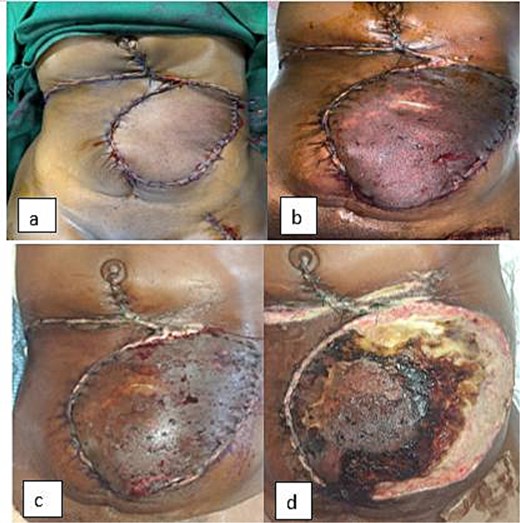
(a) Immediate postoperative photograph showing the pedicled anterolateral thigh flap in situ. (b) Second postoperative day photograph showing diffuse flap venous congestion. Note the incision on the flap on initiation of the Perez protocol. (c) Sixth day postoperative photograph with egress of venous blood from the surface of the flap. (d) Postoperative day 10 with loss of some cutaneous component of the flap.
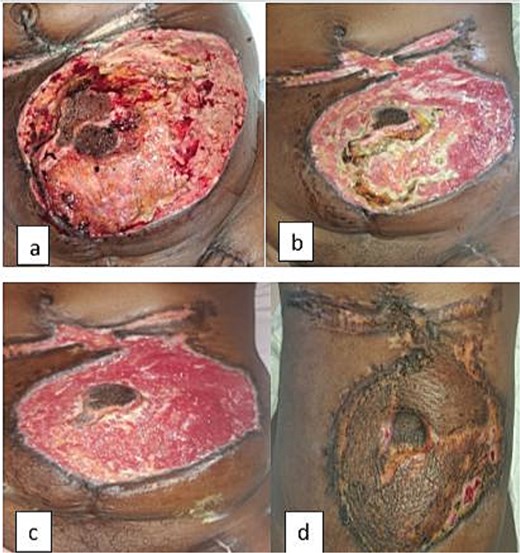
(a) Fourteenth postoperative day photograph showing survival of the adipofascial and about 10% of the cutaneous component of the flap. Perez protocol discontinued. (b) Twenty first postoperative day showing more healthy granulations and some adherent slough. (c) Postoperative day 28 photograph showing well-granulated adipofascial component and the surviving cutaneous segment. (d) Final result following meshed split-thickness skin grafting.
Modified Perez LMWH treatment protocol adopted
Peripheral venous access ascertained
Flap decompression with removal of dressings and some sutures, and haematoma
Stab incisions with a size 11 scalpel blade on the venous-congested area of the flap
Subcutaneous Enoxaparin injection given in a decreasing pattern as follows:
1st–3rd day: 40 mg Enoxaparin every 6 h
4th–6th day: 40 mg of Enoxaparin every 8 h
7th–9th day: 20 mg of Enoxaparin injection every 8 h
10th–14th day: 20 mg Enoxaparin injection every 12 h
Before each administration of Enoxaparin, blood clots were removed, and the flap was squeezed to express the excess blood.
Vital signs and haemoglobin level were monitored, and the patient received 3 units of blood throughout the therapy.
Discussion
The reconstruction of a giant full-thickness abdominal wall defect poses a quintessential challenge. Open abdominal cavity with attendant risk of visceral damage and life-threatening sequelae often result from resection of huge tumours of the anterior abdominal wall [7]. Several closure options, ranging from immediate single-stage procedures to staged surgical procedures, have been proposed in the literature [8, 9]. While the priority of visceral protection, skin closure, and restoration of abdominal wall integrity, without causing compartment syndrome, remains sacrosanct in that order, the eventual option for the patient is individualized and tailored to the specific circumstances [9]. Our patient’s huge complete abdominal wall defect was closed by a combined local abdominal and regional pedicled anterolateral thigh flaps, with venous insufficiency encountered in the latter, affecting nearly 80% of the flap. Diffuse venous congestion was detected on the 2nd postoperative day despite adequate clinical monitoring of the flap. This may result from apparent difficulty in recognizing the early dusky appearance in dark-skinned individuals. In the absence of an established hirudotherapy practice in our institution, chemical leeching remains a viable alternative [4, 10]. Medicinal Leech Therapy (MLT), otherwise known as hirudotherapy, remains widely recognized as the first-line treatment for venous congestion [11–13]. Although several mechanical devices have also been designed to relieve venous congestion in flaps, the concept of subcutaneous heparinization, negative pressure suction, and surface irrigation with a collection chamber was central to most prototypes [4, 14]. The available evidence supporting these devices is equally low and comparable to that for a much more readily accessible and standardized chemical leaching procedure by Perez and co-authors [1, 6]. In the adoption of the Perez protocol, we took cognizance of the huge flap tissue component in our case, 336 cm2 (24 × 14 cm) and prolonged the initial 40 mg dose of subcutaneous enoxaparin to 6 days instead of the proposed 3 days, while the frequency was reduced to 8hly from the 4th to 6th day as opposed to 4–6 h for the dose of 40 mg in the initial 3 days of the protocol. The Perez protocol emphasized the importance of frequency over dose, and our modification was fully compliant with this emphasis [6]. Further adjustments to the protocol were highlighted above. We are of the view that, combining the size of the flap congestive area, which is greater than four times the cut-off mark in the Perez et al. guide table, the rate of the clinical response, and the hemodynamic stability of the patient, the dosage adjustment depicted in Table 1 can be safely used.
Comparison of our modification with the guide proffered by Perez et al.
| Days | Flap congestive area = 336 cm2 | Perez protocol if >75 cm2 |
|---|---|---|
| 1–3 | 40 mg/4–6 h | 40 mg/4–6 h |
| 4–6 | 40 mg/8 h | 20 mg/8 h |
| 7–9 | 20 mg/12 h | 20 mg/12 h |
| 10–14 | 20 mg/12 h | 20 mg/24 h |
The protocol was discontinued on the 14th day following resolution of venous congestion and establishment of reliable flap circulation. This correlates with the 10–14 days duration proposed by Perez et al. for the protocol, noting that reliable neovascularization is usually established by the 7–10 days postoperative [4, 15]. Flap venous congestion has been attributed to several causes, including redistribution of venous drainage and inadequate venous outflow, pedicle kinking and torsion, pedicle compression, and thrombosis within the flap [2]. We believe the venous insufficiency in this case is attributable to the flap volume and the need for venous supercharging. However, in our context of reoperation challenges, chemical leeching, as reported by other authors in similar circumstances, proved to be our respite [6, 15]. We experienced superficial necrosis of almost the entire flap, but the residual subcutaneous component granulated well and was skin grafted. We believe that preemptive planning, early detection of venous congestion, and immediate initiation of the Perez protocol within 6–8 h postoperatively can lead to improved outcomes and greater salvage of the cutaneous component [6, 13]. Although a ventral hernia resulted, the patient was satisfied and subsequently discharged for outpatient follow-up. However, the planned second-stage restoration of abdominal wall integrity could not take place as the patient succumbed to a recurrence and progression of the disease 6 months later.
Conclusion
Successful management of venous congestion and partial salvage of a pedicled anterolateral thigh flap used for closure of a giant open abdomen post-tumour resection was achieved using the Perez protocol. We advocate preemptive preoperative planning, early detection, and immediate initiation of the protocol for postoperative flap venous congestion in suitable clinical scenarios.
Conflicts of interest
None declared.
Funding
None declared.


