


 https://orcid.org/0000-0001-7485-0065

Abstract
We present a rare case of recurrent glomus jugulare tumour, manifesting as an isolated facial nerve palsy. Glomus jugulare tumours are slow-growing paragangliomas of the jugular bulb adventitia. We report the case of a 73-year-old female referred for oculoplastic management of a facial nerve palsy, with a history of a right-sided glomus jugulare tumour treated surgically 40 years prior. Her 6-month history of facial palsy had initially been attributed towards Bell’s palsy, particularly in the context of communication challenges related to residual dysphonia and hearing loss following her prior skull-base surgery. This case underscores the importance of maintaining a high index of suspicion in patients with atypical or high-risk clinical features and highlights the necessity of timely neuroimaging to exclude underlying structural pathology.
Introduction
Glomus jugulare tumours are rare, slow-growing, benign, non-functional paragangliomas of the jugular bulb adventitia [1]. They typically present with tinnitus, ear-ache, and hearing loss [1]. With a quoted incidence of 1 in 1.3 million, the median age at diagnosis is 56 years old [1, 2]. Depending on the extent of the tumour and the involvement of adjacent structures, these tumours are managed on a case-by-case basis. Whilst complete resection is preferable, some cases preclude complete resection due to the involvement of lower cranial nerves [1]. In these cases, patients may be managed with a combination of surgical resection and focal radiotherapy, as glomus jugulare tumors are radiosensitive [1]. The recurrence rate of glomus jugulare tumors following treatment has been quoted as 28.2%, and these tumours are more likely to recur compared to other paragangliomas of the head and neck, with recurrence more frequently observed in right-sided tumours, as well as those treated with complete surgical excision alone [3–5]. Although rare, glomus jugulare tumours have been reported to present with isolated facial nerve palsy [2, 6]. However, to our knowledge, there are no published cases of recurrent glomus jugulare tumours presenting solely with facial nerve palsy.
We present a novel case of glomus jugulare tumour recurrence, manifesting solely with facial nerve palsy. The diagnostic dilemma of this presentation was enhanced by the clinical difficulties of the patient with her dysphonia.
Case report
A 73-year-old woman presented with a 6-month history of right-sided facial weakness. Examination revealed complete right-sided lower motor neuron facial palsy, with poor orbicularis oculi function, lagophthalmos, paralytic ectropion, and brow ptosis (Fig. 1a). Slit-lamp examination showed exposure keratopathy. Trigeminal nerve function was intact and a good Bell’s reflex was present. Her ocular history included primary open-angle glaucoma managed with latanoprost, in addition to prior bilateral cataract surgery. Her medical history was notable for a subtotal resection and radiotherapy for right-sided glomus jugulare tumours 41 years prior, resulting in vagus nerve damage with permanent dysphonia, and profound hearing loss on the affected side—these factors limited the communication during the initial consultation. Whilst magnetic resonance imaging is the preferred imaging technique to assess the facial nerve pathway, it was contraindicated in this case due to metallic surgical clips from her 1980s surgery. Computer tomography instead demonstrated a skull base lesion involving the right temporal bone (Fig. 1b and c). Subsequent positron emission tomography DOTA-TATE scans confirmed recurrence of the glomus jugulare tumours (Fig. 1d and e), and she was referred to the skull-base multidisciplinary team. Her lagophthalmos and paralytic ectropion was managed with an upper lid gold weight and a lateral tarsal strip.
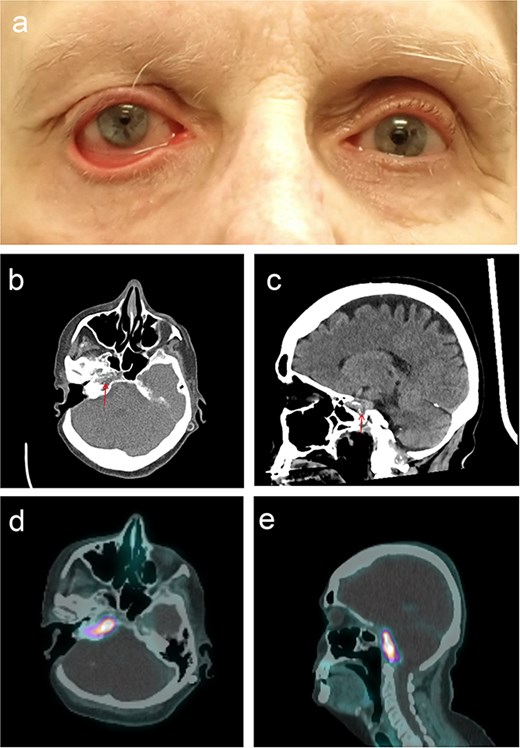
Clinical and radiological features of the case. (a) Clinical photograph demonstrating the right-sided facial palsy. (b and c) CT images of the glomus jugulare tumour in an (b) axial and (c) sagittal plane. (d and e) Positron emission tomography images showed that this was a high-avidity lesion, demonstrated on (c) axial and (d) sagittal planes.
Discussion
Glomus jugulare tumours are rare causes of isolated facial nerve palsies. Due to the proximity of the jugular foramen to the internal acoustic meatus, proximal growth of a glomus jugulare tumour can manifest with an isolated facial nerve palsy [2, 7], by slowly growing and eroding through the temporal bone, with its mass effect compressing the temporal course of the facial nerve. Whilst prior literature has described glomus jugulare tumours causing facial palsy [2, 7], this case uniquely highlights facial nerve palsy as the only sign of tumour recurrence decades later.
Facial nerve palsy has a broad differential diagnosis, encompassing congenital, birth-related, idiopathic, infectious, traumatic, iatrogenic, neurological, metabolic, and neoplastic causes [8–10]. Its complex anatomical course, from its origin at the ventral pontomedullary junction, through the internal acoustic meatus, and exiting at the stylomastoid foramen into five peripheral branches, renders it vulnerable to pathology at multiple sites. Although Bell’s palsy is the most common diagnosis, high-risk clinical features that warrant closer investigations include gradual onset, persistent symptoms for more than 6 months, ipsilateral hearing loss, history of malignancy or skull base surgery, cranial neuropathies and systemic features [9, 11].
Our patient had multiple red flags: prior skull base surgery and radiotherapy, persistent symptoms, and cranial nerve dysfunction. In such cases, neuroimaging is essential; whilst magnetic resonance imaging is ideal due to its high resolution, computed tomography (CT) may be a reasonable alternative, particularly in patients with contraindications to the former. Neuroimaging should involve the parotid gland, to capture the full path of the facial nerve [12].
Facial palsy patients often present to oculoplastic specialists for management of ocular surface exposure, lagophthalmos, and brow ptosis. Oculoplastic specialists may grade facial palsy patients utilizing the Cornea, Asymmetry, Dynamic, Synkinesis (CADS) score. The CADS score provides a structured ophthalmic grading system, with four domains assessed—the cornea, static asymmetry, dynamic function, and synkinesis. This provides a better evaluation of the ocular manifestations of facial nerve palsy. In contrast, the widely used House-Brackmann scale only evaluates ophthalmic involvement based on eyelid closure alone, failing to adequately capture the subtleties of eyelid closure and blinking [13, 14]. In patients where exposure keratopathy is a concern, initial conservative treatment should be trialled, including lubrication, lid taping, or botulinum toxin tarsorrhaphy. Surgical interventions such as upper lid gold weight placement and lower lid tightening procedures are considered for patients with persistent palsy or vision-threatening ocular surface dryness [10, 15]. Cases involving hearing loss should be referred to otolaryngology, whilst cases involving trauma or neoplasia of the skull base require referral to a multidisciplinary skull-base team.
Glomus jugulare tumours are rare causes of isolated facial nerve palsies. This case illustrates a novel case of a glomus jugulare tumour recurrence as the cause for a facial palsy and highlights the importance of reevaluating atypical or persistent facial nerve palsy with neuroimaging, especially in patients with prior skull base pathology. Early imaging and multidisciplinary review are essential to avoid misdiagnosis and optimize patient outcomes.
Conflicts of interest
The authors do not have any declarable conflicts of interest.
Funding
No funding was received for this study.
Consent
Written informed consent was provided by the patient for publication.


