


 https://orcid.org/0009-0004-3675-8216

Abstract
Dieulafoy lesions (DLs) are a rare cause of upper gastrointestinal bleeding (UGIB), accounting for about 1% of cases, and are more frequent in adult males. They can lead to hemodynamic instability and hypovolemic shock. Initial management is typically endoscopic, tailored to the patient’s clinical condition; however, surgical intervention is indicated in cases of persistent or severe instability. Hemodynamic support is essential to improve survival. Initial resuscitation in hypovolemic shock remains challenging, as fluid replacement must be guided by specific hemodynamic goals. Management includes not only crystalloids but also transfusion of blood products, such as packed red blood cells, fresh frozen plasma, and platelets, to maintain adequate perfusion and tissue oxygenation. We report the case of a female patient with UGIB secondary to a Dieulafoy lesion, successfully managed with targeted fluid resuscitation, blood products, vasopressors, and definitive surgical intervention, leading to resolution of bleeding and stabilization of her clinical condition.
Introduction
Upper gastrointestinal bleeding (UGIB) is defined as bleeding originating proximal to the ligament of Treitz, involving the esophagus, stomach, or proximal duodenum [1]. It is a frequent medical emergency with an estimated incidence of 103 cases per 100 000 persons per year and an overall mortality rate of approximately 14% [2].
The causes of UGIB are classified as variceal and non-variceal. Variceal bleeding includes esophageal and gastric varices, while non-variceal causes include peptic ulcer disease, erosive gastritis, duodenitis, esophagitis, malignancy, angiodysplasia, and Dieulafoy’s lesion [3]. Early identification of risk factors, prompt diagnosis, and prognostic stratification using scoring systems are essential to guide clinical decisions and reduce mortality, morbidity, and hospital stay [4].
Dieulafoy’s lesion is a rare vascular malformation characterized by dilation of a submucosal artery that becomes exposed through a small mucosal defect, appearing as a bleeding point without surrounding ulceration or inflammation [5]. It is most commonly located along the lesser curvature of the stomach, approximately 6 cm from the gastroesophageal junction, although it may also occur in the duodenum, jejunum, ileum, cecum, appendix, colon, and anal canal [6]. Gastrointestinal endoscopy is the first-line diagnostic and therapeutic modality, with success rates exceeding 90%. When endoscopic treatment fails or is not feasible, angiographic embolization or surgery is indicated [7].
This report describes a rare and severe case of upper gastrointestinal bleeding caused by a Dieulafoy’s lesion that required emergency surgical management due to persistent hemodynamic instability.
Case presentation
A 46-year-old woman with a history of hypothyroidism, recurrent miscarriages, mastodynia, and chronic cyclooxygenase inhibitor use presented to the emergency department of a regional hospital in Peru with hematemesis (approximately 50 cc), two episodes of melena, and 48 hours of epigastric pain.
On admission, she showed signs of hypoperfusion: delayed capillary refill (>3 seconds), cold and pale skin, and dry mucous membranes. Vital signs were: blood pressure 70/40 mmHg (MAP 50 mmHg), heart rate 112 bpm, respiratory rate 22 rpm, oxygen saturation 92% on room air, and shock index 1.6 (class IV). Abdominal examination revealed diffuse upper abdominal pain, predominantly epigastric. Neurological status was normal.
She received two units of packed red blood cells and two units of platelets. However, she developed three additional episodes of hematemesis totaling approximately 1400 cc. Initial laboratory tests were obtained (Table 1), and a central venous line was placed for hemorrhagic shock management.
Initial laboratory results obtained at admission to the emergency department, including complete blood count, coagulation profile, metabolic panel, and arterial blood gas analysis
| Complete blood count | Coagulation tests | Arterial blood gas analysis | Biochemistry |
|---|---|---|---|
| Leukocytes: 11 790/mm3 | PT: 14.8 s | PH: 7.37 | Creatinin: 1.6 mg/dL |
| Hemoglobin: 5.4 gr/dL | INR: 1.24 | PO2: 131 mmHg | Urea: 79.57 mg/dL |
| Hematocrit: 18.2 gr/dL | TS: 2 min | PCO2: 34 mmHg | AST: 14.24 UI/L |
| Platelets: 237 000 | CT: 7 min | HCO3: 21.2 mmol/L | ALT: 16.39 UI/ L |
| BE: −5.6 mmol/L | ALP: 113 UI /L | ||
| Lactate: 2.8 mmol/L | BD: 0.23 mg/dL | ||
| IB: 0.32 mg/dL | |||
| Albumin: 3.29 mg/dl |
PT: Prothrombin Time; INR: International Normalized Ratio; TS: Bleeding Time; CT: Clotting Time; PO2: Partial Pressure of Oxygen; PCO2: Partial Pressure of Carbon Dioxide; HCO3: Bicarbonate; BE: Base Excess; AST: Aspartate Aminotransferase; ALT: Alanine Aminotransferase; ALP: Alkaline Phosphatase; BT: Total Bilirubin; IB: Indirect Bilirubin; BD: Direct Bilirubin
After initial resuscitation, monitoring showed BP 139/72 mmHg, HR 106 bpm, oxygen saturation 97% on FiO₂ 28%, central venous pressure (CVP) 6 cmH₂O, pulse pressure variability (PPV) 18%, and pulse rate variability 14 mmHg. A positive fluid responsiveness test was documented. Subsequently, MAP decreased to 55 mmHg, PPV to 9%, PSV to 8 mmHg, and CVP increased to 9 cmH₂O. She was admitted to the intensive care unit (ICU).
In the ICU, she received massive transfusion therapy with 4 units of packed red blood cells, 4 units of fresh frozen plasma, 4 units of platelets, and 4 units of cryoprecipitate in a 1:1:1:1 ratio, along with intravenous saline at 100 cc/hour. Management was coordinated between gastroenterology and general surgery. Due to persistent hypotension despite aggressive resuscitation, she underwent emergency surgical intervention.
An exploratory laparotomy via Kocher incision was performed. After dissection of the phrenoesophageal ligament and identification and division of the anterior and posterior vagus nerves, a 10 cm gastrostomy was made along the greater curvature. A 1 cm Dieulafoy’s lesion was identified in the gastric fundus and surgically ligated, achieving hemostasis (Fig. 1).
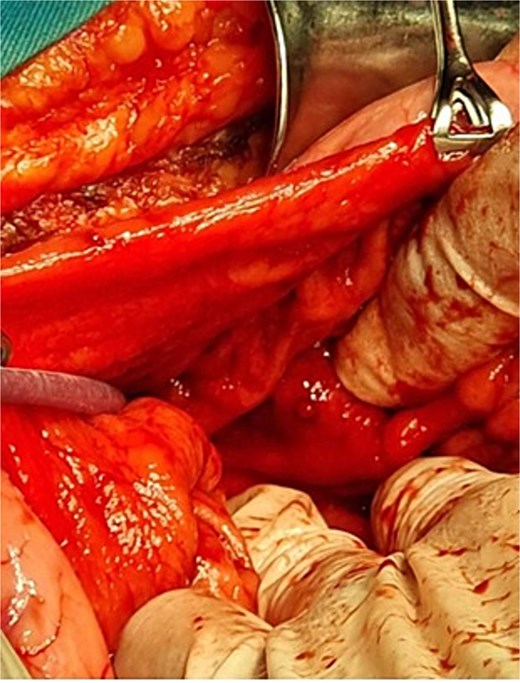
Endoscopic image showing a Dieulafoy’s lesion in the gastric fundus, characterized by a protruding submucosal vessel with active bleeding and no surrounding ulceration.
Postoperatively, she returned to the ICU. Hemodynamic parameters stabilized: BP 108/54 mmHg, MAP 72 mmHg, HR 83 bpm, shock index 0.67, PPV 7%, PSV 9 mmHg, and CVP 11 cmH₂O. Serial laboratory evaluations were performed at 12 and 24 hours (Tables 2 and 3).
Laboratory parameters 12 hours after admission to the intensive care unit, showing post-resuscitation hematologic, and metabolic values
| Complete blood count | Arterial blood gas analysis | Biochemistry |
|---|---|---|
| Leukocytes: 23.560/mm3 | pH: 7.27 | Glucose: 203.24 mg/dL |
| Hemoglobin: 12.3 gr/dL | PO2: 185 mmHg | Urea: 60.02 mg/dL |
| Hematocrit: 37.1 fL | PCO2: 48 mmHg | Creatinin: 0.54 mg/dL |
| Platelets: 187.000/mm3 | HCO3: 20.9 mmol/I | |
| BE: - 4.9 mmol/I | ||
| Lactate: 2.8 mmol/I | ||
| SO2: 99.0% |
PO2: Partial pressure of oxygen; PCO2: Partial pressure of carbon dioxide; HCO3: Bicarbonate; EB: Base excess; SO2: Oxygen saturation.
Laboratory parameters 24 hours after intensive care unit admission, demonstrating clinical, and biochemical evolution following surgical intervention
| Complete blood count | Arterial blood gas analysis | Biochemistry |
|---|---|---|
| Leukocytes: 15.410/mm3 | pH: 7.36 | Glucose: 132.74 mg/dL |
| Hemoglobin: 11.3 gr/dL | PO2: 86 mmHg | Urea: 16.75 mg/dL |
| Hematocrit: 33.8% | PCO2: 45 mmHg | Creatinin: 0.73 mg/dL |
| Platelets: 172.000/mm3 | HCO3: 24.6 mmol/I | PCR: 52.48 mg/dL |
| BE: - 0.0 mmol/I | ||
| Lactate: 2.1 mmol/I | ||
| SO2: 97.7% |
PO2: Partial pressure of oxygen; PCO2: Partial pressure of carbon dioxide; HCO3: Bicarbonate; EB: Base excess; SO2: Oxygen saturation.
She was discharged from the ICU after 48 hours with clinical and laboratory improvement (Table 4) and transferred to the surgical ward. On postoperative day five, she developed progressive dyspnea and was diagnosed with hospital-acquired pneumonia. Despite transfer to the medical ward and subsequent ICU readmission for mechanical ventilation, she died on the third ICU day due to hospital-acquired pneumonia.
Laboratory results at 48 hours postoperatively prior to discharge from the intensive care unit, reflecting hemodynamic stabilization, and hematologic recovery
| Biometría hemática | Pruebas de tendencia hemorrágica | Gasometría arterial | Bioquímica |
|---|---|---|---|
| Leukocytes: 18.890/mm3 | PT: 15.28 seg. | pH: 7.37 | AST: 41.88 U/L |
| Hemoglobin: 11.8 gr/dL | PTT: 35.84 seg. | PO2: 76 mmHg | ALT: 29.96 U/L |
| Hematocrit: 35.6 gr/dL | INR: 1.27 | PCO2: 40 mmHg | ALP: 133.27 U/I |
| Platelets: 185.000/mm3 | Fibrinogen: 642.27 md/dL | HCO3: 23.3 mmol/I | BT: 1.04 mg/dL |
| BE: - 2.2 mmol/I | IB: 0.54 mg/dL | ||
| Lactate: 0.7 mmol/I | BD: 0.50 mg/dL | ||
| SO2: 96.9% | Albumin: 3.42 mg/dL | ||
| Globulin: 1.33 mg/dL |
PT: Prothrombin Time; INR: International Normalized Ratio; TS: Bleeding Time; CT: Clotting Time; PO2: Partial Pressure of Oxygen; PCO2: Partial Pressure of Carbon Dioxide; HCO3: Bicarbonate; BE: Base Excess; SO2: Oxygen Saturation; AST: Aspartate Aminotransferase; ALT: Alanine Aminotransferase; ALP: Alkaline Phosphatase; BT: Total Bilirubin; IB: Indirect Bilirubin; BD: Direct Bilirubin.
Discussion
Dieulafoy’s lesion is an uncommon vascular anomaly consisting of a dilated, tortuous submucosal artery that protrudes through a small mucosal defect, leading to gastrointestinal bleeding [8]. It is most frequently located along the lesser curvature of the stomach and occurs twice as often in men. In this case, the lesion was located on the greater curvature in a female patient, differing from typical epidemiological patterns [9].
The etiology remains debated. Some authors propose a congenital origin, while others associate it with chronic alcohol consumption and antiplatelet use [10]. Proposed mechanisms of mucosal erosion include ischemia, thrombosis, and age-related gastric mucosal atrophy [11].
Patients with comorbidities such as hypertension, diabetes, liver disease, and renal insufficiency are at increased risk of bleeding. Although anticoagulants and NSAIDs are believed to promote bleeding, a direct causal relationship has not been definitively established. In this case, chronic cyclooxygenase inhibitor use may have contributed to mucosal erosion and bleeding [12].
Clinically, patients are often asymptomatic until sudden, massive bleeding occurs, presenting as hematemesis, melena, hematochezia, or a combination thereof [13]. Associated symptoms may include weakness, dizziness, fatigue, and dyspnea [14].
Endoscopy is the first-line diagnostic and therapeutic modality, achieving hemostasis in 90%–100% of cases and significantly reducing mortality [15]. Available endoscopic therapies include sclerotherapy, electrocoagulation, laser therapy, mechanical clipping, and adrenaline injection. Adrenaline is frequently used in combination with other techniques to improve visualization and enhance therapeutic success [16].
When endoscopic therapy fails or the patient remains hemodynamically unstable, arterial embolization or surgical intervention is indicated. In this case, persistent instability necessitated emergency surgical management to control massive hemorrhage [17].
Conclusion
Dieulafoy’s lesion is a rare but potentially life-threatening cause of upper gastrointestinal bleeding. Although most commonly located in the proximal stomach, it may occur throughout the gastrointestinal tract. Endoscopy is the initial diagnostic and therapeutic approach; however, in cases refractory to endoscopic management or accompanied by hemodynamic instability, surgical intervention remains essential. Prompt identification of the bleeding source is critical to optimize patient outcomes and reduce mortality.
Conflicts of interest
The authors declare no conflict of interest.
Funding
None declared.


