


Abstract
Epiploic appendagitis (EA) is a rare, benign, and usually self-limiting cause of acute abdominal pain resulting from inflammation or torsion of an epiploic appendage. It is typically managed conservatively with analgesia and non-steroidal anti-inflammatory medication. We report a case of a 22-year-old male who presented with acute right lower quadrant pain and radiological findings consistent with EA. Despite initial conservative management, he represented with worsening pain and rising inflammatory markers. Repeat imaging demonstrated progression of inflammatory change, atypical for uncomplicated EA. Diagnostic laparoscopy revealed a necrotic epiploic appendage walled off by adherent greater omentum, which was excised. The patient experienced near-immediate symptom resolution and was discharged on post-operative day 1, remaining well at follow-up. Although EA is generally self-limiting, clinical deterioration or atypical radiological development should prompt reassessment. In selected cases, laparoscopy can be both diagnostic and therapeutic.
Introduction
Epiploic appendagitis (EA) is an uncommon cause of acute abdominal pain resulting from torsion or spontaneous venous thrombosis of an epiploic appendage [1, 2]. These fatty peritoneal outpouchings arise from the colon and are particularly numerous along the sigmoid colon and caecum [1, 2]. EA accounts for an estimated 2%–7% of suspected diverticulitis cases and less than 1% of presentations with acute abdominal pain [3, 4]. It is more common in males aged 20–50 years, and in the context of obesity or strenuous exercise [2–4]. Diagnosis relies primarily on cross-sectional imaging, particularly computed tomography (CT) [3, 5]. EA has the potential to mimic a variety of surgical pathology however it is generally self-limiting and treated conservatively, with surgery rarely required [4].
Case report
A 22-year-old male presented with a 1-day history of sudden-onset stabbing right lower quadrant pain, nausea, and anorexia. His past medical history was significant only for obesity (BMI 42) with nil prior abdominal surgery or regular medications. On physical examination, he was afebrile and haemodynamically stable, with right lower quadrant tenderness. Laboratory work-up demonstrated high-normal WCC (10 10 × 109/l) and mildly elevated C-reactive protein (CRP) (7 mg/l). CT imaging demonstrated a 3 cm fat-density ovoid lesion adjacent to the ascending colon with surrounding inflammatory change, consistent with EA. The patient was discharged with regular non-steroidal anti-inflammatory medication (ibuprofen 600 mg orally three times a day) and appropriate return precautions.
Two days later, he represented with worsening right lower quadrant pain and diarrhoea. He remained haemodynamically stable; however, his CRP had risen to 99 mg/l. Repeat CT demonstrated an interval increase in the severity and extent of inflammatory changes centred over the anterior caecum and ascending colon.
Given diagnostic uncertainty, rising inflammatory markers, and clinical deterioration, the patient was admitted and commenced on broad-spectrum antibiotics. Diagnostic laparoscopy was performed the next day due to atypical disease progression. Intra-operatively, an inflamed necrotic epiploic appendage covered with densely adherent omentum was identified. After careful dissection, the lesion was observed to be on a peduncle arising from the colon. This was sharply divided with endoscopic scissors and retrieved via Endocatch bag. Histopathology demonstrated fat necrosis with reactive fibroplasia and inflammation consistent with infarcted EA. The patient recovered well post-operatively and was discharged on post-operative day 1. He remained asymptomatic at 2-week follow-up.
Discussion
This case describes the approach, findings, and clinical outcome of surgical management of EA that evolved clinically and radiologically despite a trial of conservative management.
Appendices epiploic are small subserosal fat outpouchings that run parallel to the taeniae coli of the large bowel [2]. Each appendage is attached to the colonic wall by a vascular stalk containing one or two arteries and a single draining vein [3]. EA results from torsion of the bulbous appendage on its peduncle and/or thrombosis of the draining vein, leading to ischaemia, aseptic necrosis, and subsequent inflammation [1, 2, 4, 6]. Cross-sectional imaging is the diagnostic modality of choice, with CT typically demonstrating an oval-shaped, fat-dense paracolic lesion with a hyperattenuating rim corresponding to inflamed visceral peritoneum, often with a central hyperdense focus representing a thrombosed vein [2, 6]. Figure 1 demonstrates this CT finding for our patient with a 2.9 cm ovoid fat density with a thin hyperdense rim immediately anterior to the ascending colon in the right lower quadrant.
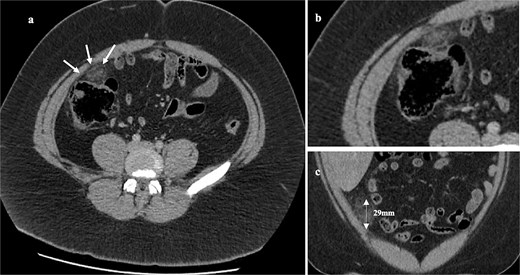
Initial contrast-enhanced CT abdomen and pelvis. (a) Axial slice demonstrating an ovoid fat-density lesion anterior to the ascending colon with a thin hyperattenuating rim. (b) More caudal axial slice again demonstrating the hyperattenuating rim characteristic of epiploic appendagitis. (c) Coronal reconstruction demonstrating the ovoid lesion anterior to the ascending colon.
Although EA is usually self-limiting, a small subset of patients demonstrate persistent or progressive symptoms despite appropriate conservative management [1, 3, 4]. These cases remain underrepresented in the literature and can create diagnostic and management dilemmas [1, 3, 4]. In most patients, symptoms improve after diagnosis with analgesia and non-steroidal medication and completely resolve within 2 weeks [4, 6]. Typically the inflammatory process subsides once the appendage becomes necrotic and eventually the appendage is absorbed by the peritoneum [2, 4]. Complications like localized abscess formation, gastrointestinal obstruction, or peritonitis are uncommon but have been described [2, 4, 7]. In cases where conservative treatment fails and symptoms persist, surgical intervention has been pursued with curative intent and to reduce the risk of complications [1, 2].
In this case, the patient demonstrated clinical deterioration after 72 h of conservative treatment. Repeat imaging revealed more extensive fat stranding anterior to the colon compared with the initial study which is unusual for uncomplicated EA (Fig. 2). Given the worsening clinical picture and concern for alternative pathology, an operative approach was pursued.
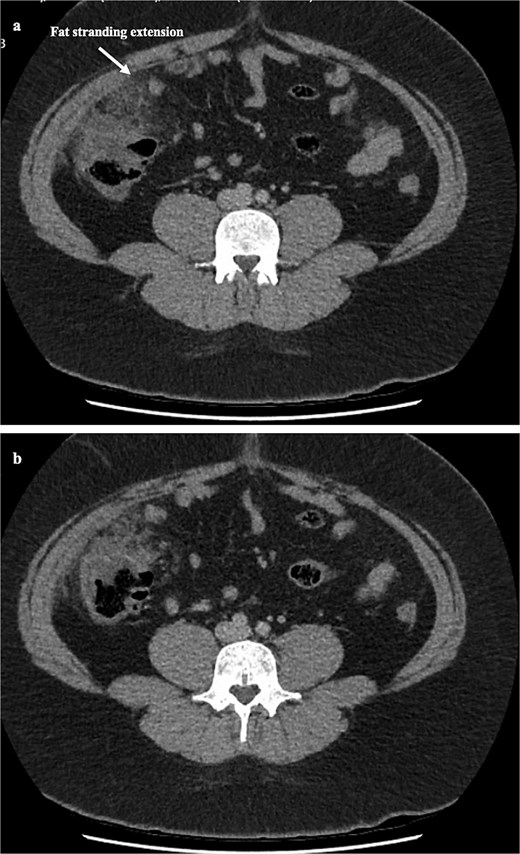
Repeat contrast-enhanced CT abdomen and pelvis performed 72 h after initial imaging. (a) Axial slice demonstrating interval progression of inflammatory fat stranding anterior to the ascending colon. (b) More caudal axial slice demonstrating inferior extension of inflammatory change compared with initial imaging.
The greater omentum plays an important role in localizing intra-abdominal inflammation and limiting disease spread [8–10]. In this case, a necrotic mass centring over the ascending colon with densely adherent omentum was observed (Fig. 3), which likely accounted for the atypical radiological evolution on repeat imaging. Surgical exploration confirmed the mass to have a peduncle connecting to the colon consistent with an epiploic appendage, walled off with omentum. Histopathology further supported this with findings of fat necrosis with reactive fibroplasia and inflammation.
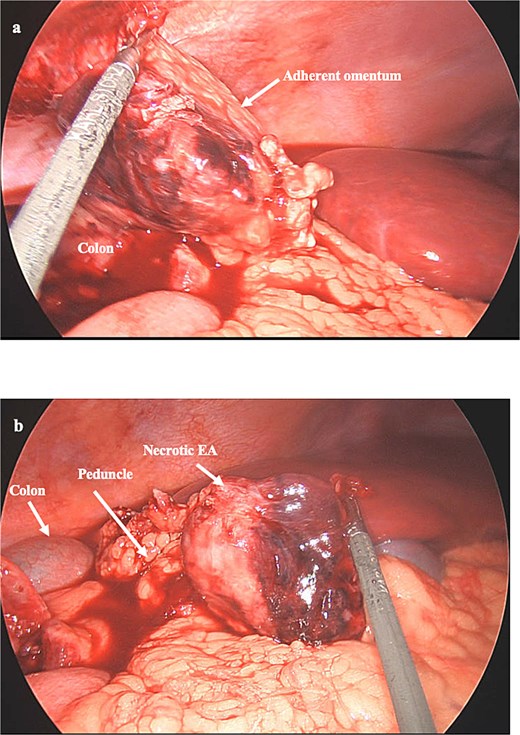
Intra-operative findings at diagnostic laparoscopy. (a) Necrotic epiploic appendage centred over the ascending colon with densely adherent omentum. (b) Necrotic epiploic appendage following careful dissection with surrounding omentum mobilized.
The patient experienced rapid symptom improvement following surgery. They were discharged on post-operative day 1 and remained well at 2-week follow-up, reporting no ongoing abdominal pain or altered bowel habit.
Conclusion
This case reinforces that EA, although benign in most cases, can rarely follow a progressive course requiring operative management [4]. Clinicians should consider surgery in patients who deteriorate clinically or who demonstrate atypical radiological progression following appropriate reassessment and exclusion of alternative diagnoses [1, 2]. Laparoscopy is a safe and effective diagnostic and therapeutic option in selected cases of EA.
Conflicts of interest
None declared.
Funding
None declared.


