


 https://orcid.org/0000-0001-7203-3707

Abstract
We report a case of a patient presenting with melena and dysphagia. His gastroscopy revealed an oesophageal mass and active duodenal papillary haemorrhage. Subsequent endoscopic retrograde cholangiopancreatography (ERCP) confirmed the presence of a haemorrhagic mediastinal pancreatic pseudocyst (MPP). Due to severe alcohol withdrawal syndrome, the patient declined surgical intervention. Conservative management and pancreatic tube placement under ERCP were performed, resulting in clinical stabilization. Follow-up imaging 2 months later demonstrated partial remission of the MPP. We further review the clinical characteristics and contemporary management strategies for MPP.
Introduction
Melena and dysphagia are common clinical manifestations of gastrointestinal disease, and are often associated with oesophageal malignancies. However, dysphagia may also result from non-neoplastic disease, including oesophageal motility disorders, cardiac tumors, and mediastinal masses. Pancreatic pseudocyst is a fluid collection that develops more than four weeks after acute pancreatitis, and can also occur asymptomatically after chronic pancreatitis. Given the retroperitoneal location of the pancreas and the presence of loosely arranged connective tissue, pancreatic secretions may disseminate to distant retroperitoneal sites, such as the perirenal space, iliac fossae, or mediastinum. Mediastinal pancreatic pseudocyst (MPP) forms via retrograde extension through the oesophageal or aortic hiatus. The cystic fluid contains active pancreatic enzymes that, once activated, can digest adjacent tissues and lead to severe complications, including perforation, infection, or multi-organ failure.
Case report
A 70-years old male was admitted to the hospital with melena and dysphagia. Gastroscopy revealed a large submucosal mass posterior to the distal oesophagus, along with the presence of old blood in the descending duodenum (Fig. 1c). Then, contrast-enhanced computed tomography (CT) of the oesophagus reported a poorly enhancing submucosal mass in the distal oesophagus, suggestive of a cystic lesion with proteinaceous content or haemorrhage (Fig. 1a). Contrast-enhanced magnetic resonance imaging (MRI) of the pancreas revealed two cystic lesions in the tail of the pancreas with a fistula-like tract extending from the inferior aspect of the lesion to the distal oesophagus (Fig. 1b). The cystic lesion exhibited haemorrhagic content and a contrast-enhancing nodule at its posterior margin. Endoscopic retrograde cholangiopancreatography (ERCP) was taken after initial active medical haemostatic therapy, which showed pancreatic fistula with MPP, and a pancreatic duct stent was placed to facilitate pancreatic ductal drainage and promote resolution of the pancreatic leakage. The pancreatic duct stent discharged a small amount of bloody fluid (Fig. 1d).
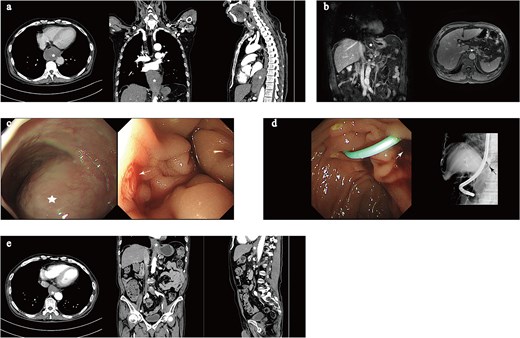
(a) Contrast-enhanced CT of oesophagus: A submucosal mass with poor enhancement at the distal segment of the oesophagus (star); (b) contrast-enhanced MRI of pancreas: Two cystic lesions in the tail of the pancreas (arrows); a fistula-like tract extending from the inferior aspect of the lesion to the distal oesophagus, suggestive of a haemorrhagic cystic lesion (star); (c) gastroscopy: A large soft mass posterior the lower oesophagus (star) and a small amount of old haemorrhagic fluid in the descending duodenum (arrows); (d) endoscopic retrograde cholangiopancreatography: Pancreatic fistula with MPP (black arrows), and a pancreatic duct stent was placed (white arrows); (e) contrast-enhanced CT of abdomen: Partial remission of MPP (star).
Given the oesophageal obstruction and haemorrhage secondary to MPP, surgery or percutaneous angiographic embolization was initially recommended as first-line therapy. However, preoperative evaluation revealed alcohol withdrawal syndrome manifesting during hospitalization, precluding immediate intervention. Conservative management was taken after multidisciplinary consultation. Fortunately, the haemorrhage of MPP stabilized after treatment, and follow-up imaging was performed 2 months later (Fig. 1e). Because of the stable, asymptomatic nature of MPP, and this patient’s inability to maintain alcohol abstinence, close monitoring was advised with planned subsequent therapy.
Discussion
MPP is rare but potentially lethal with serious complications including airway or vascular compression, pleural effusion, infection, mediastinitis, haemorrhage, and sepsis, often necessitating intervention [1, 2]. Haemorrhage is a kind of threaten complication of pancreatic pseudocyst with reported mortality rates up to 40%, which could present as retroperitoneal bleeding, haemobilia or haemosuccus pancreatitis [3]. Percutaneous angiographic embolization is recommended for haemodynamically stable patients, when surgery is reserved for patients with active bleeding or haemodynamic instability, as well as patients with failed embolization or other secondary complications like infection or extrinsic compression [4]. Fortunately, our patients finally benefited from conservative management, which may also have been facilitated by compression-induced hemostasis resulting from increased intra-cystic pressure.
Minimally invasive drainage techniques, such as endoscopic ultrasonography-guided drainage and ERCP with stent placement, have been reported to successfully resolve several MPP and avoid major surgery in selected patients [5–7]. When ductal anatomy permits, trans-papillary drainage is attractive. However, these approaches primarily relieve oesophageal obstruction and reduce cyst volume but do not adequately control haemorrhage. Critically, reduction in intra-cystic pressure during drainage may precipitate recurrent haemorrhage by disrupting pressure-mediated vascular compression. Consequently, close monitoring is mandatory post-drainage, with immediate percutaneous angiographic embolization or surgery indicated for recurrent haemorrhage.
Conclusion
We present a case of MPP manifesting as an oesophageal mass with melena, which was definitively diagnosed via ERCP. This patient was successfully managed with medical management and ERCP-assisted pancreatic stent placement. This case helps to further delineate the clinical characteristics of MPP and highlights the effectiveness of endoscopic management for MPP, especially in high-risk patients.
Author contributions
G.Y. wrote the paper. F.Q., C.Z., and L.Q. performed the edit and review.
Conflicts of interest
Yangjun Gu, Qingqing Fang, Zhitao Chen, and Qiyong Li declare that they have no conflict of interest.
Funding
National Natural Science Foundation of China (No. 82302803).
Ethical statement
All procedures followed were in accordance with the ethical standards of the responsible committee on human experimentation (Clinical Trial Ethics Review Committee of Shulan (Hangzhou) Hospital, No. KY2025176) and with the Helsinki Declaration of 1975, as revised in 2008.


