


 https://orcid.org/0009-0002-2137-9219

Abstract
True duplication of the cystic duct draining a single gallbladder is an exceptionally rare biliary anomaly, with fewer than 40 cases reported in the English literature. Failure to recognize this variant during complex hepatobiliary surgery carries significant risk of bile duct injury. We report a 60-year-old male undergoing open pancreaticoduodenectomy for pancreatic adenocarcinoma in whom an H-type duplicated cystic duct was incidentally identified during dissection of Calot’s triangle. Both ducts were individually clipped and divided; ductoplasty was performed to facilitate biliary reconstruction. The procedure was completed without biliary complications. A systematic PubMed and Scopus search confirmed this as the first reported case of duplicated cystic duct encountered during pancreaticoduodenectomy, extending the spectrum of surgical contexts beyond cholecystectomy and hepatic resection. This case underscores the importance of meticulous dissection and heightened anatomical vigilance in pancreatic oncologic surgery.
Introduction
Biliary anatomical variations are present in ~47% of the population, yet true duplication of the cystic duct draining a single gallbladder is exceedingly rare, accounting for fewer than 40 published cases and less than 1% of detected biliary variants [1, 2]. The duplicate ducts may converge before joining the common bile duct (CBD), forming a Y-type variant, or drain independently, forming the H-type variant [3]. While benign in nature, an unrecognized accessory duct may result in bile leak, biliary stricture, or residual gallbladder—consequences with significant clinical implications [2].
We present what is, to our knowledge, the first reported case of duplicated cystic ducts discovered incidentally during open pancreaticoduodenectomy (Whipple procedure), highlighting the operative implications of this anomaly in complex pancreatic oncologic surgery.
Case report
A 60-year-old male with coronary artery disease, diabetes mellitus, and dyslipidemia presented with abdominal pain and obstructive jaundice of 5 months’ duration. Workup revealed cholelithiasis and a mass in the head of the pancreas. Endoscopic retrograde cholangiopancreatography (ERCP) with biliary stenting was performed, and biopsy confirmed pancreatic adenocarcinoma. Preoperative computed tomography (triple-phase pancreas protocol) revealed a 3.2 × 2.6 × 4 cm hypoenhancing mass in the pancreatic head/uncinate process with biliary and pancreatic ductal dilatation and tumoral contact with the superior mesenteric vein. No biliary anomaly was identified on preoperative imaging. PET scan showed no distant metastasis, and the patient was scheduled for open pancreaticoduodenectomy.
Intraoperatively, upon approaching Calot’s triangle, two cystic ducts draining separately into the CBD were identified, consistent with an H-type duplicated cystic duct variant (Figs 1A, B, and 2). Ductoplasty was performed to create a single common orifice from the two adjacent ductal openings, facilitating a safe hepaticojejunostomy. Both ducts and the cystic artery were individually clipped and divided, and the gallbladder was removed safely. The Whipple procedure was completed uneventfully with an estimated blood loss of 400 ml.
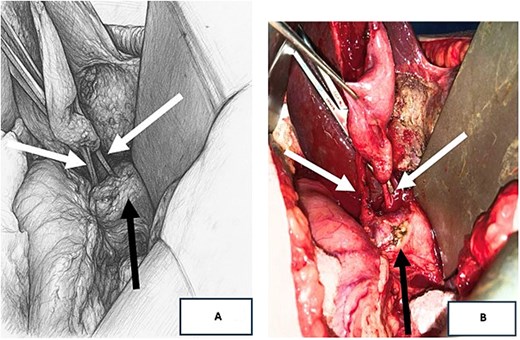
A and B: Intraoperative photograph and anatomical illustration demonstrating a rare H-type duplicated cystic duct variant with independent drainage into the CBD (white arrows: duplicated cystic ducts; black arrow: CBD).
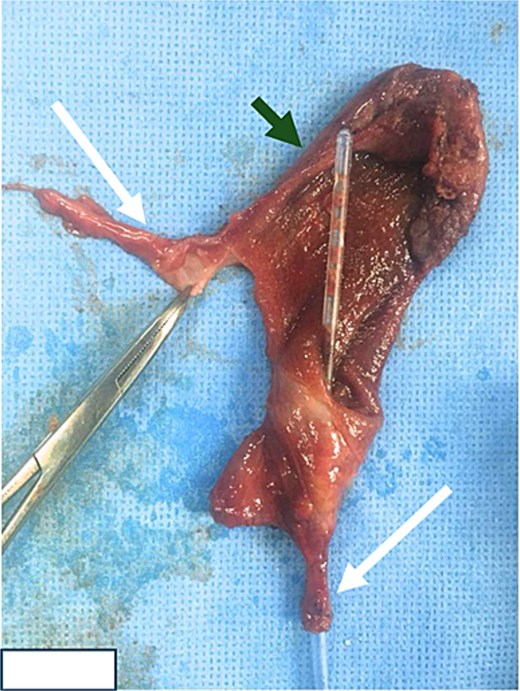
Resected gallbladder demonstrating double cystic ducts (white arrows: duplicated cystic ducts; green arrow: gallbladder).
Pathology confirmed invasive poorly differentiated pancreatic ductal adenocarcinoma (2.6 × 2.5 × 2.5 cm) with ampullary, duodenal wall, and peripancreatic involvement. The pancreatic margin was positive (R1); all other margins were negative. Vascular and perineural invasion were present; 4/13 regional lymph nodes were positive. Pathologic staging was pT2 pN2 (AJCC 8th edition). The patient recovered well and was referred for adjuvant chemotherapy.
Discussion
Duplicated cystic ducts are classified into Y-type (ducts converge before entering the biliary tree) and H-type (ducts drain independently into the CBD) variants [3]. While benign in nature, this anomaly carries significant clinical implications if left undetected during hepatobiliary or pancreatic surgery. Our case represents the H-type, in which the accessory duct is typically small, posteriorly located, and concealed within Calot’s triangle, a configuration that poses unique surgical challenges [4]. Munie et al. summarized 21 cases from 1961–2019, noting female predominance (75%) and H-type as the dominant variant, with preoperative diagnosis achieved in only a minority [5]. Since 2020, additional cases have been reported (Table 1), nearly all identified intraoperatively during laparoscopic cholecystectomy [6–15]. Our patient is also notable for being male, placing him among the minority by sex.
Cases of duplicated cystic duct draining a single gallbladder since 2020
| Year | Author | Age/sex | Type | Surgical approach | Detection |
|---|---|---|---|---|---|
| 2020 | Abdelsalam et al. [6] | 42/female | H-type | Laparoscopic | Intraoperative (cholangiogram) |
| 2020 | Anisi et al. [7] | 58/female | Y-type | Laparoscopic | Intraoperative |
| 2021 | Poddar [8] | 54/female | H-type | Laparoscopic | Intraoperative |
| 2021 | Iwasaki et al. [9] | 60/female | H-type | Open (right hepatectomy) | Intraoperative |
| 2022 | Wu et al. [10] | 67/female | H-type | Laparoscopic | Intraoperative (cholangiogram) |
| 2023 | Bachar et al. [11] | 46/a | H-type | Laparoscopic | Intraoperative |
| 2024 | Movva et al. [12] | 62/male | Not reported | Laparoscopic | Intraoperative |
| 2024 | Khan et al. [13] | 49/male | H-type | Laparoscopic | Intraoperative |
| 2024 | Alenezi et al. [14] | 33/female | H-type | Laparoscopic | Intraoperative |
| 2025 | Yousaf et al. [15] | 45/female | H-type | Laparoscopic | Intraoperative |
| 2025 | Current case | 60/male | H-type | Open (Whipple) | Intraoperative |
aSex not reported in original publication.
A systematic search of PubMed and Scopus using “duplicated cystic duct,” “double cystic duct,” and “pancreaticoduodenectomy” yielded no prior reports of this anomaly in the Whipple context. While one H-type case was identified during open right hepatectomy for gallbladder cancer [9], the present report is the first to describe this anomaly during pancreaticoduodenectomy. Preoperative detection remains difficult even with MRCP and ERCP, due to the small caliber and parallel course of the accessory duct [4]; cross-sectional staging imaging for pancreatic cancer is therefore unlikely to identify this variant, as occurred here.
Operative implications during pancreaticoduodenectomy
In pancreaticoduodenectomy, cholecystectomy is performed as part of exposure and reconstruction planning, and Calot’s triangle may not receive the same deliberate attention as during routine cholecystectomy, increasing the risk that an accessory duct is missed. When two ductal structures are suspected, dissection should pause, anatomical landmarks should be reconfirmed, and the critical view of safety must be achieved before clipping. Each duct must be traced to its insertion, blind clipping must be avoided, and if uncertainty persists, selective intraoperative cholangiography should be used [4]. Each cystic duct must then be individually clipped and divided, and the anomaly documented. The oncologic stakes are particularly high: bile leakage near pancreatoenteric and bilioenteric anastomoses risks intra-abdominal sepsis and delays adjuvant chemotherapy, consequences extending well beyond those of inadvertent duct injury during routine cholecystectomy.
To our knowledge, this is the first reported case of duplicated cystic duct identified during pancreaticoduodenectomy, extending the spectrum of surgical contexts beyond cholecystectomy and hepatic resection. Because preoperative imaging may not reliably identify this anomaly, intraoperative vigilance remains paramount. Meticulous dissection, achievement of the critical view of safety, and selective intraoperative cholangiography are essential to avoiding biliary injury in this high-stakes operative setting. Given the increasing complexity of pancreatic oncologic surgery, incorporation of rare biliary variants such as duplicated cystic duct into HPB surgical training curricula and operative checklists is warranted to prevent avoidable complications.
Author contributions
MK: concept, surgical procedure, critical revision. NB: clinical data collection, literature review, manuscript drafting, and editing. RD: clinical data collection, literature review, and manuscript drafting. AJ: manuscript drafting and editing. All authors approved the final version.
Conflicts of interest
None declared.
Funding
No funding was received for this study.
Ethical approval and consent
Written informed consent for publication of this case and accompanying images was obtained from the patient. Institutional ethical approval was not required for this single case report. This report adheres to the CARE guidelines for case report writing.


