


 https://orcid.org/0009-0009-7960-8206

Abstract
Vestibular fistula (VF) is a common anorectal malformation in females. However, the timing and methods of surgical treatment vary considerably between institutions, mainly because of concerns regarding postoperative complications at the surgical site. This concern primarily relates to the sagittal skin incision extending from the vestibule to the anal region; therefore, we sought ways to minimize its extent. The procedure involved making a skin incision only at the anus, incising the anal sphincter muscle according to the ASARP, and separating the internal fistula tract according to the PSARP. The remaining fistula tract was inverted from the intestinal side and pulled out through the vestibular opening for excision. We report a surgical technique that potentially reduces the concerns and risks of wound complications by avoiding sutured wounds in the perineal skin.
Introduction
Vestibular fistula (VF) is a major type of anorectal malformation in females [1]. Posterior sagittal anorectoplasty (PSARP), described by Peña [2], and anterior sagittal anorectoplasty (ASARP), introduced by Okada [3], are the most commonly used surgical procedures. VF can be managed using a single-stage definitive repair or a conventional two- or three-stage approach. The purpose of the multistage approach is to prevent postoperative wound infection and wound dehiscence by creating a colostomy; in this regard, it is considered superior to the single-stage approach [4]. However, we have developed a modified ASARP for VF in the neonatal period that potentially significantly reduces the risk of wound complications. This technique involves anorectoplasty using a minimal skin incision—only at the anal site—without incising the vestibular mucosa, the vulvar, or perineal skin, as the fistula tract is resected by inversion. We describe this surgical procedure based on our clinical case.
Case report
The patient was a female newborn who was transported to our medical center at birth because of the absence of an anus. Based on the physical examination of the perineal region and fistulography (Fig. 1), a diagnosis of VF was made. No cardiac anomalies or vertebral malformations were identified, except for mild hydronephrosis. We planned a single-stage repair of the VF at 11 days of age.
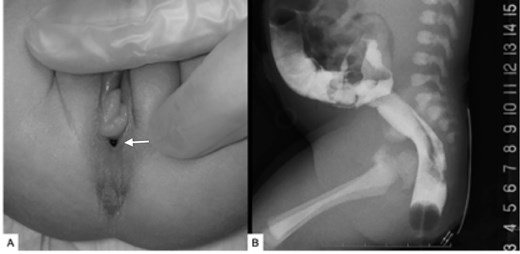
Appearance of the perineum and fistulography. A: Appearance of the perineum with a fistula opening in the vestibule (arrow). B: Fistulography of the vestibule showing contrast filling the rectum.
Surgical procedure
The patient was placed in the lithotomy position, as in ASARP, and the center of contraction of the external anal sphincter was identified using electrical stimulation. A small 14 mm sagittal incision was made with centered over the point of maximal sphincter contraction. Both ends of the incision were made as rhombic skin incisions with 2-mm sides, following the lateral flap anoplasty technique (Fig. 2A). A surgical probe was inserted through the vestibular opening to visualize the fistula tract and the rectum (Fig. 2B). Following the ASARP technique [3], the midline of the anal sphincter was incised. The fistula tract and the rectum connected to it were identified and dissected from the surrounding tissue. After thorough dissection of the rectum, an incision was made near the junction between the rectum and the fistula tract (Fig. 3A), using the PSARP technique [2]. The rectum and fistula tract were transected while confirming the fistula opening intraluminally (Fig. 3B). After dissecting the fistula tract from the surrounding tissues near the vaginal vestibule, the fistula tract stump was inverted and withdrawn from the vestibular fistula opening and closed with a transfixing suture (Fig. 4). This eliminates the need for additional incisions other than at the site of the neoanus. The anterior incised sphincter muscle was sutured, and the posterior sphincter muscle was sutured and fixed to the rectum. The anastomosis was completed by suturing the mobilized rectum circumferentially to the incised skin (Fig. 5A). The operative duration was 124 minutes. The intraoperative blood loss was 2 mL. No intraoperative complications were observed.
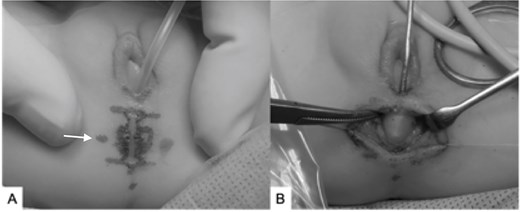
Skin incision and exposure of the fistula and rectum. A: A 14 mm sagittal incision was made with the center of the sphincter contraction as the midpoint (arrow). Both ends of the incision were made as rhombic skin incisions with 2 mm sides, following the lateral flap anoplasty technique. B: A surgical probe was inserted through the vestibular opening to visualize the fistula tract and the rectum.
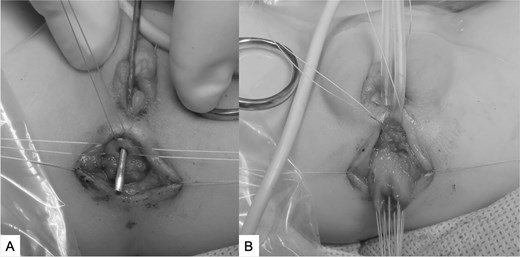
Rectal incision and fistula division. A: An incision was made near the junction between the rectum and the fistula tract. B:The rectum and the fistula tract were separated while confirming the opening of the fistula from the rectal lumen.
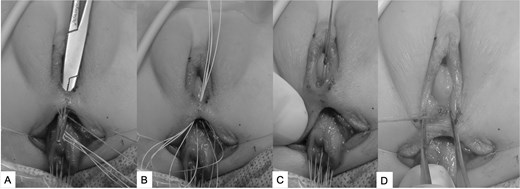
Inversion and excision of the fistula. A: Insertion of forceps through the vestibular opening. B: Grasp the thread tied to the stump of the fistula. C: Invert the fistula tract into the fistula cavity. D: Remove it from the fistula opening and excise the fistula tract by transfixing suture at the opening.
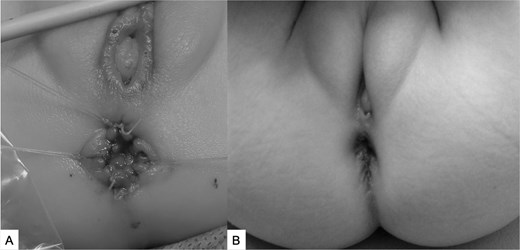
Anal findings. A: Immediately after surgery. B: Six months postoperatively. There are no wounds other than the site of the enterocutaneous anastomosis, known as the neo-anus. Cosmetic appearance is also good.
The patient began passing stools the day after surgery and started breastfeeding. No complications, such as wound infection or dehiscence, were observed. Anal dilation with a bougie was initiated as planned in the second postoperative week. The mother was instructed on stool management using glycerin enemas, and the patient was discharged on the 29th postoperative day. At 1-year follow-up, the appearance from the vestibule to the anus was good (Fig. 5B). Although stool management is ongoing, no anal stenosis or soiling has been observed to date.
Discussion
For low anorectal malformations, such as a perineal fistula, single-stage repair performed during the neonatal to infant period is common [5]. Single-stage repair has also been reported to be feasible for VF [6, 7]. The frequency of minor and major wound dehiscence after single-stage PSARP ranges widely in the literature from 0% to 48% [8]. However, for VF, single-stage repair is associated with a higher incidence of postoperative complications, such as wound infection and dehiscence, compared to multi-stage repair, and the multistage approach has been reported to be safer [4].
We devised a method to minimize skin incisions to reduce the risk of these complications. Based on the conventional surgical techniques, ASARP and PSARP [2, 3], we were able to form an anus without incising the vestibule or perineal skin by inverting and excising the fistula tract. The procedure is as follows: A skin incision was made only at the anus placement site. The anal sphincter managed according to ASARP principles, and the internal fistula tract was separated from the rectum according to PSARP, it was inverted from the rectal end of the tract. The tract was then pulled out through the external opening, transfixed, and excised. The incised anal sphincter was sutured, and the rectum was sutured circumferentially to the skin to create the anus.
This method is similar to that reported by Ostertag-Hill et al. [8] regarding the importance of preserving the perineal body during surgery for VF. We agree on the importance of preserving the perineal body. However, the approach to fistula resection is different. By severing the fistula on the rectal side and inverting it, incision of the vestibular opening is unnecessary. Ligation of the inverted fistula alone is sufficient and does not result in tension. Furthermore, no posterior skin incision, as used in PSARP, is required. This surgical procedure is based on ASARP, and in order to avoid making an incision anterior to the anus for fistula resection, the fistula is inverted from the rectal side, thereby successfully minimizing skin incisions.
The key point of this technique is to invert the intestinal end of the fistula tract and pull it out through the vestibular opening to completely remove it. This allows anorectoplasty for VF with only the minimal skin incision required for anal placement. By avoiding an incision through the perineal skin, the potential for wound dehiscence of the perineal skins is eliminated.
In the repair of anorectal malformations, wound complications such as infection and dehiscence are not only early postoperative problems but also affect anorectal function in the long-term. We report this technique because we believe this technique may be effective that minimizes the wound area and reduces complications.
The limitations of this study include the small number of patients and the one-year postoperative follow-up period, making it difficult to evaluate long-term anorectal function.
Institutional review board approval was not required for this case report, but informed consent for publication was obtained from the patient's guardians.
Conflicts of interest
None declared.
Funding
None declared.


