


 https://orcid.org/0009-0008-4861-733X

Abstract
Osteogenesis imperfecta (OI) is a rare genetic disorder marked by bone fragility and progressive deformity. Type III OI represents a severe form characterized by recurrent fractures, bowing, and significant functional impairment. We report a 17-year-old with type III OI and an extreme 111.4° tibial procurvatum deformity alongside recurrent femoral fractures. His history included multiple intramedullary nailing procedures and revision surgeries. The most recent treatment involved a two-level tibial osteotomy with subsequent cast immobilization, resulting in marked improvement. The Lower Extremity Functional Scale increased from 38/80 preoperatively to 70/80 at follow-up, surpassing the minimal clinically important difference. Severe long bone deformities exceeding 60–90° in OI are uncommon and require individualized, multidisciplinary care. Multilevel osteotomies with intramedullary fixation remain central to correction, though complications persist. This case highlights the complexity of managing extreme tibial deformities in OI and supports multistage reconstruction to restore alignment and function.
Introduction
Osteogenesis imperfecta (OI) is a rare, genetically and clinically heterogeneous connective tissue disorder with an estimated incidence of 1 in 10 000–13 500 births. The Sillence classification divides OI into types I–IV based on clinical severity and radiographic findings, with over 85%–90% of cases resulting from mutations in COL1A1 or COL1A2 genes affecting type I collagen synthesis. Type III OI represents a severe non-lethal form characterized by progressively deforming bone disease, marked growth deficiency, frequent fractures, skeletal deformities, and extraskeletal features including blue sclerae, dentinogenesis imperfecta, hearing loss, and joint laxity [1].
Management of type III OI requires a multidisciplinary approach including physical rehabilitation, bisphosphonate therapy, and orthopedic surgical interventions for fracture stabilization and deformity correction. Surgical management is complicated by extreme bone fragility and recurrent deformities. Intramedullary telescopic rod fixation and corrective osteotomies are standard approaches, though complication rates exceed 35% for telescopic rods and 50% for non-telescopic implants, with rod migration, refracture, and non-union being common. Revision surgeries are frequently required as children grow [2].
Severe limb deformities, particularly tibial procurvatum exceeding 90 degrees, present additional surgical challenges. Gradual correction using external fixation such as the Ilizarov method is preferred to minimize neurovascular complications and allow controlled multiplanar deformity correction. The Ilizarov technique enables precise gradual correction and has been successfully applied in pediatric OI patients with complex deformities. Surgical planning must be individualized, accounting for patient age, deformity severity, bone quality, and prior interventions [3].
We present a rare case of a 17-year-old male with type III OI who developed a 111.4-degree tibial procurvatum deformity and multiple femoral fractures requiring multilevel corrective osteotomies and intramedullary nail revision. This case provides valuable insight into surgical management of advanced skeletal deformities in severe OI.
Clinical presentation
This case involves a 17-year-old male with genetically confirmed OI type III who has been followed by orthopedic services since infancy. He is wheelchair-bound and non-ambulatory, with a history of multiple long-bone fractures, progressive deformities, and repeated implant-related complications despite comprehensive multidisciplinary management, including bisphosphonate therapy, nutritional supplementation, and structured rehabilitation. His baseline Lower extremity functional scale (LEFS) score was 38/80, reflecting marked functional limitation.
Surgically, his early course included revision of internal fixation for a periprosthetic refracture of the left proximal femur at age three, involving Rush nail removal and insertion of a 3-mm Nancy nail followed by half-spica casting. One year later, an impending fracture and a painful 90° knee flexion contracture of the right femur required a two-level osteotomy with shortening and intramedullary nailing, improving extension and reducing the contracture to 40°.
Subsequent interventions addressed progressive femoral deformities, including femoral corrective osteotomy, Nancy nail removal, and flexible Fassier-Duval (FD) nail fixation with intraoperative shortening to optimize alignment. In 2020, a right distal femoral fracture necessitated intramedullary nail exchange and further shortening, achieving stable fixation.
In October 2024, the patient presented with a pronounced 111.4° procurvatum deformity of the left midshaft tibia (Fig. 1a and b), causing mechanical dysfunction and significant pain. On 28 October 2024, he underwent a two-level tibia and fibula shortening osteotomy through a medial approach under tourniquet control (Fig. 2a and b). Due to a severely narrowed canal and poor bone quality, intramedullary rodding was not feasible; alignment was restored and maintained with cast immobilization (Fig. 3). Postoperative neurovascular status remained intact.
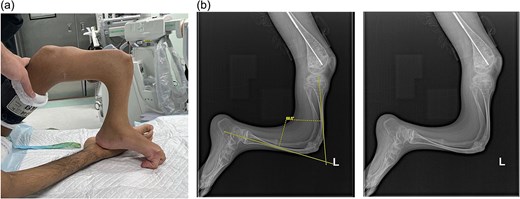
(a) Preoperative gross image showing a severe 111.4-degree procurvatum deformity of the left tibial shaft. The pronounced anterior bowing is visibly affecting the mechanical axis and limb function, highlighting the severity of the deformity that necessitated surgical intervention. (b) Preoperative lateral radiographs of the left leg demonstrate a severe procurvatum deformity at the midshaft of the tibia, with an estimated angulation approaching 111.4 degrees. The images also reveal the presence of an intramedullary nail from a prior intervention, further illustrating the complexity of the deformity in the context of previous hardware.
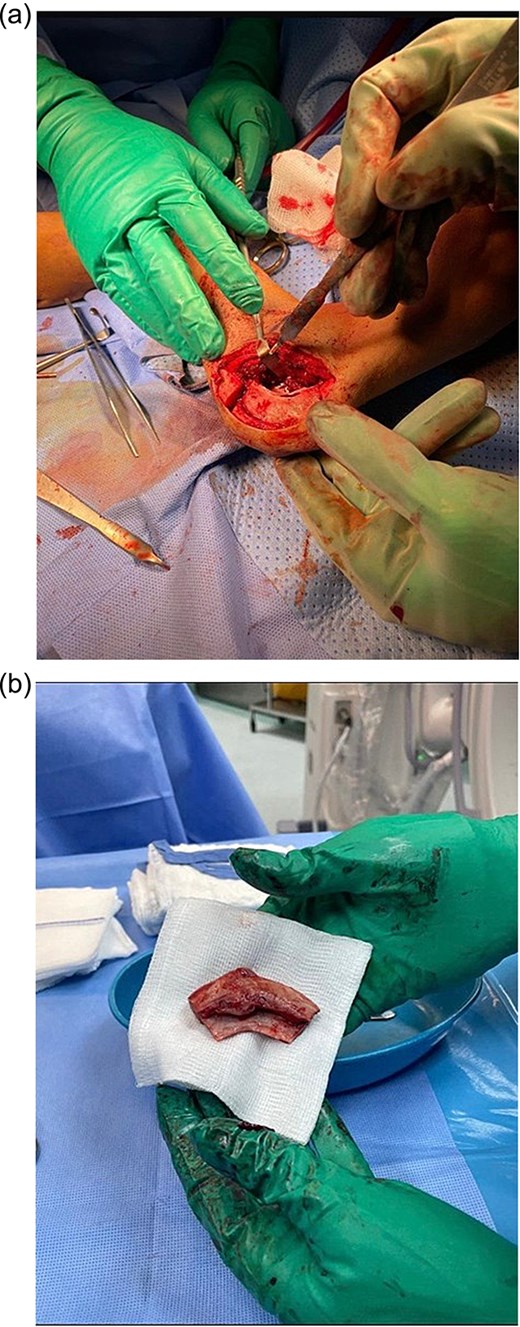
(a) Intraoperative image showing exposure of the left tibial shaft through a medial approach. The apex of the procurvatum deformity is visualized, and a two-level osteotomy is being performed to correct the 111.4-degree angulation. (b) The excised bone segment was removed during the two-level tibia/fibula shortening osteotomy. The angular contour of the specimen reflects the severity of the preoperative deformity.
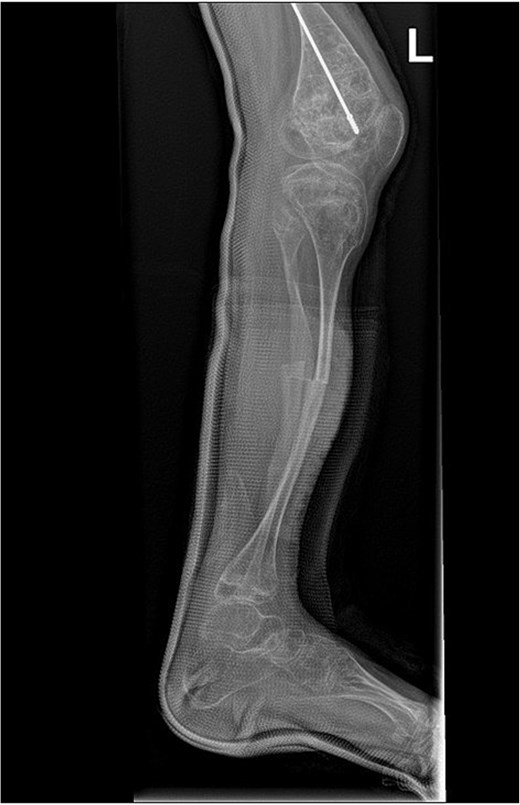
Immediate postoperative lateral radiograph of the left leg demonstrating restored alignment following two-level shortening osteotomies and internal fixation.
At follow-up, radiographs demonstrated sustained correction with a residual procurvatum angle of 23.4° and no neurovascular compromise (Fig. 4a and b). His LEFS improved to 70/80, reflecting a 32-point gain and substantial functional recovery. Although follow-up remains short-term, the outcome highlights the value of individualized surgical planning and multidisciplinary support in severe OI.
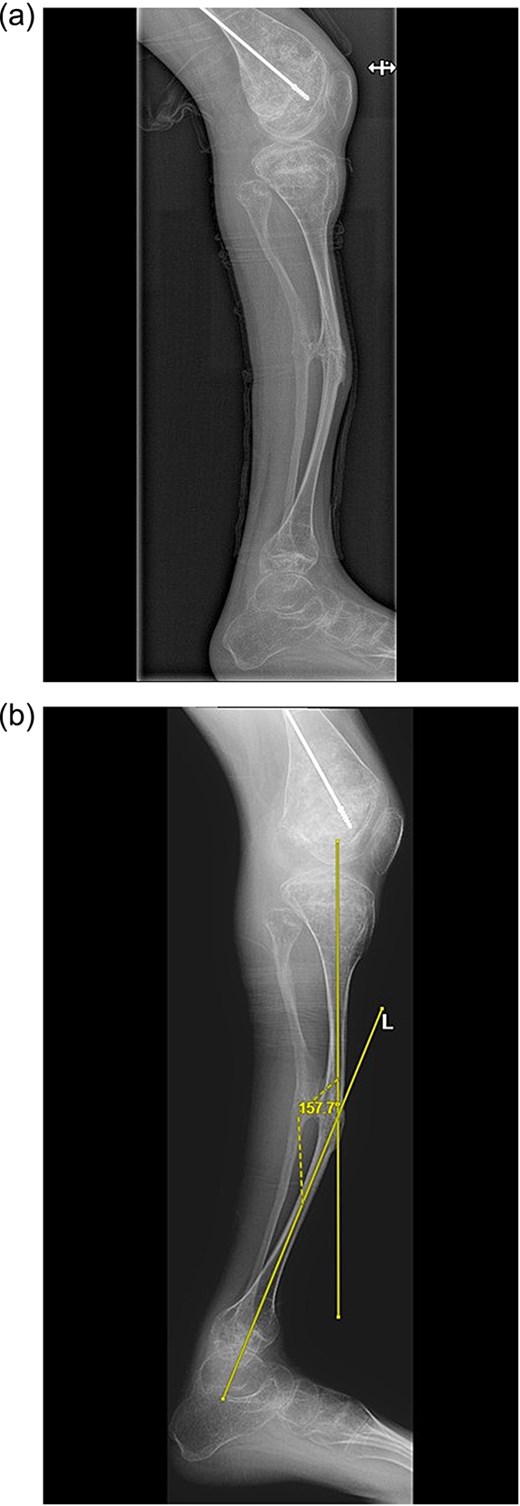
(a) Follow-up lateral radiograph of the left leg taken in 2025, demonstrating maintained alignment and implant stability. There is no evidence of deformity recurrence, and progressive bone healing is observed at the osteotomy sites. (b) Lateral radiograph from the 2025 follow-up shows maintained alignment and stable fixation, with a residual anterior angulation of 22.3°, indicating substantial correction from the preoperative deformity.
Discussion
This case highlights the complexity of managing advanced skeletal deformities in a child with type III OI. The patient presented with a rare and severe 111.4-degree tibial procurvatum deformity, accompanied by multiple recurrent femoral fractures requiring multistage orthopedic intervention. His treatment, which involved corrective osteotomies and intramedullary nail revision, illustrates the importance of individualized, staged surgical planning in severe pediatric OI.
Severe tibial procurvatum is a recognized manifestation in children with OI, with reported cases describing marked anterior tibial bowing commonly associated with recurrent fractures and functional impairment [4, 5]. These deformities are especially prevalent in type III OI, where early-life fractures often lead to complex, multilevel angular deformities [5–9]. Some presentations include combinations of angular and rotational deformities across several long bones and, in certain cases, may be associated with uncommon genetic variants, further complicating diagnosis and management [9, 10]. Such patients frequently require meticulous preoperative planning, typically involving multilevel osteotomies and intramedullary fixation [9].
Multilevel osteotomy with intramedullary stabilization is a widely adopted strategy for correcting severe long-bone deformities in type III OI. Evidence from case reports and small series supports the use of osteotomies at the apex of each deformity, followed by stabilization with intramedullary devices to restore alignment and promote safe ambulation [6, 11, 12]. For tibial deformities, both external fixation and internal devices have demonstrated success, with flexible systems such as TENS enabling early postoperative mobilization [13]. The FD telescopic rod is particularly favored in growing children, as it accommodates limb growth and reduces the need for repeated surgeries. Studies consistently show improved alignment and fewer complications with telescopic nails compared with static implants [12].
Despite advancements, refracture and implant-related complications remain significant challenges. Reported revision rates range from 30% to 50%, with re-revision occurring in up to one-third of cases [11–14]. Telescopic rods such as the FD nail offer reduced complication rates but still require long-term surveillance due to risks of migration, disengagement, and refracture [15]. This underscores the necessity for individualized surgical strategies and vigilant follow-up in managing severe deformities in OI [5].
Conclusion
This case illustrates the severity and complexity of skeletal deformities in type III OI and the demanding surgical journey these patients often face. The presence of a 111.4-degree tibial procurvatum deformity, along with multiple femoral fractures, required a carefully staged surgical approach using multilevel osteotomies and intramedullary fixation. Despite the inherent challenges posed by bone fragility, modern orthopedic techniques—particularly telescopic nails—have shown promise in improving alignment, mobility, and long-term outcomes. Our case emphasizes the importance of early intervention, multidisciplinary coordination, and personalized surgical planning in achieving meaningful functional gains in children with severe OI. Given the rarity of such deformities and the surgical strategies employed, this report adds valuable clinical evidence to the limited literature on advanced limb reconstruction in pediatric OI.
Conflicts of interest
None declared.
Funding
None declared.
References
Konadu-Yeboah D, Asante G, Okrah H et al.


