


 https://orcid.org/0009-0004-5211-7582

Abstract
Peritoneal inclusion cysts (PICs) are benign cystic lesions typically observed in women of reproductive age with prior pelvic surgery, endometriosis, or pelvic inflammatory disease. To date, no cases of PICs have been reported in transgender men in South Korea. We present the case of a 28-year-old transgender man who developed a large PIC 1.5 years after undergoing total laparoscopic hysterectomy and bilateral salpingo-oophorectomy as part of gender-affirming surgery. Ultrasound images revealed a progressively enlarging pelvic cyst, and magnetic resonance imaging findings suggested possible connection to bladder. Laparoscopic exploration identified a large, serous, fluid-filled cyst with adhesions, which was successfully excised. Histopathological examination confirmed PIC. The postoperative course was uneventful, with complete symptom resolution and no recurrence at six months. This case underscores the importance of including PIC in the differential diagnosis of pelvic masses in transgender men with a history of pelvic surgery and highlights the need for inclusive, gender-affirming care.
Introduction
Peritoneal inclusion cysts (PICs) result from the accumulation of unabsorbed peritoneal fluid or inflammatory exudates, typically occurring in the pelvic region of women of reproductive age [1, 2]. These cysts are associated with a history of abdominal surgery, pelvic inflammatory disease, or endometriosis [1, 3, 4]. Common symptoms include chronic pelvic pain, abdominal discomfort, and dyspepsia. Although benign [1, 3], PICs have a high rate of local recurrence, often requiring a wide range of treatment approaches [2, 4].
The term ‘transmen’ (transgender men) refers to individuals who identify as male despite being assigned female at birth [5]. Some individuals undergo gender-affirming surgery to alleviate gender dysphoria or to change their legal gender markers. Hysterectomy, with or without salpingo-oophorectomy, is the second most commonly performed procedure after mastectomy, and its incidence continues to increase [6].
Herein, we report a case of a PIC in a transgender man who developed the cyst following total laparoscopic hysterectomy (TLH) and bilateral salpingo-oophorectomy (BSO).
Case report
A 28-year-old transgender man presented with urinary frequency and a sensation of incomplete bladder emptying 1.5 years after undergoing TLH and BSO. He had previously consulted a family physician and an urologist regarding these symptoms; however, the exact cause remained undetermined, and his discomfort worsened. Due to distress with post-hysterectomy gynecologic exams after legal gender change, the patient sought care at a transgender-friendly medical institution. After researching inclusive healthcare providers, he presented to the gynecological clinic at our center.
Pelvic ultrasound (US) revealed a 10 cm cystic mass within the pelvic cavity (Fig. 1A). Serum tumor markers, including CA-125, CEA, LDH, and hCG, were all within normal limits. However, at a follow-up visit four months later, the patient reported worsening urinary symptoms and increasing abdominal discomfort. Repeat pelvic US revealed enlargement of the cyst to 19 cm with newly developed septations (Fig. 1B). Magnetic resonance imaging (MRI) revealed a large lobulated cystic mass with thin septa occupying pelvic cavity. The cystic contents were variably hyperintense on T2-weighted images (Fig. 2). The mass exhibited imaging characteristics suggestive of a focal connection with the bladder wall. Based on these findings, the differential diagnosis suggested by the radiologist included a PIC with a vesicocystic fistula or an urinoma secondary to bladder injury. To exclude the presence of a fistula or urinoma, the patient underwent cystoscopic evaluation, which yielded negative results.
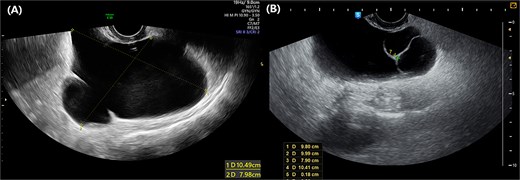
Pelvic ultrasound revealing predominantly cystic mass. (A) A 10 cm sized cystic lesion posterior to the bladder. (B) An increased sized mass with newly formed 2 mm-thick vascular septum.
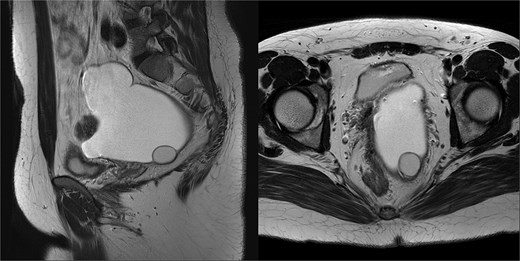
T2-weighted imaging demonstrating cystic components with various hyperintense signals.
During laparoscopic exploration, a thin peritoneal film was observed over a broad area of the posterior cul-de-sac, with severe adhesions to the sigmoid colon, vaginal vault, and right pelvic sidewall (Fig. 3A). The peritoneal film was incised and dissected, revealing a cavity of approximately 10-cm diameter containing dark-colored serous fluid. The fluid was aspirated and sent for cytological analysis. Additionally, a 1-cm cyst located in the deepest part of the posterior cul-de-sac, corresponding to the area of lower hyperintensity on T2-weighted imaging, was separately enucleated and submitted for pathological examination (Fig. 3B). Cytology results were benign. The final pathological diagnosis confirmed a PIC and an inflammatory cyst of the peritoneum.
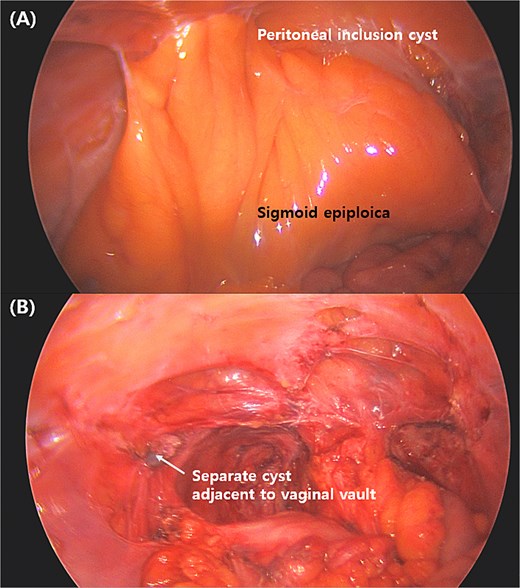
Intraoperative images showing detailed cystic structure in the posterior cul-de-sac. (A) A thin peritoneal film overlying pelvic cavity upon entering the abdomen. (B) Abdominal anatomy after draining the PIC.
The patient experienced complete resolution shortly after surgery, and no recurrence was observed on follow-up imaging at two years postoperatively.
Discussion
The etiology of PICs remains unclear, and diverse viewpoints exist regarding their pathogenesis [2–4, 7]. The most widely supported hypothesis suggests that these cysts result from reactive processes associated with intraperitoneal inflammation [3, 4, 8]. Many reported cases have been linked to prior abdominal or pelvic surgical procedures [1, 7–9]. In the absence of a history of inflammatory diseases, the PIC in this case is likely attributable to the patient’s prior TLH and BSO.
Diagnosis primarily relies on detailed medical history and imaging studies. Most patients report abdominal discomfort and the presence of a pelvic mass [1, 2]. Our patient also presented with abdominal pain and urinary symptoms due to the mass effect. Therefore, regardless of sex, healthcare providers should inquire about prior pelvic surgeries when evaluating such symptoms. US is recommended as the first-line imaging modality [1]. A characteristic feature is an anechoic cyst with multiple septations [3, 4], consistent with US findings in this case. Computed tomography and MRI can be employed for further diagnostic evaluation. However, pathological examination via biopsy remains the only definitive method for confirming a diagnosis [3, 4].
Due to the relative rarity of PICs, standardized treatment guidelines are lacking. Conservative management with hormonal agents such as gonadotropin-releasing hormone agonists, oral progestins, or levonorgestrel-releasing intrauterine devices has been reported as effective for reducing cyst size and alleviating symptoms [7–10]. Sclerotherapy and image-guided drainage are viable treatment options [11–13]. Surgical resection remains the most common therapeutic approach [8], but recurrence rates are relatively high, ranging from 30% to 50% [1, 4, 7, 9]. Hormonal agents are occasionally administered postoperatively to prevent recurrence [7, 8]. In this case, we opted for surgical resection alone, given that the patient had previously undergone bilateral oophorectomy and was receiving testosterone; additional hormone therapies were not considered due to their potential risk of exacerbating gender dysphoria.
The transgender population in South Korea continues to grow [14]. Transgender health, however, remains under-addressed in Korean healthcare. As a result, transgender individuals frequently avoid healthcare settings. Furthermore, after obtaining legal gender recognition, individuals may face additional challenges in accessing sex-specific healthcare services related to their assigned sex at birth. In this case, the patient consulted multiple specialists before receiving an accurate diagnosis, which might have been made earlier had he initially presented to a gynecologist. Such delays and fragmented care pose risks not only to individual health outcomes but also to public health. These challenges may reflect a lack of adequate training among healthcare providers in Korea to address the needs of transgender patients. Among South Korea’s 44 medical schools and graduate medical programs, only one offers a formal curriculum addressing the health needs of gender minorities [15]. These gaps highlight the need for inclusive medical education and structured clinical training programs to equip healthcare professionals with competencies required to deliver respectful and comprehensive care to transgender populations.
Acknowledgements
This research was supported by the publication fee support from the Researcher Support Project of the Public Health and Medical Research Institute of the National Medical Center. The authors would like to express their sincere gratitude for the financial support which made this publication possible.
Conflicts of interest
None declared.
Funding
None declared.


