


 https://orcid.org/0009-0003-0830-5044

Abstract
Paraneoplastic syndromes are indirect clinical manifestations of cancer, arising from immunological mechanisms or tumor-derived substances. The most common paraneoplastic syndromes associated with lung cancer are endocrine syndromes. We report the case of a 50- year-old woman with progressive ocular proptosis and orbital pain who was evaluated by multiple specialties with various diagnostic tests that did not explain her symptoms. She received immunosuppressive therapy without clinical improvement. A right paracardiac mass was subsequently identified on imaging, initially suspected to be a pericardial cyst, but prior studies over 3 years showed significant interval growth. The lesion was resected via thoracoscopic surgery, and the patient showed symptomatic improvement within a few days. Pathological results revealed a benign metastasizing leiomyoma. Given clinical presentation and postoperative evolution, a paraneoplastic mechanism is considered the most likely cause of the patient’s ocular proptosis.
Introduction
Paraneoplastic syndromes are a set of clinical manifestations caused by cancer, which are not explained by direct tumor invasion, mass effect, or metastasis, but result instead from immunological mechanisms or tumor-derived biochemical substances. They affect up to 8% of people with cancer [1]. The main types of cancer most frequently associated with paraneoplastic syndromes are lung tumors, breast cancer, gynecological, and hematological neoplasms [2]. When referring to lung tumors, endocrine syndromes are the most common ones, although patients may also present neurological, musculoskeletal, or cardiovascular syndromes, among others [3].
We report the case of a 50-year-old woman with paraneoplastic ocular proptosis secondary to a benign metastasizing leiomyoma involving the lung.
Case report
A 50-year-old woman with a medical history including hysterectomy for abnormal uterine bleeding, presented with progressive ocular proptosis for 20 months, associated with orbital pain, without any other symptoms. She was evaluated by endocrinology, orbital specialist, neurology, rheumatology, and infectious, autoimmune, and thyroid causes were excluded through appropriate testing without abnormal findings. Additionally, brain magnetic resonance imaging (MRI) was normal, and orbital MRI showed only increased retro-orbital fat. Due to persistent symptoms, treatment with betamethasone was started, without any clinical improvement.
During follow-up, an abdominal MRI was performed to evaluate a hepatic cyst and revealed a right paracardiac mass, prompting referral to the thoracic surgery department. Review of imaging over the prior 3 years showed that the lesion had initially been identified as a pericardial cyst, but it demonstrated significant interval growth and developed radiologic features consistent with a carcinoid tumor (Fig. 1).
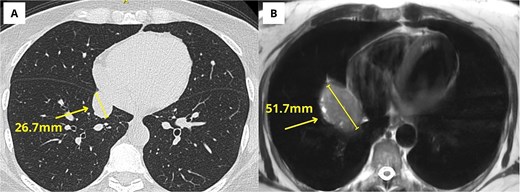
(A) Chest computed tomography from February 2022, showing a right paracardiac lesion reported as a pericardial cyst. (B) Chest MRI from July 2025 showing the same lesion as a well-defined oval mass with clear interval growth.
A right lower lobectomy with mediastinal lymph node dissection was performed via video- assisted thoracoscopic surgery without complications. Fig. 2A shows the tumor in situ and Fig. 2B shows the resected specimen. After the procedure, the patient had a favorable postoperative evolution, and the ocular proptosis began to diminish within a few days. Fig. 3A depicts an image before the surgery, and Fig. 3B demonstrates the patient’s progress 2 weeks later, with evidence of a significant decrease in ocular proptosis and improvement in the previously reported orbital pain.
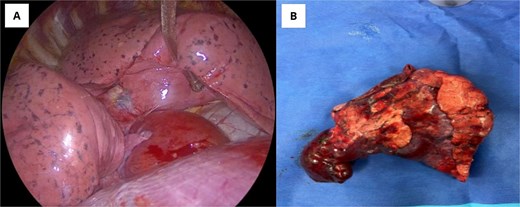
(A) Intraoperative image of the tumor in situ. (B) Resected tumor specimen.
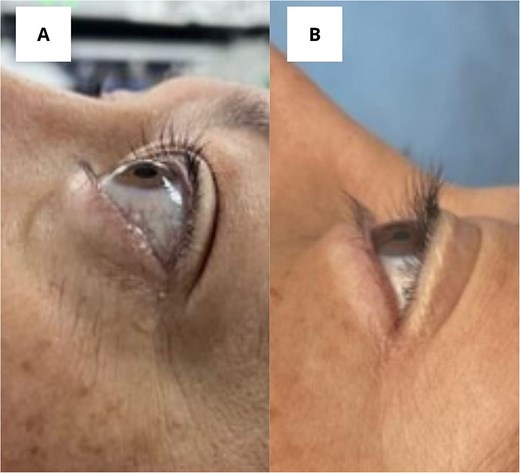
(A) Photograph taken before surgery. (B) Photograph taken 2 weeks after surgery.
Despite the initial hypothesis, histopathological analysis reported intrapulmonary involvement by a benign smooth-muscle mesenchymal neoplasm consistent with benign metastasizing leiomyoma.
Discussion
Paraneoplastic syndromes represent up to 10% of the clinical manifestations associated with lung tumors, with small-cell carcinoma being the most prevalent subtype [3, 4]. Endocrine paraneoplastic syndromes are the most frequently encountered, with humoral hypercalcemia of malignancy and the syndrome of inappropriate antidiuretic hormone secretion being the most common [4]. Nevertheless, ocular proptosis as a paraneoplastic syndrome is rare, and only six cases have been reported in the literature, six of them associated with lung tumors [5–10]. Reported lung tumors causing proptosis include pulmonary adenocarcinoma, pleomorphic carcinoma, small-cell lung cancer, and squamous cell carcinoma [5–10]. In our case, the tumor identified was a benign metastasizing leiomyoma.
Benign metastasizing leiomyoma is a rare disease characterized by the proliferation and metastasis of smooth muscle cells, usually originating from a uterine leiomyoma with metastatic growth at extra-uterine sites. It typically occurs in women with a history of uterine leiomyomas or prior hysterectomy [11]. To date, no cases have been reported in the literature describing paraneoplastic syndromes secondary to this type of tumor. The pathophysiology underlying the proptosis remains unclear, but it is believed that these cases may be caused by multiple mechanisms, such as immune cell infiltration, fibroblast proliferation, and abnormal immune activation triggered by inflammatory cytokines [9].
In all reviewed cases, ocular proptosis improved after treatment of the primary tumor. In our case, the patient had undergone an extensive diagnostic workup in an attempt to explain the ocular proptosis, as well as immunosuppressive treatment without clinical improvement. After surgical resection, the patient began to exhibit diminished ocular proptosis and orbital pain, supporting the hypothesis of a paraneoplastic syndrome as the cause of her symptoms.
Conflicts of interest
None declared.
Funding
None declared.


