


Abstract
Here we present the case of a 17-year-old male patient, affected by Asperger syndrome, who reached the emergency division of our hospital after anal insertion of some stylus batteries. Transanal extraction of 30 stylus batteries avoided surgical intervention. Lockdown and boredom due to the strict domestic quarantine policies adopted during COVID-19 pandemic might have unmasked in our patient a susceptibility to unhealthy behaviour.
INTRODUCTION
Stay-at-home orders due to COVID-19 pandemic forced all of us to experience a critical time. The adverse psychological effects related to the lockdown might reveal a susceptibility to unhealthy behaviour in subjects with mental disorders. This probably happened to our 17-year-old male patient affected by Asperger syndrome and without previous episodes of oral ingestion/anal insertion of foreign bodies. He reached the emergency division of our hospital after anal insertion of 30 stylus batteries.
CASE REPORT
In May 2020, a 17-year-old male patient affected by Asperger syndrome reached the emergency division of our hospital with abdominal pain. He referred anal insertion of some stylus batteries 2 hours before admission. No previous episodes of unhealthy behaviour (such as oral ingestion/anal insertion of foreign bodies) had been manifested in his lifetime, apparently.
At hospitalization, the clinical examination revealed moderate pain in the lower left part of the abdomen. Laboratory analyses demonstrated moderate neutrophilic leukocytosis. Abdominal X-rays revealed the presence of many radiopaque foreign bodies on the projection of the rectum, referable to stylus batteries (Figs 1 and 2).
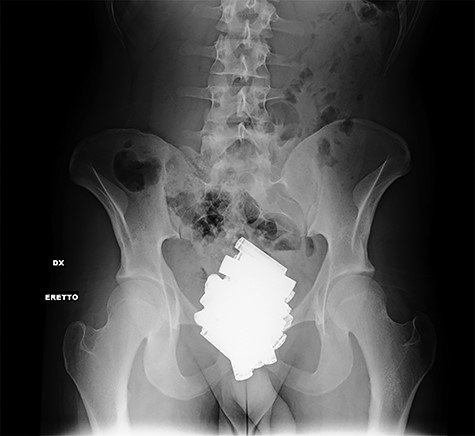
Erect abdominal X-rays (frontal view): presence of many radiopaque foreign bodies in the pelvis
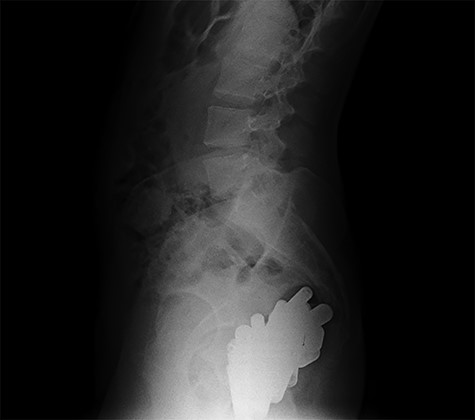
Erect abdominal X-rays (lateral view): confirmation of the presence of many radiopaque foreign bodies in the pelvis
The patient underwent to transanal extraction under pharmacological sedation, partly through digital removal and partly through endoscopic removal. In total, 30 stylus batteries were extracted (total weight: ∼2 pounds).
The subsequent abdominal X-rays demonstrated the complete absence of further foreign bodies (Fig. 3).
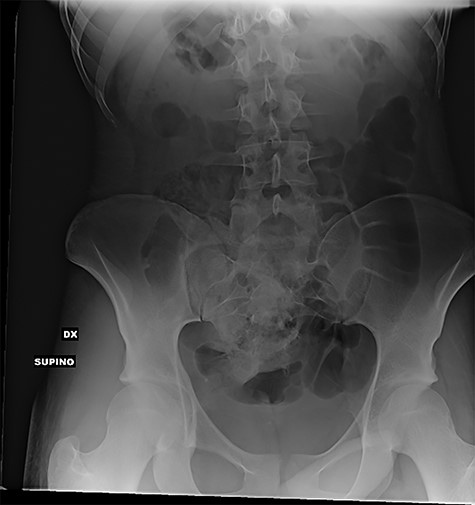
Supine abdominal X-rays (frontal view): absence of pelvic radiopaque foreign bodies at the end of the procedure
The patient had an uneventful clinical course and was discharged the day after.
DISCUSSION
People with mental disorders may be particularly vulnerable to the psychological stress associated with the COVID-19 pandemic [1]. The disease not only affects the physical health of people, but also their psychological health. The strict domestic quarantine policies adopted to control the transmission of COVID-19 might have adverse psychological effects and might exacerbate pre-existing conditions such as depression and anxiety, especially in people with mental disorders [2, 3]. Lockdown and boredom may unmask a susceptibility to unhealthy behaviour. In fact, it is well described by psychiatrists, a short-time deterioration and improvement at the symptomatic level in patients with depression, anxiety and obsessive-compulsive disorders [3]. Recent findings about the levels of stress or anxiety in response to the COVID 19 are similar to those reported during previous pandemic (such as SARS and 2009 H1N1 pandemic), highlighting that anxiety is an important driver of behaviour [4–7].
Our patient is affected by Asperger syndrome, a subtype of autism spectrum disorders characterized by significant problems in social interaction and non-verbal communication, restricted and repetitive forms of behaviour and interests [8]. No previous episodes of unhealthy behaviour had been manifested in his lifetime. Transanal extraction of 30 stylus batteries avoided surgical intervention. In our opinion, isolation and loneliness due to quarantine measures may have exacerbated the mental illness and triggered the unhealthy behaviour. Two months after the episode, we investigated our patient about his stress responses related to the pandemic using the 36-item COVID Stress Scale [4]. The results suggested that he exhibits fear and anxiety-related distress responses to the pandemic, corroborating our hypothesis.
In conclusion, the early intervention and careful vigilance for signs of psychiatric illness is very important in this critical time [9], with implementation and optimization of the departments of mental health [10].
CONFLICT OF INTEREST STATEMENT
None declared.
FUNDING
None.


