


Abstract
This report describes a rare severe tissue reaction, as demonstrated in clinical photographs, to nylon sutures and illustrates how simple immediate removal of sutures isolates the irritant stimulus and results in rapid resolution, without the risk, cost and inconvenience of antibiotic treatment.
INTRODUCTION
Ethilon® Nylon suture is a non-absorbable, monofilament, synthetic suture that is commonly used for cutaneous wound closure. It is popular among surgeons because of its high tensile strength, low tissue reactivity and good elasticity [1, 2]. To date, there has been no adverse tissue reaction reported.
CASE REPORT
A 57-year-old man presented to our plastic surgery service with a clinically suspicious basal cell carcinoma to his left forehead. He was otherwise healthy with no known medical history or any drug allergy. An excision with immediate H-flap reconstruction was performed under local anaesthesia. Wound closure included 5/0 Poliglecaprone 25 (Monocryl) to dermis and 5/0 Nylon (Ethilon) to skin. Surgery was uneventful and the patient returned for routine follow-up 1 week after. At 1 week post-surgery, the patient appeared to have developed an adverse tissue reaction with intense localized erythema surrounding each Nylon suture track (Fig. 1). Despite this, the patient was asymptomatic with no other indicators of infection present. Immediate suture removal was performed and a further 1 week follow up review was arranged. One week following suture removal, the wound had healed very well and the inflammatory tissue reaction to Nylon had settled considerably without further intervention (Fig. 2).
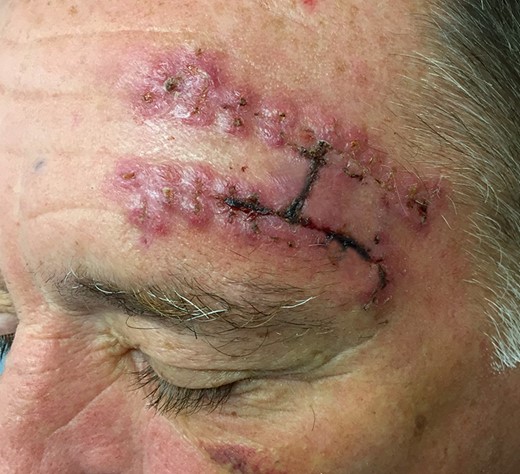
At 1 week post-surgery, the patient appeared to have developed an adverse tissue reaction with intense localized erythema surrounding each Nylon suture tract.
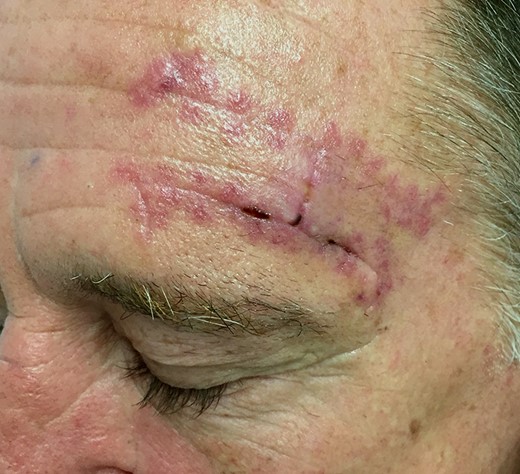
At 1 week after Nylon sutures removal, the tissue reaction had settled considerably without further intervention.
DISCUSSION
Nylon sutures are used extensively across all surgical specialties. A search of the literature revealed no reports of adverse cutaneous reaction to nylon sutures, although it is possible that it is more commonly misdiagnosed and treated as infection. A number of cases of reaction to nylon sutures were documented in the early 1990s in ophthalmic surgery [3, 4], raising the possibility that eye tissue may be more susceptible to this type of inflammatory response.
This patient was affected with a rare severe inflammatory reaction to nylon sutures. This case illustrates how simple immediate removal of sutures isolates the irritant stimulus and results in rapid resolution, without the risk, cost and inconvenience of antibiotic treatment.
CONFLICT OF INTEREST STATEMENT
None.
FUNDING
None.
ETHICAL APPROVAL
Not applicable.
INFORMED CONSENT
Obtained. Patient has given a written consent for photographs to be taken and be used for publications.


