


Abstract
Caesarean wound dehiscence that is severe enough to result in bowel herniation is exceptionally rare. This case describes a woman who experienced wound dehiscence following each of her two Caesarean sections, with bowel herniation present in the second case. The contribution of her comorbid hidradenitis suppurativa will be discussed.
INTRODUCTION
Wound dehiscence is an inconvenient but known complication of surgery, particularly in the case of Caesarean sections. However, the recurrence of significant wound dehiscence following successive Caesarean sections, as described in the case below, suggests an underlying comorbidity.
CASE REPORT
A 33-year-old woman was booked for an elective repeat Caesarean section (LSCS) at a large rural hospital. She had gestational diabetes, for which she required 16 units of insulin per day. Her body mass index (BMI) was 35 kg/m2 at booking and she smoked 10–15 cigarettes daily. Her antenatal course was otherwise unremarkable. She had good general health, apart from a diagnosis of hidradenitis suppurativa (HS; a chronic suppurative condition) eight years prior. She had experienced multiple lesions on her axilla, inguinal region and buttocks and had been treated with numerous courses of antibiotics and wide local excisions. However, she had no lesions at the time of LSCS.
The woman's first pregnancy (7 years prior) was complicated by preeclampsia and she required an emergency LSCS for failure to progress after being induced at 38 weeks of gestation. Three months after that LSCS the wound began to dehisce and suppurate. She was treated with oral antibiotics in conjunction with community wound care nursing and had satisfactory resolution of the wound after 2 years.
The woman presented for her elective repeat LSCS as booked. The operation was uncomplicated, with a 3.2-kg male delivered in good condition. The woman's rectus sheath was repaired with 1/0 vicryl and skin closed with subcuticular 3/0 monocryl. Due to the outcome of her previous LSCS, the surgery was performed by a senior obstetrics and gynaecology consultant and the woman was commenced on prophylactic intravenous antibiotics.
On Day 4 postpartum, wound dehiscence was noted. There were no clinical signs of infection, wound swab cultures grew normal skin flora only and blood tests (including inflammatory markers) were normal. On Day 5 postpartum however, she experienced nausea and vomiting. An ultrasound of her abdomen and pelvis was therefore ordered. This revealed a large defect on the anterior abdominal wall with small bowel herniation adjacent to the skin (see Fig. 1).
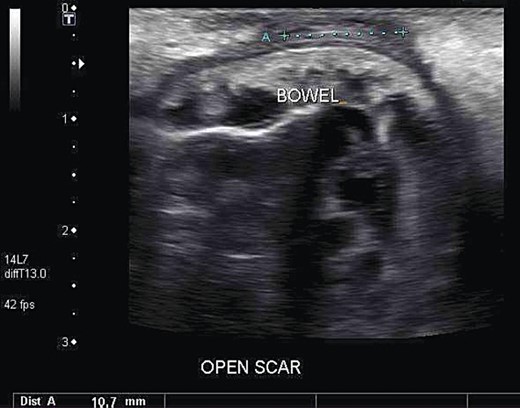
Ultrasound of the patient's abdominal wall, revealing a large defect with small bowel herniation adjacent to the skin.
The woman was returned to theatres the same day and the wound explored. The rectus sheath incision was found to be dehisced, with small bowel ‘floating’ under the skin (see Fig. 2). The bowel was replaced and sheath repaired using 2/0 vicryl. The skin was closed with interrupted mattress sutures using 1/0 vicryl.
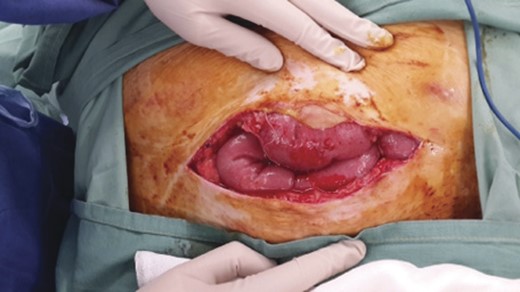
Dehiscence of the rectus sheath, resulting in small bowel herniation.
The woman recovered well and was discharged home on Day 10 postpartum. At the time of writing, she had not experienced any further complications.
DISCUSSION
Wound infection after Caesarean section occurs in 9.6% of women [1] Increased BMI [2], smoking and emergency surgery have been associated with increased rates of wound infection [3]. There is an ongoing debate as to whether skin closure with subcuticular sutures is superior to staples in reducing infections [4, 5].
Pfannenstiel wound dehiscence resulting in bowel herniation is exceedingly uncommon. In a retrospective study of 300 women who underwent gynaecological surgery, the incidence of incisional hernias after Pfannenstiel incision alone was zero [3]. In women undergoing Caesarean section, the rarity of herniation may also be due to the fact that the recently gravid uterus sits under the wound, shielding the bowel from the incision site.
In this woman's case, the recurrence of dehiscence, despite prophylactic antibiotics following her second LSCS, suggests that her comorbid HS was a contributing factor to her wound complications.
HS is a debilitating, chronic suppurative condition that affects 1% of the population, with a 3:1 female preponderance. The hallmark features are recurrent suppurative abscess and sinus formation in the inguino-perineal region. It has a predilection for areas where apocrine sweat glands occur and has been observed on submammary skin and in the axillary, gluteal and periumbilical regions. The exact pathology is unknown; however, blockage of sweat glands and hyperkeratosis of the epithelium have been observed in histological specimens. Secondary infection with skin commensals may occur due to suppuration. Treatment ranges from topical or oral antibiotics, anti-androgens, smoking cessation and weight loss (for mild disease) to oral retinoids, immunosuppressants and wide local excision (for severe cases) [6].
Wound dehiscence and/or infection after surgical excision of HS lesions is common, particularly in the perianal, perineal and gluteal regions [7]. However, HS has not been described on the lower abdomen where a Pfannenstiel incision would be made. Additionally, a search of the literature combining the terms ‘hidradenitis suppurativa’ and ‘Caesarean section’ or ‘Pfannenstiel’ yielded zero articles [8]. Despite the lack of precedence in the literature, it may not be unreasonable to conclude that HS contributed to this woman's wound complications following Caesarean section.
The prolonged wound healing, suppuration and wound dehiscence experienced following her first LSCS, combined with the recurrence of dehiscence despite prophylactic antibiotics following her second LSCS makes this woman's case very unusual. Although the woman's high BMI and cigarette smoking were risk factors for wound dehiscence, the recurrence also suggests that, despite lack of precedence in the literature, HS was a contributing factor in this woman's wound complications.


