


 https://orcid.org/0009-0006-9757-7894

Abstract
The Kawashima procedure is a variant of the bidirectional Glenn used in patients with interrupted inferior vena cava (IVC) and azygos continuation, though optimal timing and the role of fenestration remain debated. We report a 5-month-old boy with functional single ventricle physiology, transposition of the great arteries, pulmonary valve atresia with ventricular septal defect, interrupted IVC with azygos continuation, and bilateral superior vena cavae, who presented with cyanosis and failure to thrive. Imaging confirmed complex venous anomalies with hepatic venous drainage directly into the right atrium. The patient underwent a Kawashima procedure without fenestration, with stable postoperative hemodynamics, improved oxygen saturation, and an uncomplicated recovery. This case demonstrates that early Kawashima without fenestration is feasible in carefully selected infants, although exclusion of hepatic venous flow may predispose to pulmonary arteriovenous malformations, necessitating eventual Fontan completion. Favorable outcomes can be achieved in resource-limited settings with appropriate patient selection and multidisciplinary care.
Introduction
Interrupted inferior vena cava (IVC) with azygos continuation is a rare congenital venous anomaly that is frequently associated with complex congenital heart disease, particularly functional single ventricle physiology. In this condition, the hepatic segment of the IVC is absent, and venous return from the lower body bypasses the liver via the azygos system into the superior vena cava (SVC), while hepatic veins drain directly into the right atrium, resulting in unique hemodynamic and surgical considerations (Fig. 1) [1, 2].
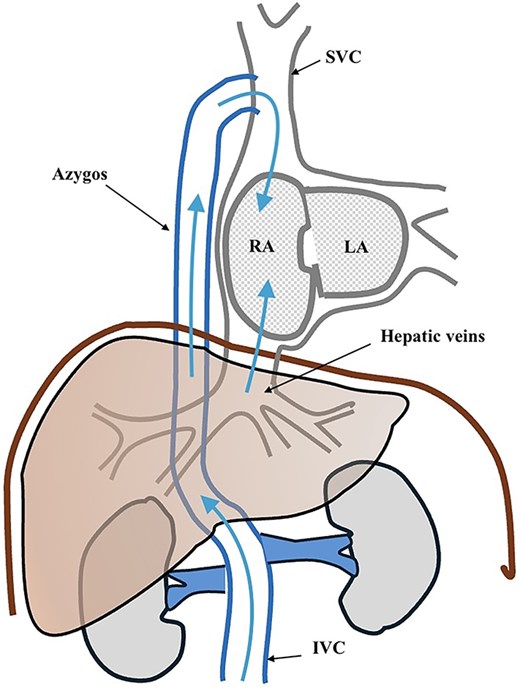
Schematic illustration of an interrupted IVC with azygos continuation from the suprarenal segment to the right SVC. The hepatic veins drain directly into the RA. A secundum atrial septal defect is present. LA, left atrium; RA, right atrium; SVC, superior vena cava.
The Kawashima procedure is specifically designed for patients with interrupted IVC and azygos continuation [3, 4]. This procedure effectively directs most systemic venous blood to the pulmonary circulation without passing through the heart. As hepatic venous flow bypasses the pulmonary circulation, incomplete perfusion predisposes to pulmonary arteriovenous malformations (PAVMs) over time [5].
The optimal timing of the Kawashima procedure and the role of fenestration remain subjects of ongoing debate. While the procedure is typically performed in early childhood as a staged approach toward Fontan completion, its application in younger infants is less well established [6–9]. In addition, whether fenestration is necessary to mitigate postoperative hemodynamic instability is still controversial, particularly in patients with favorable anatomy and ventricular function [10].
Here, we report a case of a 5-month-old infant with complex single ventricle physiology and interrupted IVC with azygos continuation who successfully underwent a Kawashima procedure without fenestration. This case demonstrates the feasibility of early surgical intervention and contributes to the ongoing discussion regarding optimal timing and operative strategy in this uncommon anatomical setting. It also underscores that favorable outcomes can be achieved in resource-limited settings, where access to advanced perioperative support may be constrained.
Case presentation
A 5-month-old male infant presented with progressive respiratory distress during feeding, cyanosis, and poor weight gain. Examination showed mild respiratory distress, low weight (4.7 kg, 60 cm), and oxygen saturation of 78% on room air.
Transthoracic echocardiography revealed complex congenital heart disease characterized by atrioventricular and ventriculoarterial discordance consistent with transposition physiology. There was pulmonary valve atresia with hypoplasia of the pulmonary valve and annulus. A large subarterial ventricular septal defect measuring ~14–15 mm was identified, along with a secundum atrial septal defect and a patent ductus arteriosus. An anomaly of the IVC was also suspected based on imaging findings. Further evaluation with contrast-enhanced computed tomography (CECT) of the chest and abdomen demonstrated the presence of a persistent left SVC and an interrupted IVC. A markedly dilated azygos vein was noted, continuing from the suprarenal segment of the IVC and draining into the SVC (Fig. 2A). Additionally, the hepatic veins were observed to drain directly into the right atrium (Fig. 2B). Cardiac catheterization confirmed the presence of an interrupted IVC with azygos continuation (Fig. 3).
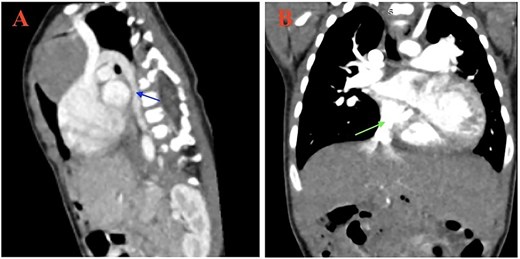
CECT of the chest and abdomen demonstrates an interrupted IVC with azygos continuation. (A) A dilated azygos vein arising from the IVC and draining into the SVC. (B) Hepatic veins draining directly into the right atrium.
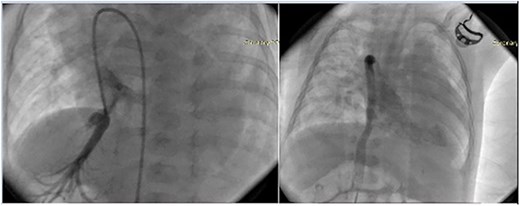
Cardiac catheterization image demonstrating interruption of the IVC with azygos continuation.
Based on the comprehensive clinical and imaging findings, the patient was diagnosed with functional single ventricle physiology associated with transposition of the great arteries, pulmonary valve atresia without ventricular septal defect, interrupted IVC with azygos continuation, secundum atrial septal defect, patent ductus arteriosus, and persistent left SVC.
The patient underwent a Kawashima procedure, which involved end-to-side anastomosis of both the right and left SVC to their respective pulmonary arteries. The operation was performed with cardiopulmonary bypass support without cardiac arrest. The total operative time was ~5 h, and the duration of cardiopulmonary bypass was 190 min.
The postoperative course was uneventful. The patient required mechanical ventilation for 48 h and remained in the intensive care unit for 166 h. Hemodynamic status remained stable throughout recovery, with improvement in oxygen saturation and no evidence of venous congestion, thrombosis, or low cardiac output syndrome. The patient was discharged in stable condition on postoperative Day 17.
Discussion
In the present case, the patient underwent a Kawashima procedure at 5 months of age, which is relatively early compared with the timing commonly reported in the literature [5, 7, 9]. A fundamental physiologic requirement for any cavopulmonary connection is a sufficiently low pulmonary vascular resistance to permit passive pulmonary blood flow [11, 12]. Recent studies suggest that earlier intervention may be feasible in carefully selected patients with favorable pulmonary artery anatomy and preserved ventricular function. Importantly, it has not been associated with increased mortality; rather, some reports suggest a trend toward improved long-term survival, possibly due to earlier unloading of the single ventricle [6–8]. Our case supports this approach, demonstrating stable hemodynamics and satisfactory early postoperative outcomes despite the young age at intervention.
Another important consideration is the role of fenestration during cavopulmonary connection. Fenestration is sometimes employed to decompress the venous system and reduce the risk of elevated central venous pressure and low cardiac output syndrome in the early postoperative period [10]. However, it may also result in persistent right-to-left shunting and lower arterial oxygen saturation. In this patient, the procedure was performed without fenestration, and the postoperative course remained uneventful, suggesting that fenestration may not be necessary in carefully selected cases with adequate hemodynamic reserve.
A well-recognized limitation of the Kawashima circulation is the exclusion of hepatic venous blood from the pulmonary circulation, which has been associated with the development of hypoxemia and PAVMs over time [5, 13]. Therefore, the Kawashima procedure should be considered a transitional stage rather than definitive palliation, and timely completion of the Fontan circulation, incorporating hepatic venous return into the pulmonary arteries, is essential to prevent long-term complications [5].
Despite the favorable early outcome observed in this case, long-term follow-up is necessary to monitor for the development of PAVMs and other complications associated with single ventricle physiology. The lack of extended follow-up represents a limitation of this report. Nevertheless, this case contributes to the growing body of evidence supporting the feasibility of the early Kawashima procedure without fenestration in selected patients.
Conclusion
The Kawashima procedure can be safely performed in selected infants with interrupted IVC and complex single-ventricle physiology, even at an early age, without fenestration. Favorable early outcomes in this case support the feasibility of this approach when appropriate patient selection is applied.
Author contributions
L.T.K.V. and L.D.T. were involved in data collection and management. L.T.K.V. and L.D.T. were involved in manuscript writing. All authors have read and approved the final version of manuscript and had full access to all the data in the study.
Conflicts of interest
The authors declare that there are no conflicts of interest.
Funding
The authors declare that they have no funding.
Informed consent
Written informed consent was obtained from the parents for publication of their personal and clinical details along with any identifying images.


