


 https://orcid.org/0000-0001-7014-7233

Abstract
Mediastinal esophageal duplication cysts are rare congenital foregut malformations that may cause respiratory symptoms due to airway compression. Excision is recommended once a diagnosis is made to prevent infection, bleeding, or rupture. We report two boys with recurrent wheeze/stridor or chronic cough; contrast-enhanced chest computed tomography showed paraesophageal cysts (20–30 mm) in the right posterior mediastinum. Both underwent thoracoscopic resection using a three-port approach with low-pressure CO₂ insufflation. Operative time was ~120 min with minimal blood loss (~10 mL). One infant had a small esophageal mucosal injury that was repaired intraoperatively; oral feeding resumed after a negative contrast study on postoperative day 5. The other patient resumed oral intake on postoperative day 1. They were discharged within 7 days and remained recurrence-free at 12 months. Thoracoscopic excision is feasible, safe, and cosmetically favorable in children. We highlight critical technical considerations in preventing, managing esophageal mucosal injury, and optimizing postoperative feeding.
Introduction
Esophageal duplication cysts are uncommon congenital anomalies arising from abnormal foregut development [1, 2]. They account for a small proportion of gastrointestinal duplications and most frequently occur in the posterior mediastinum [1, 2]. Typically, the cyst shares a muscular wall with the adjacent esophagus but does not communicate with the esophageal lumen [1]. Many patients are asymptomatic, and lesions are discovered incidentally; however, cyst enlargement or an unfavorable location can lead to airway or esophageal compression and manifest as wheeze, stridor, recurrent pneumonia, chronic cough, dysphagia, retrosternal pain, hemoptysis, or infection [3, 4]. Surgical excision is generally recommended once diagnosed—whether symptomatic or not—to prevent future complications and to establish a definitive diagnosis [1, 2]. With increasing experience in minimally invasive pediatric surgery, thoracoscopic resection has become an attractive alternative to thoracotomy for benign mediastinal lesions [5]. We describe two pediatric patients with mediastinal esophageal duplication cysts successfully treated using thoracoscopic excision, highlighting perioperative outcomes and technical considerations. Despite increasing adoption of thoracoscopic approaches, there remains limited practical guidance on intraoperative risk management and postoperative care in pediatric patients, particularly in infants.
Case series
Patient 1
A 10-month-old boy presented with recurrent wheeze, intermittent stridor, and repeated episodes of pneumonia. Physical examination between episodes was unremarkable. Contrast-enhanced chest computed tomography (CT) demonstrated a well-circumscribed cystic lesion adjacent to the upper–mid thoracic esophagus in the right posterior mediastinum, measuring ~20–30 mm (Fig. 1). The imaging appearance suggested a benign foregut duplication cyst, and thoracoscopic resection was planned.
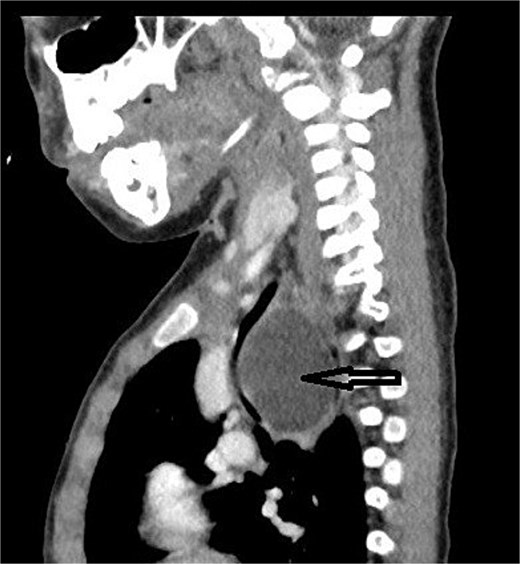
Mediastinal esophageal duplication cyst on CT. Source: Children’s Hospital No. 2.
Patient 2
A 13-year-old boy was evaluated for a chronic cough persisting for 1 year, refractory to medical treatment. Contrast-enhanced chest CT revealed a paraesophageal cystic mass in the right posterior mediastinum, contiguous with the upper–mid thoracic esophagus and of similar size (~20–30 mm). Given persistent symptoms and the potential for future complications, thoracoscopic excision was indicated.
Operative technique
Both procedures were performed under general anesthesia. Patients were positioned in lateral decubitus. A three-port technique was used: a 5-mm camera port placed below the scapular tip and two 3- or 5-mm working ports in the 6th–7th intercostal spaces along the anterior and posterior axillary lines (Fig. 2). Low-pressure CO₂ insufflation (~4 mmHg) aided lung collapse and exposure [5].
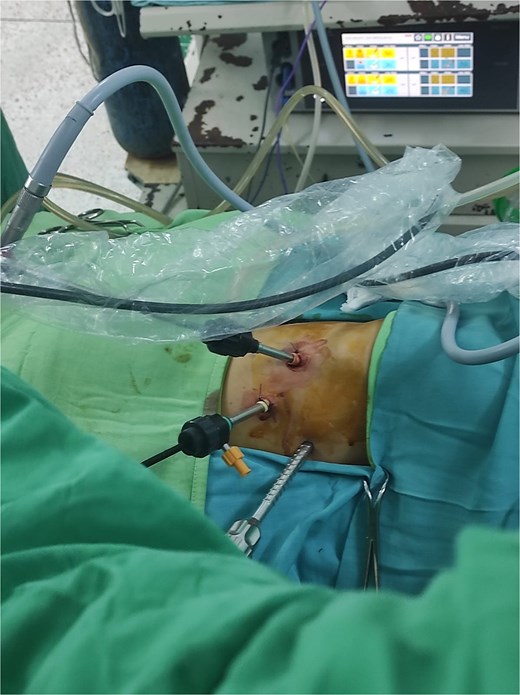
Trocar placement for video-assisted thoracoscopic surgery (VATS) in resection of a mediastinal esophageal duplication cyst. Source: Children’s Hospital No. 2.
Intraoperatively, the cysts were identified in the right posterior mediastinum and assessed for adhesions and for their relationship to the esophagus, airway, azygos vein, and vagus nerve. Dissection was performed with gentle traction and sharp/blunt separation of the cyst wall from surrounding tissues. Particular attention was paid to the shared esophageal wall during enucleation. After cyst removal, the esophageal muscular defect created by dissection was re-approximated with interrupted absorbable sutures to reduce the risk of pseudo-diverticulum. The operative field was inspected for air leak or injury to the esophagus or tracheobronchial tree. Specimens were retrieved in an endoscopic bag and sent for histopathology. Port sites were closed in layers. The most critical step is safe dissection along the shared esophageal wall, particularly in infants where tissue planes are fragile.
Perioperative outcomes
In both cases, operative time was ~120 min and estimated blood loss was minimal (~10 mL). Patient 1 sustained a small esophageal mucosal injury during cyst dissection; this was repaired intraoperatively, and a pleural drain was placed. Postoperatively, the infant received antibiotics and was kept nil per os until assessment. A contrast esophagogram on postoperative day 5 demonstrated no leak, after which oral feeding was restarted [6]. He was discharged on postoperative day 7 without further events. Patient 2 had no intraoperative complications; oral intake was resumed on postoperative day 1 and he was discharged on postoperative day 4. Both patients had small thoracic port-site scars with good cosmetic results.
Histopathology and follow-up
Histopathology in both cases demonstrated features consistent with esophageal duplication cysts, including lining by ciliated columnar epithelium. At 12 months of follow-up, neither patient showed recurrence, esophageal stricture, pseudo-diverticulum, or late thoracic wall complications.
Discussion
Mediastinal esophageal duplication cysts arise from disturbances in early foregut development (typically during weeks 3–4 of gestation) [1]. Proposed embryologic mechanisms include persistence of embryonic diverticula, aberrant recanalization of the primitive foregut, and split notochord phenomena [1]. Most lesions are cystic and are located in the posterior mediastinum, often on the right side [2]. Clinical presentation varies with age, cyst size, and anatomic relationships. Respiratory manifestations are common in infants and young children because even modest compression can narrow the airway; older children may present with chronic cough, chest discomfort, or dysphagia, or may remain asymptomatic [3, 4].
Preoperative diagnosis may be difficult because mediastinal cystic lesions share imaging features with bronchogenic cysts, pericardial cysts, cystic teratomas, and congenital pulmonary airway malformations [1]. Contrast-enhanced CT is widely available and usually defines the cystic nature of the mass and its relationship to the esophagus and airway, facilitating operative planning [1, 5]. Magnetic resonance imaging can further characterize cyst content and may help distinguish foregut duplication cysts from other cystic entities when uncertainty persists [1]. Ultimately, definitive diagnosis relies on histopathology. Classic criteria include attachment to or incorporation within the esophageal wall, a double-layer smooth muscle coat, and an epithelial lining that may be squamous, cuboidal, columnar, pseudostratified, or ciliated [1].
Complete excision remains the standard treatment [1]. Although surgery is clearly indicated in symptomatic patients, many authors advocate resection for incidentally discovered cysts to prevent infection, hemorrhage, rupture, and, very rarely, malignant transformation, and to avoid increasing technical difficulty due to inflammation or adhesions over time [1, 2]. Historically, thoracotomy was the conventional approach. However, thoracoscopic techniques have gained acceptance for benign mediastinal lesions in children, offering reduced postoperative pain, less chest wall trauma, faster recovery, and improved cosmesis compared with open surgery [5].
The principal technical challenge is safe dissection along the shared esophageal wall. Esophageal mucosal injury remains a significant intraoperative risk, particularly in infants, where tissue planes are delicate. Early recognition and immediate repair are essential to prevent postoperative leakage. In our case, prompt intraoperative repair combined with a cautious postoperative strategy resulted in an uneventful recovery. Mucosal injury is a recognized risk, particularly in infants where tissue planes are delicate and the working space is limited [6–8]. Early recognition and primary repair are crucial [6]. In our infant case, intraoperative repair and a cautious postoperative pathway—temporary drainage and delayed feeding after a negative contrast study—resulted in an uneventful recovery. This also underscores the importance of tailoring postoperative feeding strategies based on intraoperative findings, particularly when mucosal integrity is compromised. Re-approximation of the esophageal muscular layer after cyst enucleation is also important to reduce the risk of pseudo-diverticulum and subsequent symptoms [1]. In both patients, 12-month follow-up revealed no recurrence or late sequelae, supporting the safety and effectiveness of thoracoscopic excision in this setting [5].
Conclusion
Thoracoscopic resection of esophageal duplication cysts in children is effective, but requires meticulous dissection to avoid mucosal injury. Intraoperative recognition and tailored postoperative management, particularly regarding feeding, are key determinants of successful outcomes.
Acknowledgements
We are deeply grateful to Can Tho University of Medicine and Pharmacy, Director of Nam Can Tho University, and Children’s Hospital 2 for their support and facilitation, which enabled us to complete this paper.
Author contributions
VTN conceived the report, performed the surgeries, collected data, and HTV drafted the manuscript. All authors reviewed and approved the final version.
Conflicts of interest
The authors declare no competing interest.
Funding information
None declared.
Data availability
Data supporting the findings are available from the corresponding author upon reasonable request.
Consent of patient
Written informed consent was obtained from the patient for publication of this case report and accompanying images.


