


 https://orcid.org/0000-0002-4341-919X

Abstract
Trichobezoars are rare intragastric masses composed of ingested hair, most commonly affecting young females with underlying psychiatric conditions. Rapunzel syndrome is a rare variant characterized by extension beyond the stomach into the small intestine. We report the case of a 27-year-old female with a 6-month history of abdominal pain, vomiting, weight loss, and intolerance to oral intake. Endoscopy revealed a large gastric trichobezoar occupying ~90% of the gastric lumen, causing functional pyloric obstruction. Contrast-enhanced computed tomography demonstrated marked gastric and proximal duodenal dilation with imaging features suggestive of secondary superior mesenteric artery (SMA) syndrome (Welsch T, Büchler MW, Kienle P. Recalling superior mesenteric artery syndrome. Dig Surg 2007;24:149–56. https://doi.org/10.1159/000102097; Ganss A, Rampado S, Savarino E et al. Superior mesenteric artery syndrome: a prospective study in a single institution. J Gastrointest Surg 2019;23:997–1005. https://doi.org/10.1007/s11605-018-3984-6). Surgical exploration confirmed a giant trichobezoar extending from the pylorus to near the cardia with duodenal extension. Complete removal was achieved via laparotomy and anterior gastrotomy. The postoperative course was uneventful, and psychiatric evaluation confirmed trichotillomania and trichophagia. This case highlights the importance of multimodal diagnosis and suggests a possible pathophysiological relationship between severe gastric obstruction and secondary SMA syndrome.
Introduction
Rapunzel syndrome is a rare manifestation of trichobezoars in which a gastric hair mass extends beyond the pylorus into the small intestine. First described by Vaughan et al. [1], it remains an uncommon clinical entity, predominantly affecting young females with underlying psychiatric disorders [2, 3]. Due to its rarity and often insidious presentation, diagnosis may be delayed, leading to significant gastrointestinal complications. While endoscopy is the cornerstone of diagnosis, imaging studies may provide additional insights into associated complications and secondary pathophysiological processes. We present a case of a giant gastric trichobezoar causing gastric outlet obstruction, with imaging findings suggestive of superior mesenteric artery (SMA) syndrome, successfully managed surgically, emphasizing diagnostic complexity and multidisciplinary care.
Case report
A 27-year-old female presented with a 6-month history of progressive weight loss, abdominal pain, persistent vomiting, abdominal distension, and inability to tolerate oral intake. She also reported a palpable epigastric mass. Upper gastrointestinal endoscopy (Fig. 1) revealed a large intragastric mass composed of hair, occupying ~90% of the gastric lumen and measuring ~32 cm in length [3, 4]. The mass caused significant gastric distension and functional pyloric obstruction. Contrast-enhanced computed tomography (CT) of the abdomen demonstrated marked gastric and proximal duodenal dilation, with abundant intragastric content and associated inflammatory changes of the gastric mucosa, consistent with functional gastric outlet obstruction. Although the bezoar itself was not clearly delineated, the imaging findings supported significant luminal obstruction. Additionally, a reduced aortomesenteric angle (17°) and decreased aortomesenteric distance (7.3 mm) raised suspicion for SMA syndrome, likely secondary to severe weight loss [5, 6]. The patient underwent exploratory laparotomy via a supraumbilical incision. Intraoperatively, the stomach was markedly distended with thin walls. A gastrotomy was performed on the anterior wall of the gastric body, revealing a large, compact trichobezoar occupying the entire gastric cavity, extending from the pylorus to near the cardia and into the proximal duodenum. The mass was successfully removed in its entirety, although extraction required careful manipulation due to its size and consistency (Fig. 2).
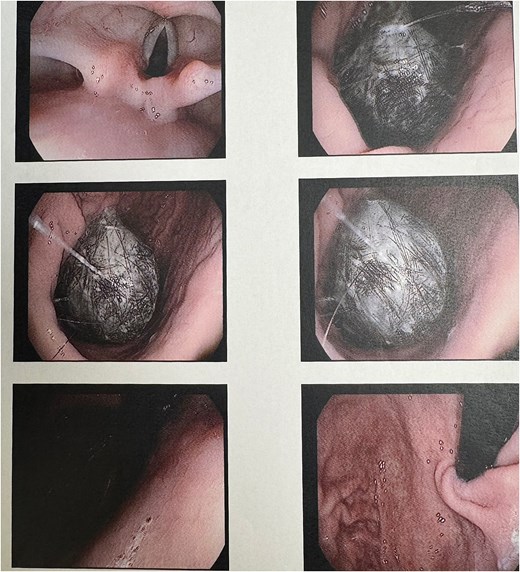
Upper endoscopy demonstrating a large trichobezoar occupying approximately 90% of the gastric lumen.
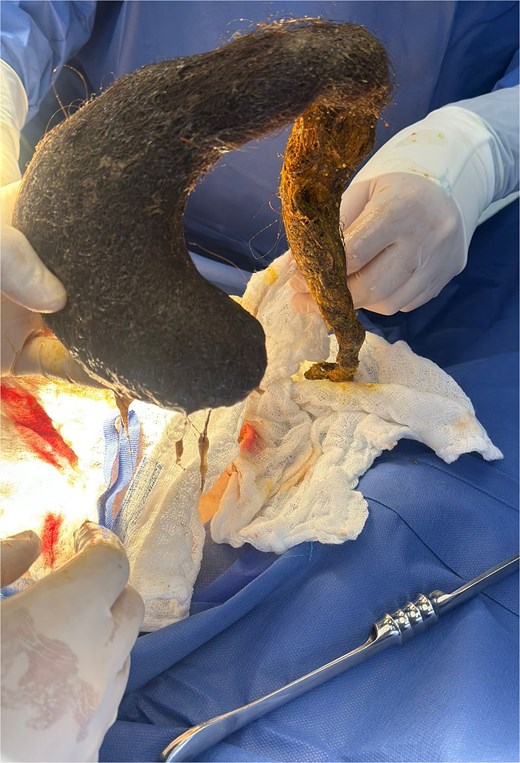
Extracted giant gastric trichobezoar with duodenal extension (Rapunzel syndrome).
The postoperative course was uneventful. The patient tolerated oral intake and was discharged after 72 h of hospitalization. At follow-up 8 days later, she remained asymptomatic and in good clinical condition. Psychiatric and psychological evaluation established a diagnosis of obsessive-compulsive disorder with trichotillomania and trichophagia. The patient was started on pharmacological therapy and scheduled for outpatient follow-up.
CT findings (Figs 3–5) were highly suggestive of advanced gastric outlet obstruction.
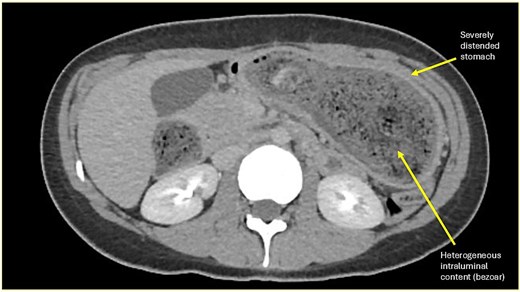
Contrast-enhanced CT demonstrating gastric outlet obstruction. Axial view showing marked gastric distension with heterogeneous intraluminal content.
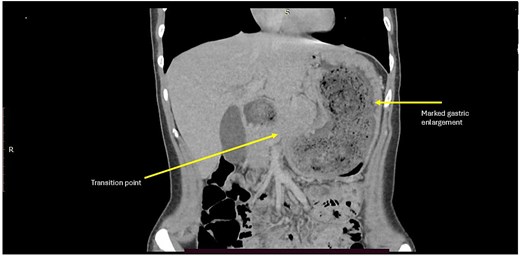
Coronal reconstruction demonstrating gastric enlargement with proximal duodenal dilation and transition point.
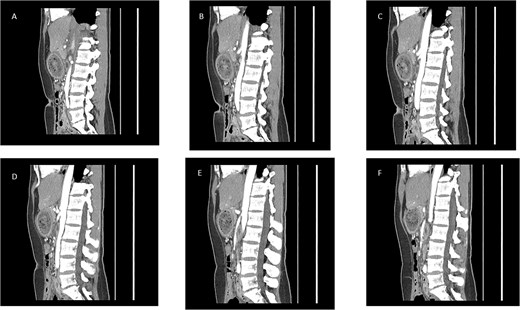
Sequential sagittal contrast-enhanced CT reconstructions demonstrating radiological features suggestive of superior mesenteric artery syndrome associated with giant gastric trichobezoar (Rapunzel syndrome). Sequential sagittal images (A–F) demonstrate marked gastric distension with proximal duodenal narrowing and a reduced aortomesenteric angle/compression pattern.
Axial images demonstrated a markedly distended stomach filled with heterogeneous intraluminal material, consistent with a compact bezoar, although direct visualization of the trichobezoar itself was limited by similarity in density to adjacent gastric contents. Coronal and sagittal reconstructions showed marked gastric enlargement with mass effect on adjacent structures and proximal duodenal dilation with an abrupt transition near the third portion. These multiplanar findings strengthened the radiologic impression of severe luminal obstruction and supported the possibility of secondary vascular compression at the aortomesenteric interval.
Discussion
From a radiological perspective, this case illustrates the value of multiplanar CT reconstruction in complex gastric pathology. Although trichobezoars may not always be sharply delineated on axial images, coronal and sagittal reconstructions can reveal the degree of gastric distension, proximal duodenal enlargement, and the relationship of the third portion of the duodenum to the narrowed aortomesenteric space. In this patient, the combination of severe gastric distension, proximal duodenal dilation, a reduced aortomesenteric angle, and a decreased aortomesenteric distance strongly supported imaging features suggestive of SMA syndrome.
This case adds to the limited literature on Rapunzel syndrome and is particularly notable because of the coexistence of imaging findings suggestive of SMA syndrome. Although causality cannot be definitively established, chronic gastric outlet obstruction caused by the giant trichobezoar likely contributed to progressive weight loss and mesenteric fat depletion, creating a plausible pathophysiological continuum. The extracted specimen, with a long tail extending beyond the pylorus into the proximal duodenum, further confirmed Rapunzel syndrome and provided an anatomic explanation for the severity of the obstruction [7, 8].
Rapunzel syndrome represents a rare and severe manifestation of trichobezoars, characterized by the extension of a gastric hair mass beyond the pylorus into the small intestine. Fewer than 100 cases have been reported worldwide, with most evidence derived from isolated case reports. It predominantly affects young female patients with underlying psychiatric disorders, particularly trichotillomania and trichophagia, as observed in this case. Clinically, the condition often presents with progressive gastrointestinal symptoms, including abdominal pain, vomiting, early satiety, and significant weight loss, eventually leading to gastric outlet obstruction. Endoscopy remains the gold standard for diagnosis; however, it is typically insufficient for treatment in cases of large bezoars. CT serves as a complementary modality, particularly in evaluating the extent of obstruction and identifying secondary findings. In this case, CT imaging demonstrated significant gastric and proximal duodenal dilation, consistent with obstruction. Importantly, it also revealed a reduced aortomesenteric angle and distance, raising suspicion for SMA syndrome. This condition is classically associated with rapid or severe weight loss leading to depletion of mesenteric fat and subsequent compression of the third portion of the duodenum. The coexistence of Rapunzel syndrome and imaging findings suggestive of SMA syndrome may represent a pathophysiological continuum. Chronic gastric obstruction caused by the trichobezoar likely contributed to progressive weight loss, which in turn may have predisposed the patient to duodenal compression. Although rarely described, this association underscores the importance of considering secondary vascular compression syndromes in patients with prolonged obstructive symptoms. Surgical management remains the definitive treatment for giant trichobezoars. Open laparotomy with gastrotomy continues to be the most reliable approach, especially in cases with duodenal extension. In this case, complete removal was achieved successfully, with an excellent postoperative outcome. Equally critical is the role of multidisciplinary care. Psychiatric evaluation and long-term follow-up are essential to prevent recurrence, given the strong association with behavioral disorders. The diagnosis of obsessive-compulsive disorder with trichotillomania and trichophagia in this patient reinforces this necessity. This case contributes to the limited literature on Rapunzel syndrome and provides additional insight into its potential association with SMA syndrome, highlighting the importance of comprehensive clinical and radiological assessment [9–13].
Conclusion
Rapunzel syndrome is a rare but clinically significant condition that should be considered in young female patients presenting with chronic gastrointestinal symptoms. Endoscopy is essential for diagnosis, while imaging plays a complementary role in identifying complications and associated conditions. Surgical management remains the cornerstone of treatment, and multidisciplinary care is critical to prevent recurrence. This case highlights a possible association between severe gastric obstruction and secondary SMA syndrome, emphasizing the need for a comprehensive diagnostic approach.
Acknowledgements
The authors thank Andrés Renet Palma Hernández, final-year medical student at Universidad Técnica de Manabí, for assistance with data collection.
Conflicts of interest
The authors declare no conflicts of interest.
Funding
No funding was received for this study.
Consent
Written informed consent was obtained from the patient for publication of this case report and accompanying images.


