


 https://orcid.org/0000-0002-4806-9301

Abstract
There is a paucity of data on the use of the subcutaneous onlay laparoscopic approach (SCOLA) for management of recurrent incisional hernia after transversus abdominis release (TAR), particularly in patients with higher BMI and a hostile abdomen. Our patient is a 60-year-old woman with obesity and a complex surgical history resulting in a large M2–4 W3 R1 incisional hernia underwent open TAR and subsequently developed a symptomatic, bowel-containing superior recurrence. A robotic SCOLA approach was selected to avoid relaparotomy in a hostile abdomen. The defect was closed with a permanent barbed suture, and a 20-cm-wide lightweight polypropylene mesh was placed in an onlay position. This case report is the first to describe use of SCOLA to treat such a recurrence in a comorbid patient with a high BMI and a hostile abdomen. SCOLA is a viable option and should be considered in this unique patient population.
Introduction
This case report highlights the role of the subcutaneous onlay laparoscopic approach (SCOLA) in managing recurrent incisional hernia after transversus abdominis release (TAR). The subcutaneous endoscopic approach was proposed by Bellido Luque (2015) and Juárez Muas (2019) and was popularized as SCOLA by Claus et al. (2018) [1–3]. All three authors describe suprapubic laparoscopic access, development of lipocutaneous flaps, and plication of diastasis in patients with primary midline ventral hernias (if present), with selective reinforcement using a synthetic onlay mesh. All three excluded patients with BMI >32–35, and 92% of cases were for nonrecurrent hernias [1–3].
There is a paucity of data on SCOLA outcomes in patients with higher BMI and in those with prior laparotomy or abdominal wall reconstruction (AWR). Here we present a patient in whom we utilized robotic SCOLA to repair a high epigastric recurrence following TAR—an approach that, to our knowledge, has not been described previously.
Case report
Our patient is a 60-year-old woman with morbid obesity (BMI 42) and a complex surgical history, including laparoscopic sleeve gastrectomy and cholecystectomy, two cesarean sections, and a partial hysterectomy, resulting in a large ventral hernia, and an exploratory laparotomy with small bowel resection for strangulation. She also underwent a panniculectomy for chronic pannus lymphedema. She was normoglycemic and a never-smoker. Over the last several years, she experienced multiple small bowel obstructions (SBO; 15 total), with transition zones within her large midline hernia (M2–M4 W3 R1, European Hernia Society classification) and loss of domain (LOD). Despite being a suboptimal candidate, she was offered an AWR in hopes of resolving her recurrent SBOs.
She underwent an open TAR with classic ‘home-plate’ mesh placement (30 × 30 cm lightweight polypropylene) performed by our team, with concurrent fleur-de-lis abdominoplasty. We did not have a preoperative chemodenervation program at that time, and the midline required bridging with heavyweight polypropylene (HWPP) because of her LOD. Her recovery was complicated by abdominal wall lymphedema, superficial surgical site infection, and wound dehiscence at the T-junction with mesh exposure. She ultimately healed by tertiary intention.
Eighteen months after AWR, she was found to have a reducible symptomatic 4-cm recurrence in the upper epigastric midline, superior to the bridging mesh. In retrospect, we should have implanted an additional (third) large piece of retromuscular mesh extending toward the central tendon of the diaphragm. Given her hostile abdomen and prior AWR, we offered robotic SCOLA repair.
After induction of general endotracheal anesthesia, the epigastric defect was marked with ultrasound, and initial camera port was placed 15 cm to the left. As in classic SCOLA, this was done by direct dissection toward and along the external oblique to create necessary and sufficient initial space for placement of working robotic 8 mm ports (Fig. 1). The initial 4 cm incision at the camera port was temporarily closed with a running suture to create an airtight seal. After docking, we developed subcutaneous space toward and around the defect and carefully reduced the bowel without opening the peritoneum (Fig. 1, insert 1). We confirmed that the fascial edges were free of bowel circumferentially. This was facilitated by placement of an additional 5-mm laparoscopic port in the right subcostal area. After completion of an appropriate size subcutaneous pocket, we closed the defect with running #1 non-absorbable barbed suture and placed a 15 × 20 cm lightweight polypropylene onlay mesh, secured it with several 2–0 Prolene sutures, applied 10 ml of fibrin sealant, and left a channeled drain. The patient was discharged home the next day and had an uncomplicated course with no seromas. She was instructed to wear an abdominal binder day and night, and the drain was removed after 3 weeks. To date, she has no hernia recurrence.
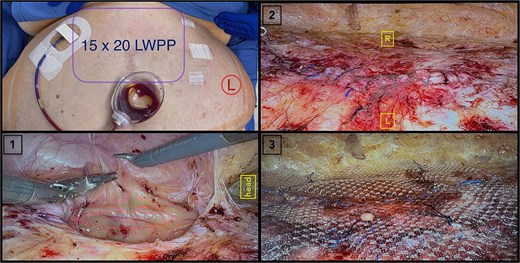
Diagram of mesh placement and steps 1–3 of the repair. (1) Subcutaneous dissection and reduction of the herniated bowel; (2) closure of the defect; (3) onlay mesh placement.
Discussion
The use of a minimally invasive pre-aponeurotic mesh repair of a ventral hernia with simultaneous plication of the linea alba for diastasis recti is an effective approach to the management of epigastric and subxiphoid hernias. Numerous different authors have described variations to this procedure with similar outcomes. Bellido et al. (2015) describe a totally extraperitoneal technique plication of the linea alba [1]. Maus et al. (2019) demonstrated a very similar technique without the presence of a defect [2]. Cuenca et al. (2017) modified Bellido’s technique using a polypropylene mesh [4]. Claus et al. (2018) popularized this technique as SCOLA and showed its plausibility on a robotic platform [3]. Dong et al. (2021) describe the first documented case series in the United States, which showed promising results with minimal complications, highlighting that improved patient selection (lower BMI, overall body habitus, etc.) directly correlated with improved outcomes [5]. More recently, Mehta et al. (2024) described the use of SCOLA in India, which again showed promising results [6]. Exemption criteria for this study shared among these studies were prior laparotomies, large pannus, prior abdominoplasty, small hernias <2 cm, recurrent hernias, high BMI, or hernias off midline [1–6].
Unlike these studies, our patient had class III (morbid) obesity with a BMI > 42. She had multiple prior exploratory laparotomies and abdominal wall surgeries. Lastly, her ventral epigastric hernia was a recurrence. Given the hostile environment of this patient's abdomen and recent AWR, this technique offered a way to address the hernia without entering the prior surgical field. This could be a valuable surgical option for patients with recurrences in the setting of prior complex reconstructions.
All prior SCOLA repairs describe the patient placed supine in a split leg configuration with suprapubic ports working from an inferior to superior. We wanted to avoid her healed panniculectomy incision, and all three robotic ports were placed in the left subcostal region. Using this setup, we gained sufficient space to close the defect and place the mesh.
Despite being a single case, it demonstrates an alternative way to perform SCOLA on a robotic platform for epigastric hernias. Our study is limited by sample size, generalizability, and long-term follow-up data, but we do think that this is a viable option in similar scenarios.
Author contributions
David Roberts: Writing—original draft, review & editing.
Artem Shmelev: Study guarantor; Conceptualization, Writing—original draft, review & editing.
All authors contributed to interpretation of results, discussion, and critical revision. All authors have approved the final manuscript.
Conflicts of interest
No benefits in any form have been received or will be received from a commercial party related directly or indirectly to the subject of this article.
Funding
None declared.
Ethical statement
According to our institution’s policy, case reports or case series of up to three clinical cases do not require IRB approval. A signed informed consent was obtained from the patient (HIPAA release form).


