


 https://orcid.org/0009-0004-2892-0965

Abstract
Duodeno-jejunal intussusception is highly unusual because of the retroperitoneal fixation of the duodenum, with only a limited number of cases documented in the literature. Furthermore, intussusception caused by a malignant ampullary lead point has not been reported previously. We present the case of a 58-year-old man who presented with obstructive jaundice for 8 months with no features of intestinal obstruction. Computed tomography imaging revealed dilation and deformation of the pancreaticobiliary tree due to duodenal intussusception. Intraoperative findings confirmed duodeno-jejunal intussusception with an ampullary mass acting as the lead point, which was confirmed to be adenocarcinoma upon pathological examination. The patient successfully underwent pylorus-preserving pancreaticoduodenectomy (Whipple procedure) with Child’s reconstruction. Although duodenal intussusception is rarely encountered, clinicians must consider it in the differential diagnosis of unexplained biliary obstruction, even in the absence of intestinal obstruction features. A comprehensive diagnostic evaluation and tailored surgical approach are essential for optimal management.
Introduction
Small-bowel intussusception is predominantly observed in the pediatric population. In contrast, it is rare in adults, where it almost invariably occurs secondary to benign pathological lead points [1]. Although anatomical fixation of the duodenum in the retroperitoneum theoretically precludes intussusception of this segment, rare occurrences have been reported [2].
While duodenal neoplasms are the most common type of small bowel tumor and are frequently malignant, ampullary tumors are rare [3]. They typically present with symptoms of obstructive jaundice and rarely cause duodenal intussusception [4].
In this report, we describe a rare case of ampullary adenocarcinoma presenting as chronic biliary obstruction with concomitant duodenal intussusception without the classic signs of intestinal obstruction (IO). To our knowledge, this particular clinical presentation has not been documented in the literature, offering valuable insights into the diverse manifestations of ampullary tumors.
Case presentation
A 58-year-old Tanzanian man with no known comorbidities presented with an 8-month history of progressive scleral icterus. This was associated with generalized pruritus, clay-colored stools, and dark-colored urine. The patient had no history of vomiting, abdominal pain, distension, or constipation. On physical examination, the patient was jaundiced, with excoriations evident on the skin secondary to pruritus. The remainder of the physical examination was unremarkable.
Laboratory investigations revealed a cholestatic pattern marked by elevated bilirubin, alkaline phosphatase, and γ-glutamyl transferase levels. Synthetic liver function was impaired, as evidenced by prolonged prothrombin time. However, transaminase levels, full blood count, and renal function test results were within normal limits. Serum tumor markers, including Carcinoembryonic Antigen and Carbohydrate Antigen 19–9, were also within normal limits.
Esophagogastroduodenoscopy revealed no significant mucosal abnormalities; however, the ampulla of Vater could not be visualized. Subsequent thoracoabdominal computed tomography (CT) revealed a double-duct sign (Fig. 1a and b). Imaging further revealed medial displacement of the ampullary region and intussusception of the second portion of the duodenum through the fourth portion (Fig. 1b and c).
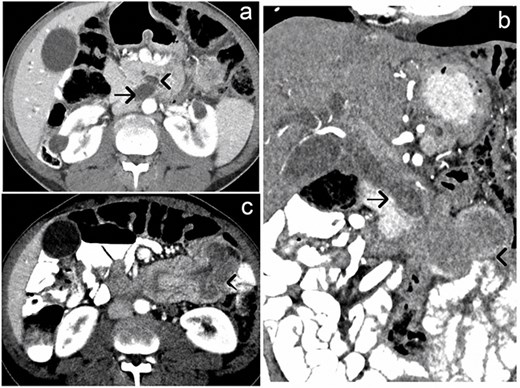
(a) Axial CT demonstrating medial displacement of the common bile duct (arrow) and main pancreatic duct (arrowhead). (b) Coronal CT image demonstrating medial displacement of the common bile duct (arrow) and duodenal intussusception (arrowhead). (c) Axial CT demonstrating duodenal intussusception (arrowhead).
Elective surgery was performed, and intraoperative exploration revealed duodeno-jejunal intussusception extending through the fourth portion of the duodenum, distal to the ligament of Treitz (Fig. 2a). A palpable telescoped tumor, confirmed as the lead point, was found within the intussusception. Marked dilation of the extrahepatic biliary system was noted; however, there was no evidence of metastasis. Intussusception was reduced, followed by antimesenteric duodenotomy, allowing direct visualization of the polypoidal tumor (Fig. 2b). Pylorus-preserving pancreaticoduodenectomy (Whipple procedure) and Child’s reconstruction were then performed in a standard fashion (Fig. 2c). Histological examination confirmed duodenal adenocarcinoma, pathological stage pT1aN0M0, originating from a tubulovillous adenoma (Fig. 3). All resection margins were negative.
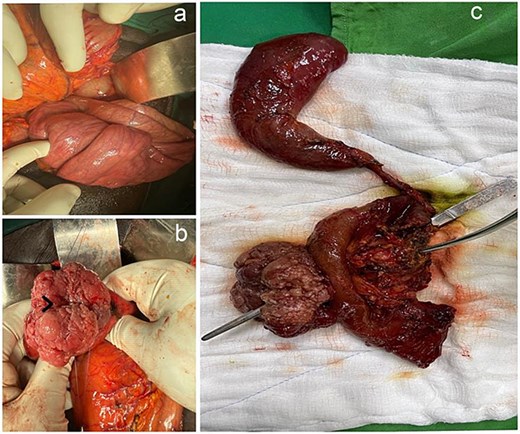
(a) Duodeno-jejunal intussusception. (b) Ampullary tumor with draining bile (arrowhead). (c) Specimen after Pancreaticoduodenectomy. Forceps placed through the common bile duct and emerged from the ampulla. The curved hemostat demonstrates the pancreatic duct.
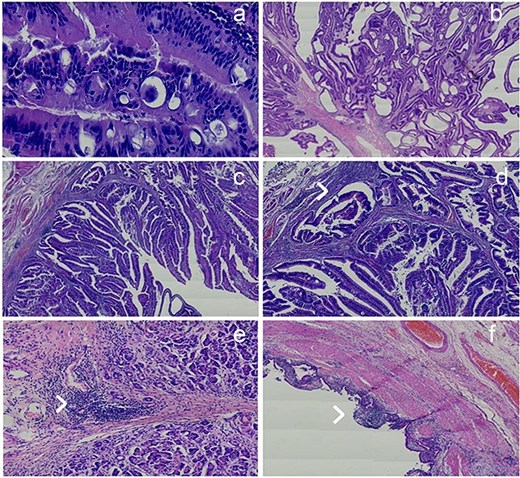
Hematoxylin and eosin sections showing (a) cribriform glands lined by pseudostratified tall columnar cells with elongated, hyperchromatic, enlarged, and pleomorphic nuclei. (b) Pedunculated polyp with tubulovillous adenoma. (c) Abnormal villous architecture with back-to-back glands, prominent glandular budding, intraluminal papillary tufting, and invasion into the muscularis mucosa. (d) Atypical gland invasion into the muscularis mucosa, as indicated by the arrowhead. (e) Section of the pancreas showing benign acini with marked fibrosis and lymphocytic inflammatory infiltrates, as indicated by the arrowhead. (f) Gallbladder mucosa (arrowhead) showing erosion and marked lymphocytic inflammatory cell infiltrates.
The patient was admitted to the Intensive Care Unit and transferred to the ward on postoperative day (POD) 2. The abdominal drains were removed on POD 7, and the patient was discharged 5 days later. Following a multidisciplinary team discussion, adjuvant chemotherapy was initiated, consisting of six cycles of oxaliplatin, capecitabine, and bevacizumab (CAPEOX + Bevacizumab), along with a single intraperitoneal wash dose of cisplatin. His postoperative follow-up, which included a CEA tumor marker and screening colonoscopy, remained uneventful for up to 2 years.
Discussion
Ampullary adenocarcinomas are exceedingly rare, constituting ~0.2% of all gastrointestinal and less than 16% of periampullary malignancies [5]. The typical presentation is obstructive jaundice. While duodenal intussusception has been previously reported due to ampullary adenoma [4, 6] and duodenal adenocarcinoma [2, 7], this is the first documented case of an ampullary adenocarcinoma presenting as duodenal intussusception.
The clinical course of duodenal intussusception is often non-specific, presenting with weight loss or intermittent signs of IO [8, 9]. In contrast, our patient presented solely with obstructive jaundice and lacked any signs of IO. We hypothesized that jaundice was caused by the combined anatomical distortion and direct compression of the pancreaticobiliary tree by the ampullary tumor and the resulting intussusception, similar to the mechanism reported by Hirata et al. [4]. The absence of IO may be due to intermittent spontaneous reduction of the intussusception.
CT is the preferred diagnostic modality for intussusception, boasting a high sensitivity (58%–100%) and often identifying the causal lead point [10]. A definitive diagnosis requires visualization of the characteristic coiled-spring and target signs, which distinguish true full-thickness invagination of the bowel and mesentery from simple mucosal prolapse [4]. Our CT findings confirmed these characteristic features; however, the origin of the lead point could not be determined.
Pancreaticoduodenectomy remains the gold standard for malignant duodenal intussusception. This approach is necessary to ensure adequate lymphadenectomy and clear resection margins, thereby conferring a survival advantage and lowering the risk of recurrence [11]. Given the theoretical risk of peritoneal seeding from tumor manipulation during intussusception reduction and duodenotomy, neoadjuvant chemotherapy was prescribed despite the favorable pathology (pT1aN0M0).
Conclusions
This case report highlights a rare and clinically significant presentation of ampullary adenocarcinoma, leading to duodeno-jejunal intussusception accompanied by obstructive jaundice. The atypical nature of this case underscores the importance of considering intussusception as a differential diagnosis in patients with obstructive jaundice, even in the absence of the classic symptoms of bowel obstruction.
Author contributions
Conceptualization: H.A.A., D.W.K., A.H.M., G.M., CEG. Gathering clinical information: H.A.A., D.W.K., G.E.M., K.B.K., A.A.A., G.M., F.R.L., A.B.M., S.K.N. Drafting the initial manuscript: H.A.A., G.M., F.R.L., A.B.M. Surgical description: D.W.K., A.H.M., G.E.M., K.B.K., A.A.A., C.E.G. Radiological interpretation: G.M., F.R.L. Pathological interpretation: A.B.M. Revising the final manuscript: D.W.K., A.H.M., C.E.G., S.K.N. All the authors approved the final manuscript.
Conflicts of interest
None declared.
Funding
None declared.
Data availability
None declared.
Ethics approval
This case report study was exempted from ethical approval as per institutional standards.
Informed consent and consent for publication
Written informed consent was obtained to publish this case report and accompanying images.


