


 https://orcid.org/0000-0003-4074-6811

Abstract
Parasitic infections continue to be a weakness for developing countries since the lack of hygiene and clean water can affect the health of all citizens, especially the most vulnerable. Most Ascaris lumbricoides infections are mild; however, in rare cases, when the infection is severe enough, the parasites can cause obstruction or even perforation of the intestinal wall, leading to potentially fatal outcomes. We present the case of a 65-year-old who lives in a remote area far from the city, without access to clean water. He became infected with Ascaris lumbricoides and developed peritonitis due to it. After prompt treatment, he recovered completely.
Introduction
Infecting more than one-quarter of the global population, ascariasis is an infection of humans caused by the nematode Ascaris lumbricoides (AL) [1]. This infection is highly relevant in countries with poor hygiene and limited basic sanitation [1, 2]. As a result, its complications, morbidity, and mortality are increased in these scenarios, representing an important medical, social, and economic problem for developing countries [1].
We present the case of a 65-year-old with no past medical history who lives in a remote area far from the city, without access to clean water or a sewer system. He became severely infected with AL and developed peritonitis due to it. After prompt treatment, he recovered completely, and a high priority was given to him and his family on safe health practices.
Case report
Patient is a 65-year-old with no past medical history who lives in a remote area far from the city, without access to clean water or a sewer system. Suddenly, he presented with a 24-h history of lower right abdominal pain, at first it was mild and accompanied by nausea and vomiting; however, as time passed, the pain became unbearable, and then fever appeared; therefore, he was brought immediately by his family to the emergency room. On clinical evaluation, a febrile and tachycardic patient was encountered; his abdomen was distended with tenderness around the lower abdomen. Complementary exams were needed, revealing leukocytosis with neutrophilia and an elevated C-reactive protein. Acute abdomen was suspected, and a computed tomography scan was needed. It uncovered fat stranding near the cecum with severe inflammation surrounding the descending colon (Fig. 1a and b).
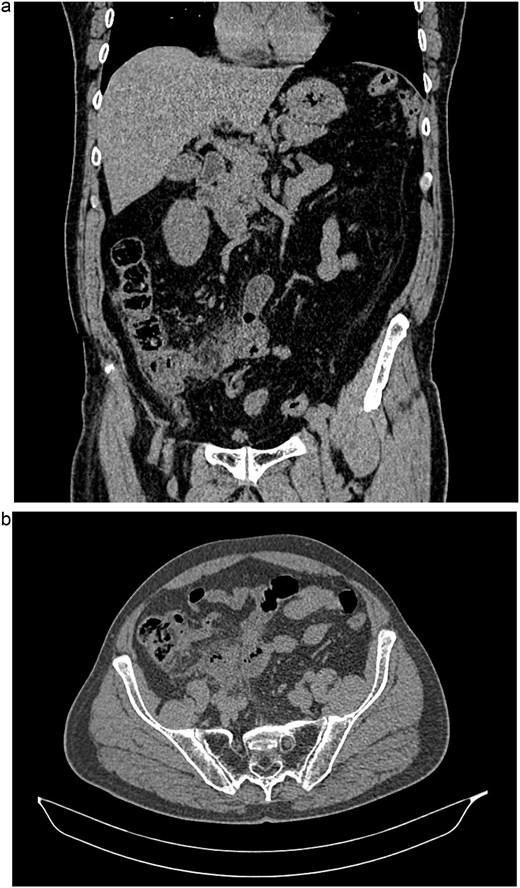
(a) CT, fat stranding is seen around the colon and the terminal ileum. (b) CT, severe inflammation surrounding the cecum and iliac fossa.
Acute appendicitis, perforated tumor, and masses were among the differential diagnoses, and after obtaining consents, surgery was decided. On laparoscopy, severe small-bowel inflammation was encountered, with marked colonic distention, which made laparoscopy difficult. However, while looking for the appendix, a thin 10 cm parasite was seen crawling through the peritoneum (Fig. 2). Upon encountering the appendix, it was found to be fully perforated, and multiple roundworms were exiting from it into the abdomen. A decision to convert laparoscopy to open surgery was made to provide extensive washing and to complete the appendectomy.
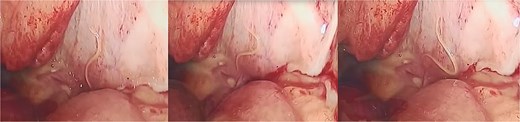
A live Ascaris lumbricoides in the abdominal wall is seen moving.
A handful of parasites were removed from the bowel wall and the peritoneum. Afterward, the appendectomy was completed, extensive washing of the abdomen was done, and a drain was placed. Pathology confirmed multiple nematodes measuring between 10 and 25 cm inside the appendiceal wall with perforation of the appendix. Peritonitis due to perforation of the appendix due to AL was the final diagnosis (Fig. 3a and b).
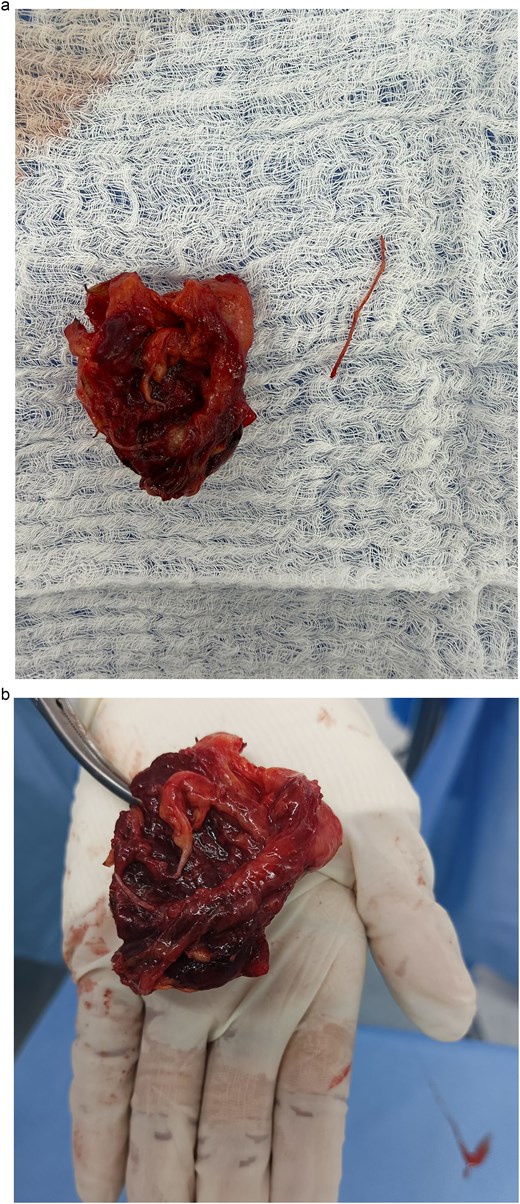
(a) Perforated appendix with a live Ascaris lumbricoides. (b) Appendiceal wall completely surrounded by parasites.
Patient’s postoperative period was uneventful; he completed antibiotic and antiparasitic medication and recovered without complication. On follow-up, the patient is doing well, and safe hygiene practices were provided to him and his family.
Discussion
AL remains the most common parasitic disease worldwide. First described by Carl Linnaeus in 1758, AL is the causative agent of the human disease ascariasis [1]. It is highly prevalent in developing countries, where the warm, humid climate intertwines with poor health conditions (Sub-Saharan Africa, America, East Asia) [1, 2]. AL’s cycle begins when eggs are ingested through contaminated food or water [1, 2]. Once inside the intestine, the larvae penetrate the mucosa and migrate to the liver and into the lungs through the bloodstream [1]. Then they cross the alveolar space and move into the pharynx, where they can be coughed up or swallowed [1, 3]. The ones that are swallowed mature and produce eggs that are passed into the feces [2].
Patients usually develop symptoms depending on the complexity of the infestation and the location of the parasites; pneumonia, asthma, respiratory symptoms, fever, dyspepsia, nausea, abdominal pain, bloating, and malnutrition are among the most common symptoms [1, 3]. In addition, they often cause hypersensitivity and severely affect the patient’s microbiota and immune system [1, 4]. AL doesn’t usually perforate the bowel wall; however, this behavior can be seen under stimulation of the gastrointestinal tract with spicy food or inappropriate dosage of drugs [2, 4]. This affects the parasites, causing them to migrate into the pancreas or bile ducts, or cause obstruction and perforation [5]. Perforation is an extremely rare complication, with few cases reported in the literature, in which fatality is unfortunately high [1, 5].
In our case, the patient must have had a long history of infection, as he didn’t have safe access to water and had poor health and safety practices. Once the infection was severe, the AL led to perforation of the appendix and peritonitis.
Diagnosis is based on the etiological examination of the parasite or parasite eggs [2]. The Kato-Katz smear is the WHO-recommended test, but other sedimentation tests, such as the McMaster and FECPAKG2, are also available [2, 3]. Imaging, such as ultrasound or computed tomography (CT), can visualize the ascarids if the infestation is large enough to be noticed [4, 5]. In our case, we were able to visualize the parasites in the patient during laparoscopy and observe them free in the abdomen.
Albendazole is the drug of choice; a single dose or a 10-day treatment can be given in severe cases [6]. Other drugs, such as mebendazole or levamisole, can be used [1, 5]. If complications such as biliary ascariasis, obstruction, or perforation occur, prompt intervention is necessary to halt disease progression and prevent the mobilization of the parasites into other areas [2, 5], as we did with our patient. However, the most effective treatment is not drugs but prevention [3, 7]. Deworming treatment is important, but proper sanitation and food-handling practices are essential [4, 5]. The medical team must enforce safe health practices (waste disposal and safe defecation practices) to minimize fecal contamination [6].
Public education and health measures must be ongoing practices to promote and prevent the transmission of ascariasis, especially in developing countries like ours. Ascariasis infection remains a burden for our communities, and it is up to us to safeguard vulnerable populations and prevent these extreme cases.
Conclusion
Ascariasis can lead to life-threatening complications under the right conditions, highlighting the importance of education on good hygiene practices, especially in the most underserved areas of developing countries. Cases like this call for heightened awareness and suspicion in affected areas, reminding all medical personnel that without adequate care and basic sanitary conditions, complications can become more severe.
Conflicts of interest
None declared.
Funding
None declared.


