


 https://orcid.org/0009-0009-7824-5298

Abstract
Epidermolysis bullosa (EB) is a rare congenital disorder caused by mutations affecting structural proteins of the epidermis and dermo-epidermal junction, resulting in extreme skin and mucosal fragility, blistering with minimal trauma, and impaired wound healing. Gastric outlet obstruction (GOO) in newborns arises from disruption of normal gastric emptying and may cause poor feeding, weight loss, severe vomiting, dehydration, and electrolyte imbalance. Long-segment gastroduodenal atresia is a rare subtype of GOO in which the blockage spans a continuous region from the distal stomach into the proximal duodenum. To date, no published reports have described EB associated with a long-segment gastroduodenal atresia. We report a full-term female newborn who presented with diffuse blistering, nail dystrophy, and a long-segment gastroduodenal atresia.
Introduction
Skin-fragility disorders encompass a group of inherited conditions characterized by blister formation following minimal trauma to skin or mucous membranes [1].
Epidermolysis bullosa (EB) classically presents at birth with erosions and blisters [1] and demonstrates a wide clinical spectrum—from mild disease to early onset lethality [5].
EB is classified into three major types based on the ultrastructural level of skin cleavage [6]:
EB simplex (EBS): intraepidermal separation within basal keratinocytes [6]
Junctional EB (JEB): cleavage within the lamina lucida due to defects of laminin-332 or hemidesmosomal proteins [7]
Dystrophic EB (DEB): sub-lamina-densa blistering due to COL7A1 deficiency and defective anchoring fibrils [8]
Gastric outlet obstruction (GOO) is an uncommon congenital anomaly typically resulting from structural abnormalities such as pyloric atresia, duodenal atresia, malrotation, or antral webs [9]. Long-segment gastroduodenal atresia involves a continuous region of atresia extending across the distal stomach, pylorus, and/or proximal duodenum and represents an extremely rare variant [3].
EB is most often associated with pyloric atresia (EB-PA), especially in JEB subtypes [10], though duodenal atresia and esophageal stenosis have also been reported.
However, long-segment gastroduodenal atresia has not been documented in association with EB [4].
Because co-occurrence of EB and congenital GOO significantly increases morbidity and mortality, detailed reporting is essential for advancing awareness, genetic evaluation, and multidisciplinary management.
Case presentation
A full-term female neonate was born to a 29-year-old gravida 3, para 1 + 1 mother via emergency cesarean section at 38 + 2 weeks due to fetal distress and prolonged labor. Apgar scores were 5 and 6 at 1 and 5 min, respectively. Birth weight was 1950 gms. The pregnancy was complicated by gestational diabetes mellitus managed with metformin and dietary modification, and by polyhydramnios identified at 32 weeks.
At birth, the infant demonstrated widespread bullous lesions and large areas of denuded skin involving the lower limbs, parts of the upper limbs, trunk, and cheeks (Fig. 1a).
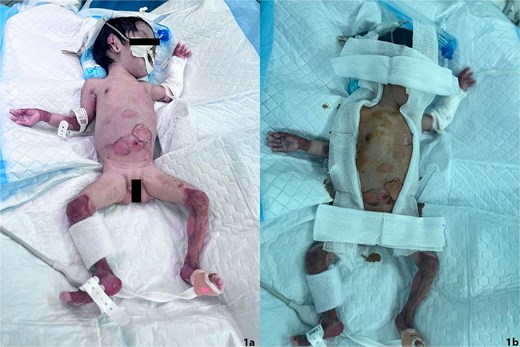
(a) Skin manifestation upon initial resuscitation. Shows widespread bullous lesions and large areas of denuded skin. (b) Pre-operation protective draping.
Nail dystrophy was present. These features suggested junctional EB, and the presence of focal cutis aplasia raised suspicion for Bart syndrome. The abdomen was moderately distended with visible peristalsis and increased bowel sounds. Meconium passage occurred within 48 h, making distal obstruction unlikely.
The combination of severe skin fragility and early gastrointestinal obstruction strongly suggested EB with gastrointestinal involvement, most commonly seen in JEB-PA.
Management
Initial management included gastric decompression, fluid and electrolyte correction, infection control, and total parenteral nutrition (TPN). Surgery was postponed until day 6 of life because of neonatal sepsis risk.
Abdominal X-ray showed a single large gastric bubble without distal gas. After meticulous protective draping to prevent skin trauma, a transverse laparotomy was performed (Fig. 1b).
Duodenal Kocherization exposed a long-segment gastroduodenal atresia extending from the distal antrum through the pylorus to the D1–D2 junction, proximal to the pancreaticobiliary duct (Fig. 2a).
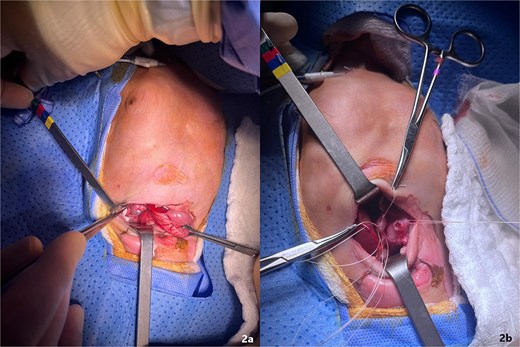
(a) The area of long-segment gastroduodenal atresia. That extends from the distal antrum through the pylorus to the D1–D2 junction. (b) Gastroduodenal bypass anastomosis.
Because the atretic length and location precluded a stricturoplasty, a gastroduodenal bypass anastomosis was performed. The pylorus and duodenal bulb were excluded from the alimentary tract (Fig. 2b). Our primary surgical goal in this case was to restore gastrointestinal continuity while minimizing the handling of friable tissues. We opted for a gastroduodenal bypass because the pyloric tissue was extremely thin and prone to sloughing. A resection (antrectomy) was deemed too high-risk for anastomotic leak given the systemic epithelial fragility. Stricturoplasty was not feasible due to the length and circumferential nature of the narrowing.
The procedure was completed without intraoperative complications. The neonate tolerated oral feeds by day 20 post-operation and passed stools normally. However, on day 26 of life, she developed an abrupt, severe bradycardic episode. The most recent blood cultures revealed no growth, and electrolytes such as potassium and ionized calcium were within normal ranges at the time. A primary cardiac arrhythmia or abrupt autonomic collapse, which has been documented in severe cases of EB, is suspected in the absence of sepsis or metabolic abnormalities. The family refused a formal post-mortem examination to look for the cause of death.
Discussion
EB is a rare inherited blistering disorder, with an incidence of ~1 per 50 000 live births [1]. Junctional EB arises primarily from mutations in LAMA3, LAMB3, LAMC2, which encode laminin-332, and in COL17A1, ITGA6, ITGB4, which encode hemidesmosomal components [7]. Mutations in ITGB4 are strongly associated with EB-pyloric atresia (EB-PA) [10].
The mechanism of gastrointestinal atresia in EB remains uncertain but is hypothesized to originate from defective epithelial–mesenchymal adhesion or intrauterine ischemic injury secondary to epithelial fragility [11]. Because laminin-332 and integrin complexes are expressed in both skin and gastrointestinal mucosa, combined cutaneous and intestinal manifestations are embryologically plausible [7]. In addition, the low birth weight in our case may indicate the condition of small for gestational age, however no formal antenatal diagnosis of intrauterine growth restriction (IUGR) was documented. Several factors might explain the low birth weight, severe EP especially those associated with gastrointestinal atresia linked with impaired fetal growth due to chronic intrauterine stress and altered metabolic demands [11]. Additionally, presence of polyhydramnios suggest significant gastrointestinal obstruction in utero [6]. Furthermore, the emergency C-S performed due to fetal distress which raises the possibility of chronic intrauterine compromise. Therefore, his low birth weight would be multifactorial, including genetic condition, antenatal fetal stress, and long-segment gastroduodenal atresia.
Numerous published reports describe EB combined with pyloric atresia [10], and rare reports describe duodenal atresia [11] or combined esophageal and pyloric stenosis (Table 1) [2].
Previously reported cases of epidermolysis bullosa associated with gastrointestinal obstruction [1–10].
| Reference | EB type | GI involvement | Key clinical details | Outcome | Reference |
|---|---|---|---|---|---|
| Mithwani et al., 2013 | Likely JEB | Pyloric atresia | Female neonate with polyhydramnios and gastric distension; underwent gastroduodenostomy. | Died on day 25 | 1 |
| Mutlu et al., 2015 | JEB (ITGB4 mutation) | Pyloric atresia | Novel ITGB4 mutation (c.4505–4508insACTC); classic EB-PA phenotype. | Not reported | 2 |
| Almonla et al., 2025 | EB (subtype unspecified) | Duodenal atresia | Newborn with EB + DA; repaired via duodenoduodenostomy. | Not reported | 3 |
| Chahed et al., 2015 | Mixed JEB + DEB | Pyloric atresia, esophageal stenosis | Six-patient series with multiple digestive tract anomalies. | Variable; several deaths | 4 |
| Saleem et al., 2024 | Junctional EB | Web-type pyloric atresia | Underwent web excision + pyloroplasty; later developed sepsis. | Died | 5 |
| Luo et al., 2023 | JEB (ITGB4 & ITGA6 variants) | Pyloric atresia | Review of 49 EB-PA cases; strong link to ITGB4 mutations. | High mortality (24 deaths) | 6 |
| Atherton et al., 1990 | JEB | Pyloric atresia | Landmark review defining EB-PA phenotype. | Majority died neonatally | 7 |
| Richard et al., 2002 | JEB (ITGB4 variants) | Pyloric atresia | Defined EB-PA as a molecular subtype via integrin mutations. | Survivors with morbidity | 8 |
| Erçin et al., 2010 | JEB | Pyloric + colonic atresia | Rare combined upper + lower GI involvement. | Poor outcome | 9 |
| Ciftci et al., 1999 | JEB | Pyloric atresia | Classic EB-PA case series. | High mortality | 10 |
| Current Case (2025) | Junctional EB (suspected) | Long-segment gastric outlet obstruction | Atresia from distal antrum → pylorus → D1–D2 junction—first reported case of long-segment involvement. | Died day 26 | New |
However, none have described a continuous long-segment atresia extending across the distal stomach and duodenum, making this case likely the first documented instance [4].
Polyhydramnios in pregnancy is frequently observed in EB-PA and may result from impaired fetal swallowing due to obstructed gastric emptying [6]. This finding was also present in the mother in our case.
Prognosis in EB with gastrointestinal malformations remains guarded. Mortality is driven primarily by the severity of the underlying EB, sepsis risk, and nutritional compromise [12]. Even after successful reconstruction, neonates often succumb to infection or metabolic instability [2, 10].
This case broadens the known spectrum of EB-related gastrointestinal anomalies and suggests that EB-associated epithelial defects may disrupt a longer embryologic segment of the foregut than previously recognized.
Learning points
EB may rarely be associated with gastrointestinal atresia, typically pyloric atresia.
This is the first report of EB associated with long-segment gastroduodenal atresia.
Polyhydramnios plus severe neonatal skin fragility should prompt evaluation for EB with possible gastrointestinal (GI) involvement.
Extreme caution is required during perioperative care to prevent skin injury in EB.
Prognosis is determined primarily by EB severity, not by the gastrointestinal reconstruction.
Conclusion
This report presents the first documented association between EB and long-segment gastroduodenal atresia. The unusual extent of atresia suggests a broader developmental impact of EB-related adhesion defects on the embryonic foregut. Despite successful surgical bypass, the neonate’s outcome was limited by the severity of EB, consistent with prior literature. Early diagnosis, gentle handling, multidisciplinary care, and genetic counseling remain essential in managing such complex and rare conditions.
Limitations
Our facility lacks the specialized diagnostic equipment to confirm the diagnosis of EB, such as immunofluorescence mapping or transmission electron microscopy. Thus, the sample should be taken outside for definitive diagnosis. However, when the patient decreases a parental decision was made to abort the mentioned test.
No post-mortem autopsy has been made as the parents refuse.
Conflicts of interest
None declared.
Funding
None declared.


