


 https://orcid.org/0000-0002-3067-7122

Abstract
Cystic squamous cell carcinoma (cySCC) is a variant of cutaneous squamous cell carcinoma that manifests clinically as a cystic lesion instead of a solid tumor. Owing to their benign appearance, accurate diagnosis and treatment are often delayed. We report a case of a 55-year-old male presenting with a scalp lesion. The patient was keen for removal of the lesion as it was bothersome, although there were no overt sinister features on history nor examination. An excision biopsy was performed and histopathological examination revealed a cySCC. A wider excision was subsequently performed and the patient made an uneventful recovery. The number of cases of cySCC reported in the literature has been increasing. Clinical suspicion for malignancy must be high for any evolving lesion. The diagnosis of cySCC may only be apparent on histopathological examination. Prompt wider excision and further imaging studies are essential upon confirmation of cySCC.
Introduction
Squamous cell carcinoma (SCC) is a malignant neoplasm arising from atypical keratinocytes. SCC may arise from any areas of the body with squamous cells, such as the skin, lip, and oral cavity. Cutaneous SCC accounts for 20%–25% of all skin tumors [1]. Risk factors for development of cutaneous SCC include ultraviolet exposure, chronic inflammation, and immunosuppression [2]. Early recognition and prompt surgical excision remain the cornerstone of management and are associated with favorable oncological outcomes [3, 4].
Cystic squamous cell carcinoma (cySCC) is a variant of cutaneous SCC characterized macroscopically by a cystic appearance that may mimic that of benign cutaneous lesions. Microscopically, cySCC is characterized by cystic spaces lined with atypical malignant squamous epithelium, often containing keratinous debris or necrotic material. Owing to its benign macroscopic appearance, the diagnosis of cySCC is often made only on histopathological examination, and repeat excision is often needed [5].
We report a case of primary cySCC of the scalp in a male patient of East Asian descent in a tertiary care institution. This case highlights the importance of histological analysis even in seemingly benign lesions. A review of the available literature on cySCC was also performed. This case report was written in accordance with the Surgical CAse REport (SCARE) guidelines [6].
Case report
Patient information and clinical findings
A 55-year-old male of Chinese ethnicity with no significant past medical history was referred by the Dermatology service for evaluation and excision of a scalp lesion. The patient had no known risk factors for cutaneous malignancies. The lesion had been present for approximately 1 year and was slowly enlarging. The patient requested removal due to interference with hair grooming. There was no pain, discharge, or bleeding from the lesion. A review of systems was unremarkable.
On physical examination, there was a solitary 2 cm hemispherical exophytic lesion over the right frontal scalp (Fig. 1). The lesion was soft, mobile, skin-colored, and well-circumscribed. There was no overlying ulceration or surrounding erythema. No additional similar cutaneous lesions were identified on the rest of the body. Examination of the regional lymph node basins revealed no palpable lymphadenopathy. Dermoscopic evaluation demonstrated superficial vascular structures without any overtly suspicious features.
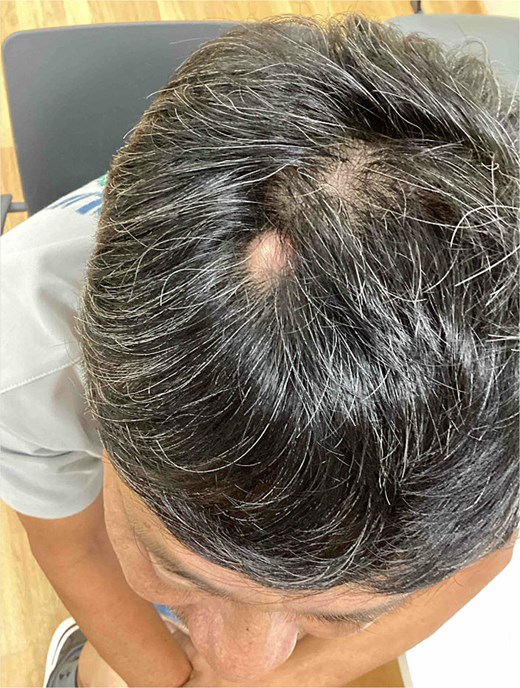
Pre-operative view of the right frontal scalp lesion.
Diagnostic assessment
A working diagnosis of an epidermal cyst was made. The authors do not routinely arrange for imaging of soft tissue tumors. As such, no additional pre-operative imaging was performed as there were no concerns of a malignant lesion.
Therapeutic intervention
The patient underwent an uncomplicated excision biopsy under local anesthesia. Gross pathological examination revealed a 1 × 0.8 × 0.6 cm cyst containing whitish pasty material. Histological examination showed a well- to moderately differentiated SCC exhibiting cystic architecture – the lesion demonstrated malignant squamous epithelium lining cystic spaces with keratinous debris, consistent with a diagnosis of cySCC. The tumor extended to within 1 mm of the closest radial margin.
The case was discussed at a multidisciplinary team meeting. Computed tomography (CT) of the head and neck was performed and showed a 1.3 × 0.7 × 0.7 cm hypodense lesion at the midline nasopharynx, but no evidence of deep tissue invasion or regional lymphadenopathy. Positron emission tomography (PET) imaging did not reveal any metabolically-active lesion suggestive of an occult primary tumor or distant metastasis. In view of the CT findings, nasoendoscopy was performed, and a biopsy was obtained, which showed only reactive lymphoid tissue.
In view of the close tumor margins, the patient was counseled for and consented to undergo a wider excision with margins of non-melanoma skin cancer of at least 5 mm (Fig. 2). The defect was primarily closed, and the post-operative course was uneventful.
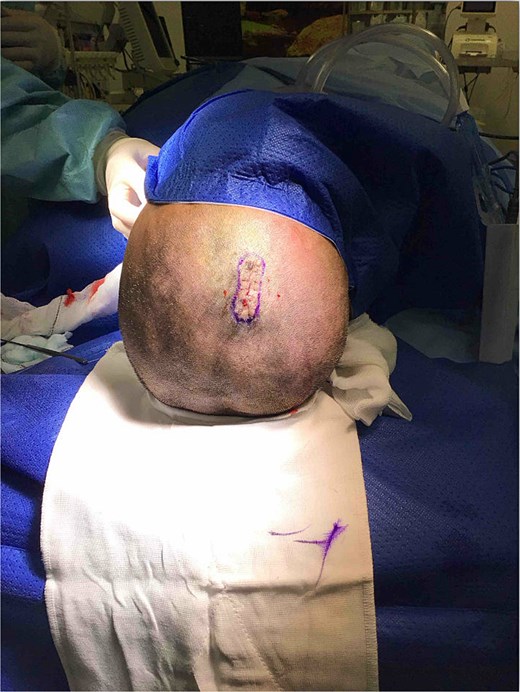
Intra-operative view from the wider excision with planned margins around the healed scar.
Follow-up and outcomes
Histopathological analysis of the specimen from the second excision demonstrated only post-surgical changes with no residual carcinoma identified. The patient recovered well and remains on regular follow-up for skin cancer surveillance (Fig. 3). No local recurrence or new lesions have been detected to date.
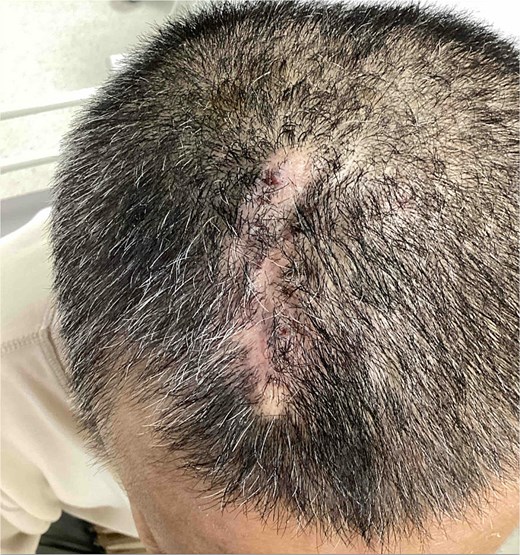
One month post-operatively from the wider excision.
Discussion
The number of cases of cySCC described has increased over the years, but cySCC remains a poorly-described entity. In early years, cySCC largely referred to cystic lesions of the lateral neck, which would in time reveal an underlying malignancy arising from the head and neck region. The term cySCC was therefore associated with a poor prognosis [7]. However, an increasing number of reports now show that cySCC may also exist as a primary tumor for which the prognosis is no different than other cutaneous malignancy. We propose dichotomizing cySCC into primary cySCC and secondary cySCC for better conceptualization.
Primary cySCC
Epidermal cysts are one of the commonest cystic lesions in the skin. Found in the mid- to deep-dermis, epidermal cysts are lined by normal epidermis and stratified squamous epithelium. As the vast majority of epidermal cysts are benign, management strategies include observation or surgical excision. During excision, it is the practice of the authors to excise an elliptical skin paddle to encompass the skin pit and overlying thinned-out areas of skin. This skin paddle tends to be smaller than the size of the main lesion and would result in positive oncological margins should the lesion eventually turn out to be malignant.
Primary cySCC refers to SCC arising from within a pre-existing epidermal cyst rather than a metastatic deposit from a distant primary. These have been previously reported but not consistently termed cySCC [8]. While uncommon, malignant transformation of epidermal cysts has been reported, with studies reporting transformation rates from 0.011% to 2.2%. Clinical findings in malignant transformation may be non-specific and include rapid enlargement, ulceration, and rupture. The pathogenesis behind malignant transformation of epidermal cysts is still unclear. In general, recurrent and chronic inflammation is known to give rise to cellular dysplasia and anaplasia. Given their superficial location, epidermal cysts have a propensity for infection as well as direct trauma. Repeated cycles of damage from infection and trauma, followed by attempts at repair over a prolonged period, may lead to malignant transformation.
Primary cySCC has been described in multiple body sites [7, 9]. Pre-operative imaging, when done, seldom reveals features suggestive of malignancy. While histological analysis may provide the diagnosis of cySCC, it does not allow one to determine if the cySCC in question is a primary tumor or a metastatic deposit. As such, investigations for an occult primary lesion should be undertaken for completeness. In our institution, we perform a CT scan of the head and neck region to identify any occult primary malignancy and nodal disease, and a PET scan to identify any distant metastases. Such investigations are not expected to yield positive findings for primary cySCC. We do not perform a fine needle aspiration for cytology as the aspirate tends to be hypocellular with a high false negative rate [10].
Secondary cySCC
In contrast, secondary cySCC refers to SCC seen within a predominantly cystic lesion that has metastasized from a primary lesion. Historically, these have been described in the setting of a newly diagnosed cystic mass in the lateral neck. In 1881, these were thought to be a malignant transformation of branchial cleft cysts and therefore termed branchiogenic carcinoma. Now, these lesions are being recognized as cystic metastases arising from a primary SCC in the head and neck region, which might be undiagnosed even at the time of discovery of the metastasis [11]. Goldenberg et al. had previously described these primary cancers to originate from within Waldeyer’s ring, a ring-shaped structure in the oropharynx consisting of pharyngeal, tubal, palatine, and lingual tonsillar tissue [11].
A search for an occult primary should always be undertaken, given the diagnosis of a cySCC. In particular, when the cySCC is located in the lateral neck region, additional effort must be made to rule out primary head and neck malignancies. We utilize the same investigation strategy as we would in the case of a primary cySCC (CT and PET scans). Should the cySCC arise from the lateral neck region, a panendoscopy is also performed to identify potential primary lesions that might be radio-occult. We concur with Goldenberg et al.’s suggestion for a diagnostic bilateral tonsillectomy and targeted biopsy of Waldeyer’s ring, but do so only if the prior investigations fail to reveal a primary malignancy.
Conclusion
cySCC is an atypical form of SCC that presents as a cystic swelling instead of a solid tumor. Primary cySCC originates from epidermal cysts and poses a challenge as its benign clinical and radiological appearance may delay diagnosis and treatment. Secondary cySCC is a cystic metastatic deposit commonly found in the lateral neck with a primary tumor—often times occult and only diagnosed later—in the head and neck region. Prompt excision biopsy of evolving cystic lesions is key for accurate and timely diagnosis. Advanced imaging modalities and nasoendoscopy allow us to differentiate primary from secondary cySCC.
Conflicts of interest
None declared.
Funding
None declared.


