


 https://orcid.org/0009-0000-5139-452X

Abstract
Impacted maxillary canines are common in patients with cleft lip and palate (CLP) due to altered anatomy and scar tissue formation, making surgical exposure challenging. This case report describes the use of artificial intelligence (AI)-assisted CBCT segmentation combined with three-dimensional (3D) printing for surgical planning and orthodontic traction of a palatal impacted canine in a unilateral CLP patient. AI-based segmentation enabled precise localization of the impacted tooth and adjacent structures, and a patient-specific 3D printed model was fabricated to guide surgical access and traction direction. A minimally invasive mucoperiosteal flap was performed, followed by immediate light orthodontic traction. The digital workflow facilitated accurate exposure and controlled biomechanical movement without complications. The integration of AI and 3D printing may enhance precision and efficiency in managing complex impacted canine cases associated with CLP.
Introduction
Impacted canines in complex cleft lip and palate (CLP) patients pose a considerable surgical challenge. Altered alveolar anatomy, scar tissue, and dense palatal mucosa can obscure normal landmarks, often necessitating wide mucoperiosteal flaps to locate the tooth. Such extensive exposure is associated with increased bleeding, difficult access for bonding, and even risk of bone loss [1].
Advanced imaging and technology offer new solutions in these complex cases. Cone-beam computer tomography (CBCT) provides 3D visualization of impacted teeth, and artificial intelligence (AI) now enables automated, accurate segmentation of impacted canines from CBCT data [2]. In this case, BlueSky Plan software was used to integrate the AI-generated models into a virtual plan and design a patient-specific anatomical 3D model. The 3D printed model used as an orientation aid allowed a faster, minimally invasive surgical exposure with a clear path for orthodontic traction [1]. This approach is especially valuable for CLP patients who often endure numerous procedures, underscoring the need to minimize additional surgical interventions [3]. Digital applications, particularly AI and 3D printing applications, are widely used and make the treatment more efficient and accurate [4–6].
Case presentation
A 14-year-old female with a history of repaired bilateral cleft lip and palate presented for orthodontic evaluation of missing maxillary permanent canines. Clinical examination revealed unerupted maxillary canines (Fig. 1).
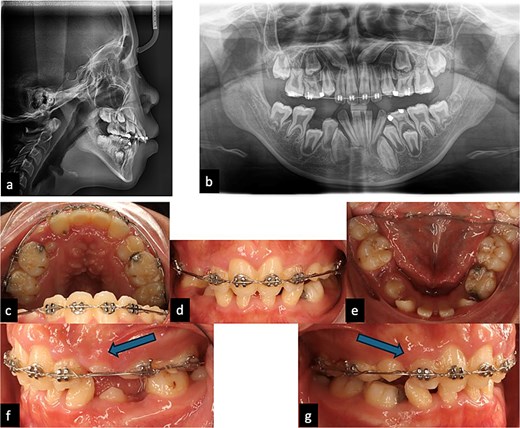
Pre-treatment records. (a–b) Pre-treatment radiographies; (c–g) intraoral pictures.
A CBCT scan was obtained to assess the impacted teeth relative to the cleft defect. The CBCT data was processed in BlueSky Plan software, using AI-based segmentation tools to delineate the impacted teeth and surrounding maxillary structures. A patient specific 3D-printed anatomical model of the maxilla (including the cleft and impacted canines) was fabricated to aid surgical planning; the model served solely for visualization of the anatomy and planned exposure (Fig. 2).
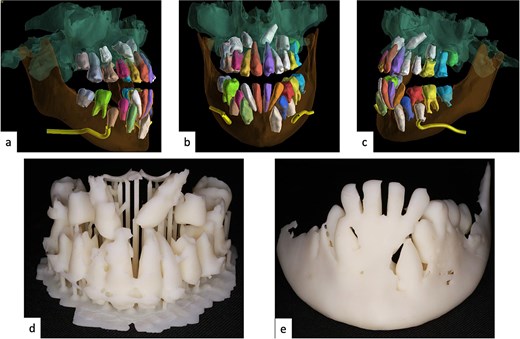
Pre-treatment (a-c) CBCT-based AI segmentation by Bluesky software; (d–e) 3D printed anatomical model for surgical planning.
This planning aided the surgical team in visualizing the three-dimensional anatomy and refining the planned flap design. Under local anesthesia, bilateral palatal mucoperiosteal flaps were elevated to expose the crowns of teeth #13 and #23. Orthodontic bonding buttons were immediately attached to the exposed canines before the flaps were repositioned and sutured. The patient tolerated the procedure well without complications. Elastomeric traction chains were connected from the bonded buttons on #13 and #23 to the orthodontic arch wire to begin guided eruption of the canines. Postoperative healing was uneventful, and the patient continued with routine orthodontic follow-up for cleft and alignment management.
Treatment objectives
The objective was to achieve accurate, minimally invasive surgical exposure of impacted canines in a patient with a complex cleft palate via AI-driven digital planning and 3D-printed guides
Avoiding general anesthesia given the patient’s multiple prior surgeries.
Potential alternative treatments
Alternative treatments considered included extraction of either the impacted cleft side canine or the first premolar. Given the canine’s high aesthetic and functional importance, extraction of the canine is generally avoided, and the family accordingly opted to extract the premolar, which could likely be completed under local anesthesia to avoid another general anesthetic.
Removal of the impacted canine would likely require general anesthesia due to the complex cleft anatomy, and since the patient had already undergone multiple surgeries, further anesthetic exposures were minimized.
Treatment progress
Guided by preoperative 3D planning, a full-thickness palatal mucoperiosteal flap was designed and elevated along the planned outline to optimally expose the impacted maxillary canines. Conservative osteotomy, guided by the 3D plan, exposed the canine crowns with minimal bone removal, streamlining the procedure. Buttons were immediately bonded to each exposed canine, and orthodontic traction wires were attached. The palatal flap was repositioned and sutured for tension-free primary closure, completing an efficient and precise surgical exposure that ensured optimal tissue handling and minimal bone sacrifice (Fig. 3).
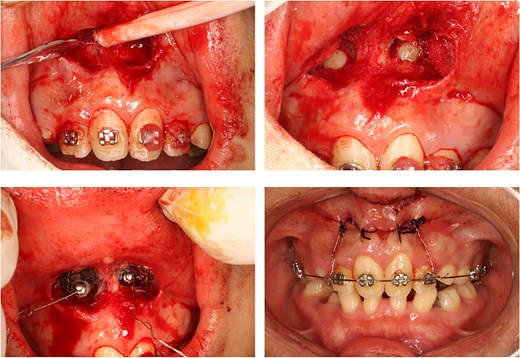
Surgical exposure under 3D-guided planning.
At about two weeks post-exposure the palatal soft tissues were deemed healed sufficiently to begin orthodontic traction of the impacted maxillary canines. We applied gentle continuous force (100 g) to extrude the canines into the arch; these low-magnitude forces are in line with recommended levels for safely moving impacted teeth without harming adjacent roots [7]. In practice, clinicians typically activate traction around 1–2 weeks after surgical exposure once healing permits [8]. Our timing was consistent with this guideline, allowing initial spontaneous movement of the canines while ensuring the wound had stabilized (Fig. 4). After three months of orthodontic traction on the impacted maxillary canines, the first maxillary premolars were extracted to create space for the canines (Fig. 5).
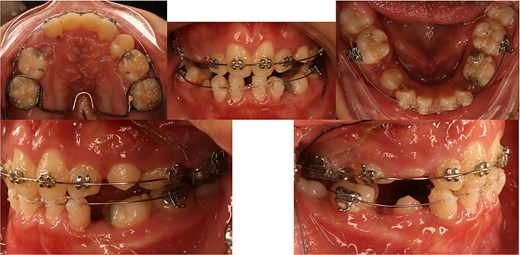
Intraoral condition 2 weeks after surgery; TPA and initiation light posteriorly traction.

Extracted maxillary first premolars after 3 month.
In the mandibular arch, extraction of teeth 34 and 43 was performed to relieve lower arch crowding and create space for alignment. Premolar extraction improves anterior alignment and yields a more balanced occlusion. This facilitated leveling of the mandibular curve of Spee and ideal alignment of the lower incisors, achieving occlusal harmony with the maxillary arch.
Treatment results
After 36 months of orthodontic treatment, all treatment objectives were successfully accomplished. Both maxillary canines had been successfully erupted and aligned into the occlusion, establishing normal overjet and overbite. Extraction of first premolars in the upper and lower arches provided space to relieve crowding and achieve harmonious arch coordination. The dental midlines were coincident and arch form normalized. Occlusal interdigitation was well balanced, with appropriate canine guidance. The patient’s facial profile and smile aesthetics improved: lip support was enhanced, the nasolabial angle normalized, and smile symmetry was restored (Fig. 6).
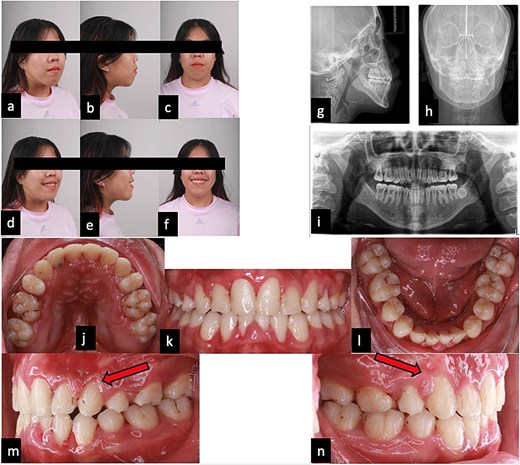
Post-treatment records. (a–f) Extra oral pictures; (g–i) radiographies; (j–n) intra oral pictures.
One-year post-treatment review showed that these results were well maintained, with stable result. In summary, the combined surgical–orthodontic approach achieved the planned functional and aesthetic outcomes without adverse sequelae (Fig. 7).
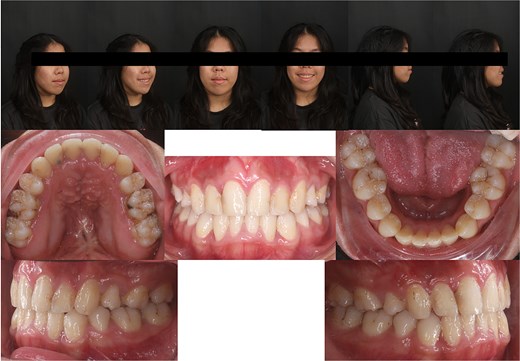
1 year follow-up after treatment.
Discussion
Conventional flap surgery for palatal impacted canines in CLP often requires wide dissection, with attendant bleeding, bone loss and prolonged operative time [1, 3]. In contrast, our AI-assisted workflow used CBCT segmentation and a patient-specific 3D-printed maxillary model to plan the exposure. The printed model provided exact anatomical orientation and allowed designing a narrowly tailored palatal flap directly over the canine crowns. Guided by this virtual plan, we achieved direct line-of-sight exposure with minimal soft-tissue and bone removal. This outcome is consistent with recent reports that 3D-printed guides enable highly accurate exposure of palatal canines with reduced tissue trauma [1, 5]. The pre-planning also enabled immediate bonding of attachments and optimal traction direction, effectively defining the force vectors for efficient canine eruption. Systematic reviews confirm that 3D-printed anatomic models improve surgical planning efficiency, significantly shortening operating time and reducing blood loss [9, 10]. Likewise, deep-learning segmentation markedly accelerates the planning process and enhances localization accuracy [2]. In our patients, this synergy of AI and 3D printing allowed rapid, minimally invasive exposure under local anesthesia and streamlined subsequent orthodontics [4, 6]. Overall, the combined digital workflow minimized morbidity and highlighted the value of precise pre-surgical mapping, a key advantage when treating CLP patients who otherwise face multiple interventions.
Conclusion
AI-driven CBCT segmentation together with patient-specific 3D planning enabled a minimally invasive, highly accurate exposure of impacted canines, dramatically reducing surgical time and tissue sacrifice for complex treatment, especially for CLP patients.
Acknowledgements
The authors thank the patient and her legal guardian for their cooperation and consent to publish this case.
Author contributions
Hoang Viet contributed to conceptualization, methodology, and writing—original draft preparation.
Bui Huu Khoi contributed to data collection, and manuscript revision.
Nattapon Chantarapanich contributed to software, 3D modeling, and validation.
Tran Hong Phuoc contributed to clinical treatment and data acquisition.
Anand Marya contributed to supervision, project administration, and final manuscript approval.
Conflicts of interest
None declared.
Funding
None declared.
Data availability
The data supporting the findings of this study are available from the corresponding author upon reasonable request.
References
Schulze M, Juergensen L, Rischen R et al. Quality assurance of 3D-printed patient specific anatomical models: a systematic review. 3D Print Med


