


 https://orcid.org/0009-0009-4879-1968

Abstract
Ventriculosubgaleal shunting is an effective treatment for infectious hydrocephalus. We report two pediatric cases of infectious hydrocephalus treated with ventriculosubgaleal shunting, in whom syringomyelia developed during follow-up. Syringomyelia in this setting should not be ascribed directly to the shunt itself, but may be related to persistent infection, inflammation, and disturbed cerebrospinal fluid dynamics.
Introduction
Management of infectious hydrocephalus includes external ventricular drainage, Ommaya reservoir placement, lumbar puncture, and ventriculoperitoneal shunt [1]. However, no appropriate surgical option exists for patients with persistently abnormal cerebrospinal fluid (CSF) parameters who do not qualify for shunting yet present with elevated intracranial pressure. This scenario poses a significant challenge for clinicians. Identifying a closed space capable of absorbing CSF while tolerating infection, high protein levels, and intraventricular debris may provide a potential solution. The subgaleal space represents one such site [2–4]. This surgical approach involves draining CSF into the subgaleal space, thereby avoiding potential complications such as abdominal infections, catheter obstruction, and other related issues that may arise with traditional ventriculoperitoneal shunting. Ventriculosubgaleal shunt is widely used in the treatment of hydrocephalus in neonates [5], and is also frequently applied in the management of hydrocephalus caused by cerebral hemorrhage and brain tumors [6, 7]. Furthermore, it is suitable for treating infectious hydrocephalus [8–10]. Studies have indicated that ventriculosubgaleal shunt may offer potential advantages in reducing complications and improving long-term survival rates [11]. In this report, we present two cases of Syringomyelia following ventriculosubgaleal shunt for infectious hydrocephalus, which is the first documented instance of Syringomyelia as a complication after ventriculosubgaleal shunt. The purpose of this case report is to describe the clinical manifestations and treatment outcomes of this condition.
Case presentation
The first case presentation
A 3-year-old boy was transferred to ICU for 6 days of fever, 5 days of headache, and 1 day of unequal pupil enlargement. Other symptoms included nausea, vomiting, and drowsiness. The patient initially presented to a local medical facility with fever, chills, and lethargy. Intravenous therapy was initiated, though the exact diagnosis and medications were not documented. After six consecutive days of treatment, the patient’s condition showed no improvement. The first lumbar puncture revealed markedly elevated leukocyte and protein levels, confirming purulent meningitis. The patient subsequently developed anisocoria and worsening consciousness, prompting transfer to our ICU. The results of the CSF test showed that white blood cells 2848 × 106 / L, glucose 6.51 mmol/L, protein 1.64 g/L, chloride 112.9 mmol/L, Streptococcus pneumonia infection, cranial computed tomography (CT) revealed hydrocephalus (Fig. 1A). Considering the patient’s emaciated and frail condition and the anticipated need for prolonged external drainage, a ventriculo-abdominal shunt with externalization of the distal catheter (long-tunnel external drainage) was performed. After over 20 days of drainage, the child’s condition improved: consciousness was clear, pupils were normal, limb movements recovered, daily drainage averaged ~150 ml, and intracranial pressure normalized. However, the cerebrospinal fluid index indicates infection and is not suitable for further shunt operation. The patient was subsequently discharged with the external drainage system in place, with a planned readmission two months later for reassessment of cerebrospinal fluid parameters to determine the necessity of subsequent definitive shunt surgery. The patient was later readmitted with concomitant intracranial infection caused by Staphylococcus epidermidis and Staphylococcus aureus. Intravenous vancomycin and meropenem, along with intraventricular vancomycin administered via the shunt system, were initiated. After a prolonged course of antimicrobial therapy and external drainage, the cerebrospinal fluid white blood cell count remained >50 × 106/L. Given the high risk of infection associated with ventriculoperitoneal shunting, a subgaleal shunt was therefore performed on March 2020 (Fig. 1B). On postoperative day 20 following subgaleal shunt placement, the patient developed bilateral lower extremity weakness (grade II), accompanied by increased tension of the subgaleal pouch. Magnetic resonance imaging (MRI) revealed spinal cord infection, edema, syringomyelia, and aggravation of hydrocephalus (Fig. 1C). Reexamination of the cerebrospinal fluid showed that leukocyte 212 × 106/L, glucose 3.51 mmol/L protein 0.19 g/L, culture: no bacteria were found. Therefore, spinal decompression surgery was performed. Postoperatively, intraventricular vancomycin was administered via puncture of the subgaleal shunt valve reservoir for two months, resulting in effective infection control. The patient was discharged with improvement in bilateral lower extremity muscle strength to grade IV. During 18 months of follow-up, no recurrence of infection was observed, and the subgaleal shunt was successfully removed. Although follow-up MRI revealed marked thinning of the spinal cord, the patient was able to ambulate with a limp and remained functionally independent.
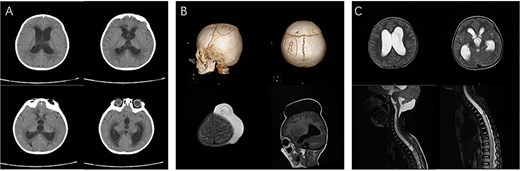
Syringomyelia developed in a 3-year-and-5-month-old male patient following ventriculosubgaleal shunt. (A) Initial cranial CT upon admission demonstrated hydrocephalus. (B) A postoperative cranial CT scan was obtained following ventriculosubgaleal shunt. (C) MRI performed on postoperative day 20 after ventriculosubgaleal shunt demonstrated spinal cord infection, spinal cord edema, syringomyelia, and progression of hydrocephalus.
The second case presentation
A 1-year-old girl was admitted because of abnormal head circumference enlargement and intermittent vomiting for more than 6 months. Prenatal ultrasound performed 1 day before birth had revealed an intracranial tumor. At 5 months of age, cranial MRI demonstrated a tumor in the lateral ventricle associated with hydrocephalus (Fig. 2A). During the course of the disease, the child developed progressive enlargement of head circumference, a bulging anterior fontanelle, visibly distended scalp veins, intermittent vomiting, and occasional seizures. The seizures were characterized by fixed gaze and perioral cyanosis, lasting several minutes before spontaneous resolution. At admission to our hospital, the initial diagnosis was a lateral ventricular space-occupying lesion with hydrocephalus. After completion of the preoperative evaluation, the patient underwent elective ventriculoperitoneal (VP) shunting. The operation was successful, her general condition improved, the wound healed well, and she was discharged in stable condition. One year and six months later, the child was readmitted due to intermittent vomiting and recurrent seizures lasting for five months. Oral valproic acid was given to control the seizures, but it was ineffective. During this interval, repeat cranial MRI at another hospital revealed a tumor involving the pineal region and interventricular foramen with obstructive hydrocephalus. Since the first discharge, the child had also shown delayed neurological development, and her head circumference had continued to enlarge. After admission, relevant examinations were completed, and under general anesthesia, the patient underwent resection of the pineal region lesion via an infratentorial supracerebellar approach. Her postoperative condition stabilized, and she was discharged. Subsequently, the child underwent a second intracranial tumor resection and VP shunt revision/replacement at Shanghai Xinhua Hospital. Later, due to an infection of the VP shunt, she underwent Ommaya reservoir implantation and VP shunting at the same hospital. The child was readmitted to our hospital because of poor drainage from the externalized distal drainage catheter, with an output of ~40–120 mL/day, for replacement of the drainage catheter. Preoperative cranial CT (Fig. 2B) showed an irregular, mixed-density lesion in the pineal region with unclear borders; enlargement of the third and fourth ventricles, as well as both lateral ventricles, with irregular shapes. The transparent septum was unclear, and linear fluid-density low signals were seen beneath the bilateral frontal and temporal parietal bones, with the widest measurement on the left side being about 4.04 cm. The left-sided low-density area appeared to communicate with the left lateral ventricle. Both cerebral hemispheres and both cerebellar hemispheres were compressed and deformed. Drainage catheter tracts were visible in the right frontal bone and bilateral parietal bones, with the catheter tip located in the right lateral ventricle and beneath the left parietal bone. Preoperative cerebrospinal fluid (CSF) analysis showed severe inflammatory changes, including a white blood cell count of 1428 × 106/L, chloride of 110.5 mmol/L, glucose of 2.58 mmol/L, protein of 0.47 g/L, and red blood cells of 46 × 109/L. Preoperative anti-infective treatment consisted of meropenem and vancomycin, with vancomycin administered via injection into the Ommaya reservoir. After completion of 2 courses of anti-infective therapy, the patient underwent emergency VP shunt revision, Ommaya reservoir removal, and ventriculosubgaleal shunting. Seven days after surgery, combination anti-infective therapy with vancomycin and meropenem was continued. Postoperative cranial CT (Fig. 2C) and spinal MRI (Fig. 2D) showed diffuse spinal cord swelling. Clinically, the patient exhibited poor coordination of lower limb movement, decreased activity of the left lower limb, and gait instability. On postoperative day 15, repeat CSF analysis showed partial improvement, with a white blood cell count of 125 × 106/L, glucose of 3.44 mmol/L, protein of 0.55 g/L, and red blood cells of 25 × 109/L. The child was discharged without obvious fever. Follow-up was performed at 6 and 9 months after surgery, and serial CSF examinations showed no obvious evidence of persistent infection. Nine months after surgery, the subgaleal shunt catheter was removed and VP shunting was performed. Follow-up spinal MRI demonstrated multiple bead-like cystic abnormal signals along the entire spinal cord, suggestive of syringomyelia (Fig. 2E). Despite residual neurological impairment, the child was still able to ambulate with a limp and perform simple daily activities independently. The final diagnosis in this case was a pineal region space-occupying lesion with obstructive hydrocephalus, complicated by VP shunt infection, shunt dysfunction, and subsequent syringomyelia. Adjunctive therapies included oral valproic acid for seizure control, anti-infective treatment with meropenem and vancomycin, intraventricular antibiotic administration via the Ommaya reservoir, and serial CSF monitoring during follow-up.
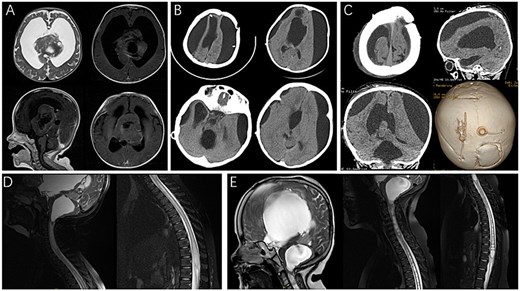
A 1-year-old female patient was noted to have progressive macrocephaly associated with intermittent episodes of vomiting. (A) At five months of age, cranial MRI showed a tumor in the lateral ventricle and hydrocephalus. (B) Preoperative cranial CT showed an irregular, mixed-density lesion in the pineal region with unclear borders. (C, D) Postoperative cranial CT and spinal MRI showed diffuse swelling of the spinal cord. (E) Follow-up spinal MRI at 9 months after surgery demonstrated multiple beaded, cystic signal changes extending throughout the spinal cord, consistent with syringomyelia.
Results
In the two cases we report, bacterial colonization within the ventricular system may have already been present before ventriculosubgaleal shunt placement. Although prolonged external ventricular drainage was performed, the intraventricular infection may not have been completely eradicated, allowing viable bacteria to persist. After ventriculosubgaleal shunt placement, the subsequent development of syringomyelia may have been associated with persistent infection, inflammation, and secondary disturbance of cerebrospinal fluid circulation rather than direct bacterial spread into the spinal cord. However, intraventricular vancomycin administration through the reservoir before conversion to VP shunting ultimately eradicated the ventricular infection, and the patient subsequently underwent VP shunt placement successfully. No further infections recurred during the one and a half years of follow-up. Although abnormal cranial remodeling was noted after removal of the ventriculosubgaleal shunt, the cranial shape gradually returned to normal during follow-up.
Discussion
The subgaleal layer is located between the galea aponeurotica and the periosteum and has a strong absorption capacity [12]. A 4-year-old child who had undergone hydrocephalus shunting developed a subgaleal cyst due to shunt catheter rupture. However, the child did not experience increased intracranial pressure despite the malfunctioning shunt, which further demonstrates the strong absorption and storage capacities of the subgaleal space [13]. Ventriculosubgaleal shunt (VSG) can serve an important role in clearing debris and infections from the ventricles [8]. Ventriculosubgaleal shunt (VSG) can prevent the loss of electrolytes, fluids, and nutrients, which is particularly beneficial for children [14]. For infants with infectious hydrocephalus awaiting ventriculoperitoneal shunt (VPS) surgery, ventriculosubgaleal shunt is a safe and effective method [15].
There is no standardized surgical procedure for ventriculosubgaleal shunt, and some ventriculosubgaleal shunts are performed without valves [16]. The infection rate for ventriculosubgaleal shunting varies, with a range of 1.5%–41% [17, 18]. This variation may be related to the repeated flow of cerebrospinal fluid between the subgaleal space and the ventricles. Unlike the use of low-pressure valves [19], we use a one-way valve (the medium-pressure valve from the Sophysa shunt) to allow cerebrospinal fluid to flow unidirectionally into the subgaleal pocket (We use a distal slit valve in order to create a one-way flow of CSF into the subgaleal pocket). This prevents the subgaleal fluid from flowing back into the ventricles. The one-way valve maintains a pressure of 110 mmHg, which helps to avoid a sudden decrease in intracranial pressure that could lead to intracranial hemorrhage. Frassanito et al. also recommended using a valve in ventriculosubgaleal shunting, but they did not specify the type of valve to be used [20].
Compared to other short-term treatments for hydrocephalus, VSG has significant advantages in draining excessive cerebrospinal fluid. Due to the closed nature of the CSF drainage system and the absence of external drainage tubes, VSG has a lower infection rate compared to other ventriculoperitoneal shunts [12]. Common complications after VSG include infection, leakage, wound rupture, shunt tube kinking, and skull deformation [12, 21, 22]. However, cases of spinal infection as a complication following VSG are rare and have not been reported in the literature so far.
Conclusion
Syringomyelia occurring after ventriculosubgaleal shunting in patients with infectious hydrocephalus should not be interpreted as a direct consequence of the shunt alone. Persistent ventricular infection, inflammation, and disturbed cerebrospinal fluid hydrodynamics may jointly contribute to syrinx formation.
Acknowledgements
The authors would like to express our gratitude to Chatgpt4o (https://www.openai.com/) for the expert linguistic services provided.
Conflicts of interest
The authors declare no conflicts of interest.
Funding
None declared.
References
Author notes
Peipei Guo and Hao Zhang contributed equally to this work.


