


Abstract
Diaphragm disease of the intestine is a rare entity that is commonly associated with long-term non-steroidal anti-inflammatory drug (NSAID) usage. There are reports on those that also occur without appreciable NSAID usage. Resection and anastomosis of the affected segment is the approved treatment.
INTRODUCTION
Small bowel obstruction can be caused by a myriad of factors; extrinsic, intramural or intraluminal. These factors are too numerous to mention here for the purpose of this report. However the pathogenic factor being presented here is unusual to the point of being highly unexpected; a pin-hole within a septum inside the distal ileum in two places about 20cm from each other. This unusual lesion is termed diaphragm disease of the ileum. A case is presented here with a discussion of presentation, diagnosis and treatment with a review of available literature. This case is the first reported case in West Africa.
CASE REPORT
A 67-year old female Jehovah’s Witness presented to a private hospital in Ibadan with a 2-week history of recurrent severe colicky abdominal pain. There was vomiting but no significant abdominal distension other than the presence of a right lower quadrant mass whenever the abdominal colic starts. The abdominal pain was usually truncated by a gush of liquid faeces roughly 1 or 2 hours after the onset of pain. She had been to 2 other hospitals that had refused to operate on her without blood transfusion before being brought to the present hospital that is a cooperator with Jehovah’s Witnesses health liaison unit.
On examination, the patient was elderly, conscious but in pain, she was not dehydrated. Her temperature was 36.8°C, pulse rate 100/minute and a blood pressure of 124/85mmhg in the supine position. Her chest was clinically clear, her abdomen was full but not distended, and it was soft with the presence of 2 oval masses in the right lower quadrant. These masses were firm and moderately tender, mobile in all planes. There was no demonstrable ascites. Vaginal and rectal examinations were unremarkable. Our initial diagnosis was recurrent incomplete small bowel obstruction from intussusception with a differential diagnosis of abdominal lymphoma.
Her white blood cell count was 3,800/cubic mm and her electrolytes and urea estimations were within normal limits.
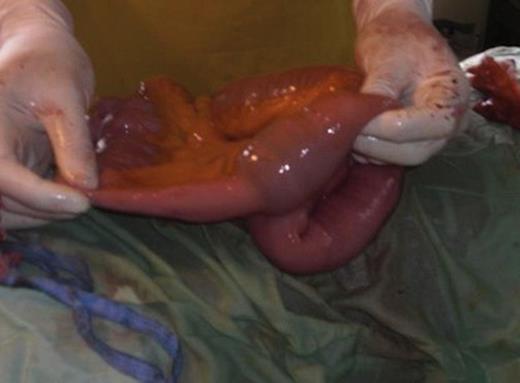
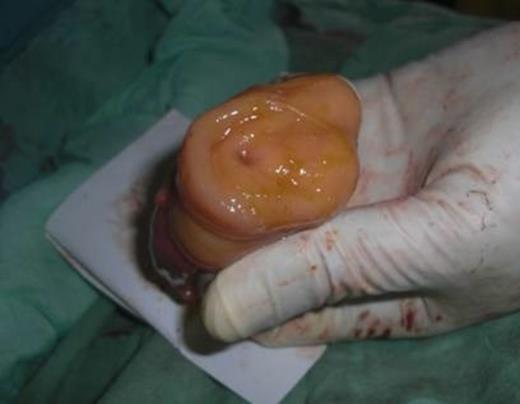
Informed consent was then obtained to operate without blood. She had an exploratory laparotomy the next day and there were findings at two areas of the distal ileum that showed proximal dilatations (Figure 1). Otherwise the peritoneal cavity looked grossly normal. Our first thought was that the intussusceptions had reduced spontaneously under anesthesia but attempts to milk held-up intestinal contents in a pro-grade manner failed, thus we felt it was better to resect these segments. Our findings after resection showed the reasons for these 2 blockages were pin-hole septa, 20cm from each other (Figure 2). End to end anastomoses were performed at both sites and her post-operative period was uneventful. Histopathology report of the 2 resected segments was sub-mucosal fibrosis.
DISCUSSION
Diaphragm disease is seen when the lumen of the small bowel is divided into short compartments by circular membranes of mucosa and sub-mucosa; these membranes have a pinhole lumen leading to frequent bouts of intestinal obstruction (1). The condition is said to be rare and associated with prolonged or long-term usage of non-steroidal anti-inflammatory drugs (NSAIDs) (1,–,6). It occurs more commonly in elderly patients, who, by virtue of arthritic complaints, are more likely to take NSAIDs for long periods (2,3).
Although a definite history of prolonged NSAID use was not obtained in this patient, this condition has also been reported in patients who denied NSAID usage (1). The condition typically presents with acute intestinal obstruction with bouts of colicky abdominal pain, vomiting and constipation. The Pathophysiology is said to involve the local stimulation, damage and attempts at repair by the mucosa in patients using NSAIDs for a long time (4). However a report challenged that hypothesis when such a diaphragm was found in a bypassed ileal segment that had not come in contact with intra-luminal contents for many years; the authors made a case for at least a partial systemic mechanism in the Pathophysiology of this lesion (5). Recognizing this condition pre-operatively requires a high index of suspicion, however enteroclysis intra-operative enteroscopy (2,3), double-balloon enteroscopy (6) and combined enteroscopy and enteroclysis (7) are some imaging modalities that may help confirm the diagnosis and also delineate the extent of resection.
Resection of the segments involved with anastomosis is the definitive treatment; however there has been report of the use of stricturoplasty for this condition (8).


