


 https://orcid.org/0000-0002-2356-7494

Abstract
The da Vinci Single-Port (SP) system received CE Mark approval for transoral robotic surgery in January 2024. Nevertheless, clinical experience with this platform in Europe remains limited – particularly in the field of minimally invasive head and neck surgery. In this report, we present the case of a 51-year-old man with p16-positive squamous cell carcinoma of the right tonsil who underwent transoral robotic resection using the da Vinci SP system, combined with contralateral tonsillectomy and bilateral neck dissection, at a German university hospital. To our knowledge, this represents one of the earliest reported oncologic applications of the da Vinci SP system in Germany following CE mark approval, highlighting its integration into established multimodal treatment pathways for oropharyngeal carcinoma. Further multicenter studies are required to define its role in clinical implementation compared with established techniques such as transoral laser microsurgery and earlier robotic systems.
Introduction
Transoral tumour surgery has traditionally relied on well-established techniques such as CO2 transoral laser microsurgery (TLM). However, these approaches may be constrained by limited visualization and restricted instrument maneuverability in anatomically complex regions of the upper aerodigestive tract [1]. In recent years, robotic-assisted platforms have emerged as promising alternatives, expanding the surgical armamentarium of head and neck surgeons [2]. Earlier multiport robotic platforms, including the da Vinci Xi system (Intuitive Surgical Inc., USA), improved surgical access and dexterity compared with conventional transoral approaches and became widely adopted in transoral robotic surgery (TORS) programs worldwide [3]. Nevertheless, external robotic arm collision, limited flexibility in narrow anatomical regions, and challenging visualization remain recognized technical limitations [4]. The da Vinci Single-Port (SP) system (Intuitive Surgical Inc., USA) represents the latest advancement in robotic-assisted head and neck surgery. It features a single robotic arm that accommodates an articulating endoscope and up to three articulating instruments, all introduced through a single point, such as the oral cavity. This design aims to overcome limitations of conventional transoral techniques and earlier multi-port robotic systems by enabling intracavitary instrument triangulation through a single access port. Its articulating endoscope and instruments facilitate visualization and maneuverability within confined oropharyngeal regions while reducing external instrument collision and crowding around the oral cavity, thereby improving assistant access for suction, tissue retraction, and instrument exchange. We have previously demonstrated the feasibility of the da Vinci SP system for TORS in bilateral tonsillectomy [5]. Building on this experience, we now report an early oncologic application of the da Vinci SP system in Germany following CE mark approval, in a patient with human papilloma (HPV)-associated oropharyngeal carcinoma, with the aim of further defining its role in contemporary head and neck surgery.
Case report
Case presentation
A 51-year-old man presented to our outpatient clinic with a 2-month history of painless right-sided cervical swelling. His medical history was unremarkable. Otorhinolaryngological examination revealed asymmetry of the tonsils, with enlargement of the right tonsil. The patient subsequently underwent panendoscopy with bilateral tonsillar biopsies. Histopathological analysis demonstrated a p16-positive squamous cell carcinoma of the right tonsil. Contrast-enhanced computed tomography (CT) of the neck revealed suspicious metastatic lymph nodes in the right level II. Following multidisciplinary tumour board discussion, the indication was made for transoral tumour resection with contralateral tonsillectomy and bilateral neck dissection.
Operative technique
The surgical setup—including patient positioning, head positioning, intubation route, configuration of the da Vinci SP system, and operating room layout—was identical to that described in our previous publication [5]. In detail, the operating table was set to its lowest position, the patient was placed in the supine position, and the assistant’s position was to the right of the patient’s head and behind the port, while the port placement was aligned above the opened patient’s mouth with all inserted instruments directed towards the tonsil region after docking (Fig. 1). For the present procedure, a Morinière mouth gag (MicroFrance, France) was used to achieve improved oral and oropharyngeal exposure. In addition, a flexible suction catheter was inserted transnasally to further facilitate smoke evacuation via the oropharynx (Fig. 2).
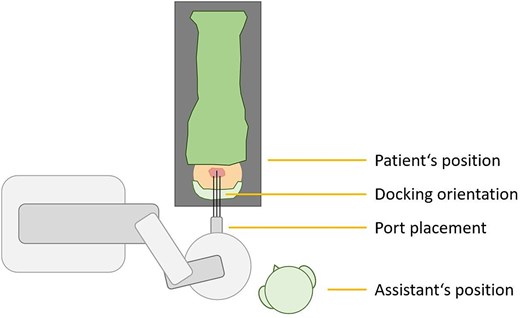
Operating room setup and orientation of patient, assistant, and port.
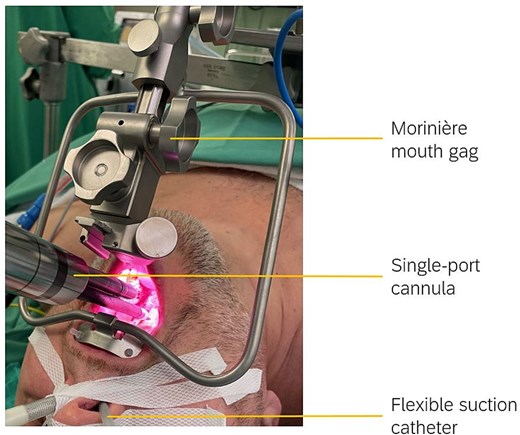
Surgical setup. The patient is positioned supine with the head extended. A Morinière mouth gag (MicroFrance, France) provides optimal exposure with the single-port cannula positioned in front of the oral cavity. A flexible suction catheter is inserted transnasally to facilitate smoke evacuation via the oropharynx.
The procedure commenced with transoral orientation and alignment of the robotic instruments—an articulating monopolar cautery instrument on the right and an articulating Maryland bipolar forceps on the left—while the assistant at the head of the patient provided suction and tissue retraction. The superior tonsillar pole was grasped and medialized. Sharp dissection was then initiated at the superior aspect of the tonsil using monopolar cautery, facilitating release of the tumour from its underlying tissue (Fig. 3).
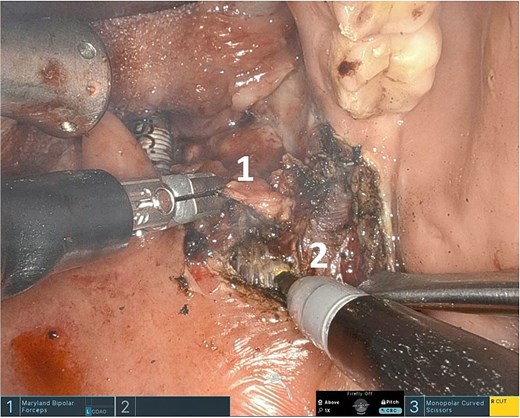
Initiation of transoral dissection. Medialization of the tonsil squamous cell carcinoma (1) and sharp dissection of the tumor from its underlying tissue (2).
Sharp dissection continued caudolateral using the monopolar instrument with closed scissors, maintaining an oncologic safety margin around the tumour, which had invaded the pharyngeal constrictor muscle. The squamous cell carcinoma was retracted with the articulating Maryland bipolar forceps. Minor bleeding was controlled intermittently with bipolar coagulation. The stylohyoid muscle was then divided to expose the underlying vessels, with no residual tumour observed in this region (Fig. 4).
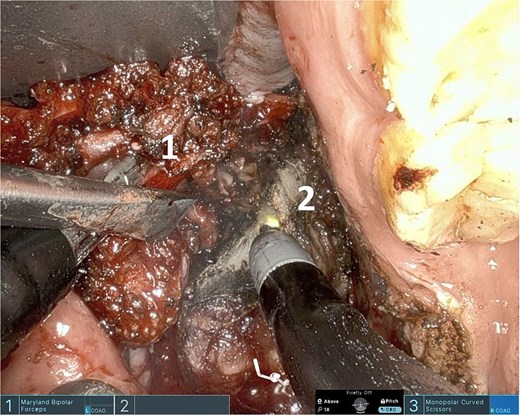
Caudolateral dissection. Tumour retraction (1) and exposure of the stylohyoid region (2), with no residual squamous cell carcinoma observed.
Dissection continued caudally toward the base of the tongue, where the tumour extended deeply. The mouth gag was repositioned to optimize exposure of the tongue base. The tumour portion involving the tongue base and extending into the vallecula was then carefully resected with an oncologic safety margin, with the caudal margin reaching the vallecular and close to the epiglottis (Fig. 5).
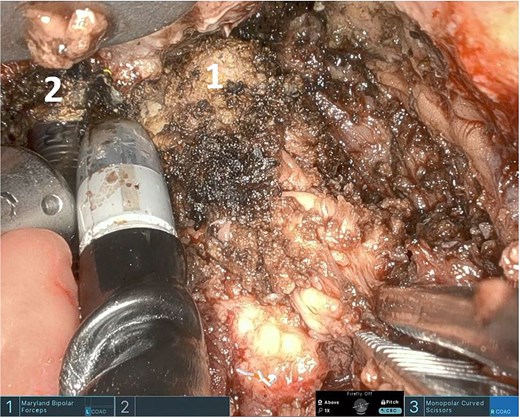
Tongue base dissection. Resection of the tumor involving the vallecula (1), with the caudal margin approaching the epiglottis (2).
Shortly before completing the dissection, the nearly fully mobilized tumour was secured at the superior tonsillar pole with forceps. Following the completed tumour resection (Fig. 6), the specimen was oriented and suture-marked on the instrument table to facilitate accurate pathological assessment (Fig. 7).
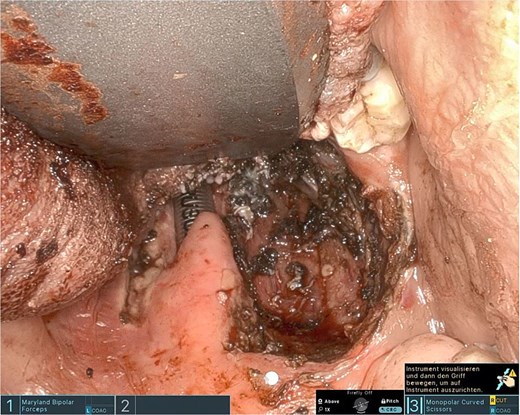
Situs after completed tumour resection.
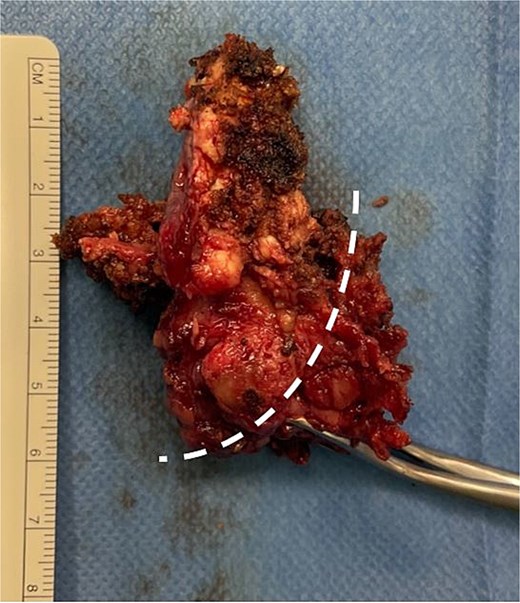
Tumor specimen after en bloc resection. Forceps indicate the formerly superior pole of the right tonsil. The dotted white line marks the palatoglossal arch.
Following tumour resection, frozen-section samples were obtained from all resection margins, including the tongue base, posterior pharyngeal wall, wound bed, buccal mucosa, palatoglossal arch, and uvula. All frozen sections were free of tumour. Subsequently, left tonsillectomy, bilateral neck dissection, and tracheotomy for airway protection were performed. A nasogastric feeding tube was inserted and secured. The total operative time was 5 hours and 27 minutes, of which 1 hour and 9 minutes were dedicated on the da Vinci SP-assisted tumour resection. No intraoperative complications occurred. Postoperatively, the patient was monitored on the ward, with no episodes of bleeding during follow-up. The patient was discharged home in good general condition. Histological examination confirmed a tumour stage of pT3 (4.7 cm), pN1b, L0, V0, Pn0.
Discussion
Oropharyngeal carcinomas, predominantly HPV-associated, are increasingly common, with squamous cell carcinomas of the oropharynx now ranking sixth among cancers in men [6]. This underscores the need for ongoing evaluation of alternative therapeutic approaches, such as TORS, to continuously refine and optimize treatment strategies [6]. TORS of the oropharynx is not a novel concept. It was first described in 2007 by Weinstein et al. for radical tonsillectomy using an earlier generation da Vinci system [2]. Since then, transoral robotic approaches have become an established treatment option in head and neck oncology, particularly for oropharyngeal tumours. It allows precise, tissue-sparing resections while maintaining oncological control and preserving functional outcomes [7]. This case demonstrated the feasibility of integrating the da Vinci SP system into established oncological workflows for oropharyngeal carcinoma management, combining enhanced visualization with precision instrument control in anatomically challenging regions. Several groups have recently reported successful application of the da Vinci SP system, e.g. for lateral oropharyngectomy or supraglottic laryngectomy [8, 9]. Comparative analyses between the da Vinci SP and Xi platforms have demonstrated comparable oncologic outcomes, while highlighting potential advantage of the SP system regarding reduced instrument collision and improved exposure in confined surgical fields [10]. In the present case, these characteristics were particularly evident during tongue base and vallecular dissection, where the SP configuration enabled stable visualization and precise instrument articulation despite the restricted anatomy. Nevertheless, core operative principles of established TORS techniques, including adequate transoral exposure, margin control, and assistant-guided suction and retraction, remained unchanged. Potential limitations of the da Vinci SP system include the learning curve associated with articulating intracavitary instruments as well as the current limited clinical experience and availability in Europe. To establish the broader application of the da Vinci SP system, robust multicenter data are required, ideally in comparison with established techniques such as TLM as well as earlier robotic platforms including the da Vinci Xi system.
Conflicts of interest
The authors declare no conflict of interest.
Funding
None declared.
Data availability
All data generated or analysed during this study are included in this article. Further inquiries can be directed at the corresponding author.
Consent
Written informed consent was obtained from the patient for use of images for academic and research purposes as well as publication.


