


Abstract
Intentional ingestion of sharp foreign bodies in adults is uncommon and often associated with self-harm behavior. Multiple sharp objects located in different gastrointestinal segments significantly increase the risk of perforation and bleeding. We report a 27-year-old man who intentionally ingested nine razor blades and a full-length metallic fork. Radiography demonstrated multiple radiopaque objects without free air. Non-contrast computed tomography revealed a 185-mm fork extending from the distal esophagus into the stomach and razor blades within the proximal small bowel. Given the length of the fork, the multiplicity of sharp objects, and their distribution beyond the pylorus, endoscopic retrieval was deemed unsafe. The patient underwent urgent exploratory laparotomy with combined enterotomy and gastrotomy, enabling complete removal under intraoperative fluoroscopic guidance. Recovery was uneventful, and psychiatric follow-up was arranged. This case highlights the importance of early imaging, timely surgical intervention, and multidisciplinary care in managing complex sharp foreign body ingestion.
Introduction
Foreign body ingestion accounts for approximately 150 000 emergency visits annually in the United States, with the majority occurring in young children (ASGE guidelines) [1]. In adults, ingestion is usually intentional and associated with psychiatric illness, substance abuse, incarceration, or self-harm behavior [2, 3].
Most swallowed objects pass spontaneously; however, sharp and elongated objects behave differently. Sharp objects have a perforation risk of up to 35% [1], and objects >6 cm seldom traverse the pylorus because of duodenal angulation [4]. Multiple sharp objects across different gastrointestinal segments dramatically increase the risk of perforation and bleeding.
Published reports typically describe either a single razor blade or a single elongated object. Our case is unusual for involving both a full-length table fork lodged in the distal esophagus and stomach, and multiple razor blades in the small bowel, necessitating combined gastrotomy and enterotomy. This report highlights decision-making principles for high-risk ingestions.
Case presentation
A 27-year-old man presented to the emergency department on June 26 after intentionally ingesting a full-length metal table fork and multiple razor blades approximately 6 hours prior to admission. The patient reported that the ingestion occurred during an episode of acute emotional distress following a personal conflict. He denied any prior history of self-harm, psychiatric illness, or substance abuse.
On presentation, he was calm, alert, and hemodynamically stable. His vital signs were within normal limits, including a blood pressure of 122/76 mmHg, heart rate of 88 beats per minute, respiratory rate of 18 breaths per minute, temperature of 37.1°C, and oxygen saturation of 98% on room air. Physical examination revealed a soft, non-tender abdomen without guarding or rebound tenderness, and normal bowel sounds were present. Rectal examination was unremarkable. The patient denied abdominal pain, nausea, vomiting, hematemesis, melena, chest pain, dyspnea, or dysphagia.
Laboratory investigations showed leukocytosis with a white blood cell count of 14.9 × 10³/μL (reference range: 4–10 × 103/μL) and neutrophil predominance (73.6%). Hemoglobin was 12.4 g/dL (reference range: 13–17 g/dL), and platelet count was 336 × 103/μL (reference range: 150–400 × 103/μL). Serum electrolytes were within normal limits (Na 141 mmol/L [135–145], K 4.4 mmol/L [3.5–5.0]). Coagulation profile was normal (PT 14.2 s [11–15], INR 1.1, aPTT 32.6 s [25–35]). Arterial blood gas analysis showed pH 7.35 (7.35–7.45), pCO₂ 48.9 mmHg (35–45), and HCO₃ 26.4 mmol/L (22–26). Toxicology screening was negative.
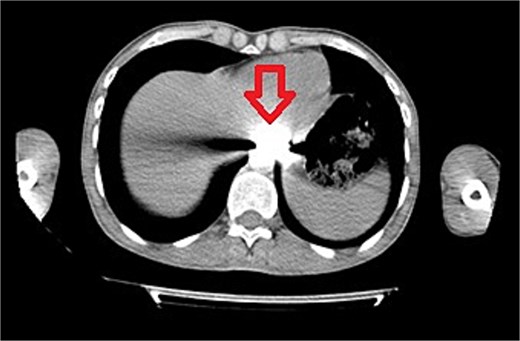
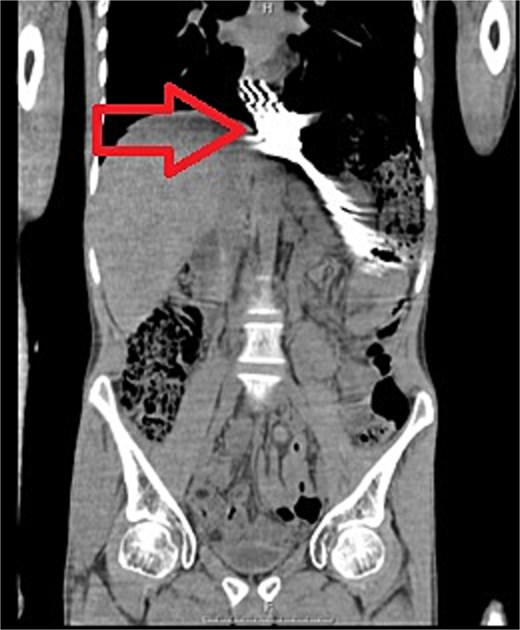
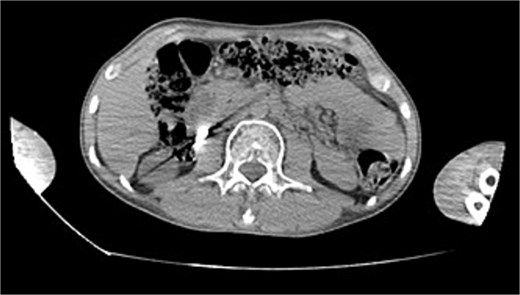
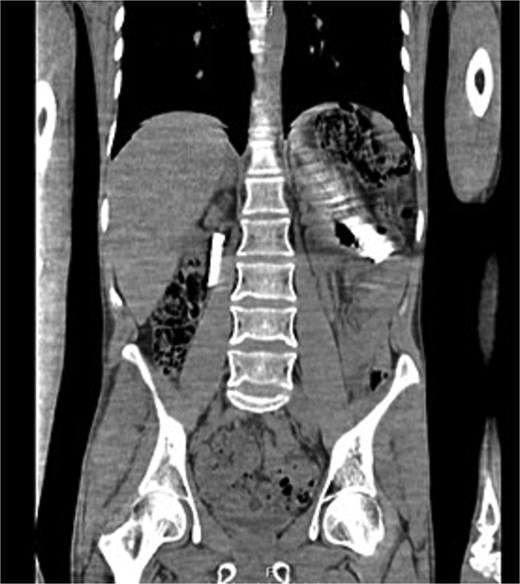
Plain radiographs demonstrated multiple radiopaque foreign bodies without evidence of free air (Figs 1–3). Non-contrast computed tomography (CT) revealed a 185 × 26 mm metallic fork extending from the distal esophagus into the stomach, as well as a razor blade measuring 46 × 10 mm within the duodenum, without pneumoperitoneum or free fluid (Figs 4–7).
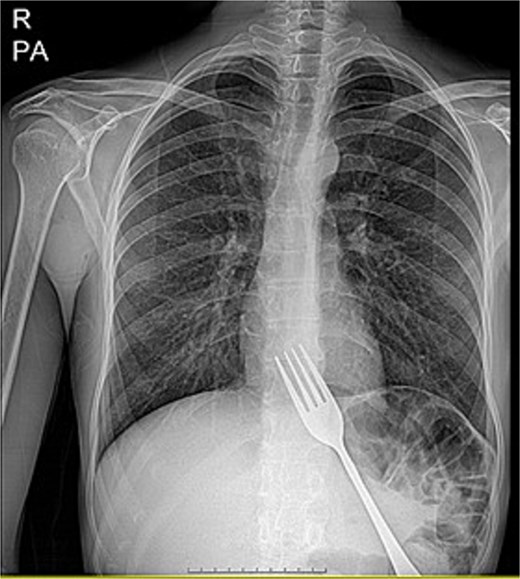
Upright chest X-ray (PA view) shows no subdiaphragmatic free gas, with intact diaphragmatic contour bilaterally. The findings are negative for pneumoperitoneum.
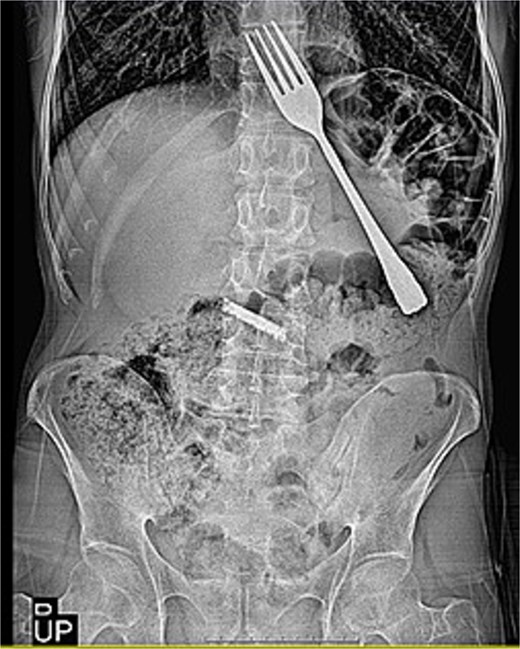
Upright abdominal X-ray showing metallic densities in the upper abdomen, consistent with ingested foreign bodies. No pneumoperitoneum is noted.
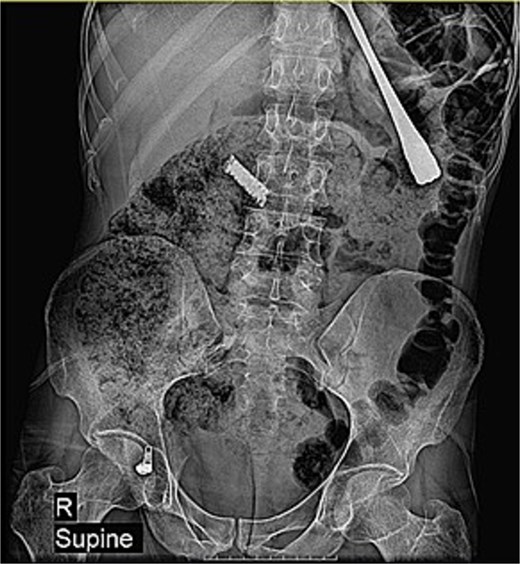
Supine abdominal X-ray demonstrating multiple metallic objects, corresponding to the table fork and razor blades, without evidence of free air or obstruction.
Sagittal non-contrast CT images demonstrating a metallic fork extending from the distal esophagus into the stomach. Due to significant beam-hardening artifacts, visualization of the full contour of the fork is partially obscured. The approximate location and orientation of the fork should be interpreted with caution. Arrows are used to indicate the suspected position of the foreign body.
Axial non-contrast CT images demonstrating a metallic fork extending from the distal esophagus into the stomach. Due to significant beam-hardening artifacts, visualization of the full contour of the fork is partially obscured. The approximate location and orientation of the fork should be interpreted with caution. Arrows are used to indicate the suspected position of the foreign body.
Sagittal non-contrast CT image showing a 46 × 10 mm razor blade located in the duodenum. No free fluid or pneumoperitoneum is present.
Axial CT image showing a 46 × 10 mm razor blade located in the duodenum. No free fluid or pneumoperitoneum is present.
Given the length of the fork, the presence of multiple sharp objects, and their distribution beyond the pylorus, endoscopic retrieval was considered unsafe. The patient underwent urgent exploratory laparotomy under general anesthesia. A midline incision was performed, and the abdominal cavity was systematically explored. An enterotomy was created approximately 30 cm distal to the ligament of Treitz, through which nine razor blades were carefully extracted. The small bowel was subsequently examined along its entire length and confirmed to be free of additional foreign bodies.
A gastrotomy was then performed on the anterior wall of the stomach, approximately 8 cm proximal to the pylorus, allowing removal of the full-length fork intact (Fig. 8). Intraoperative fluoroscopy (C-arm) was used to confirm complete clearance of all foreign bodies. The gastrointestinal tract was repaired in standard fashion, and the abdominal cavity was irrigated and closed.
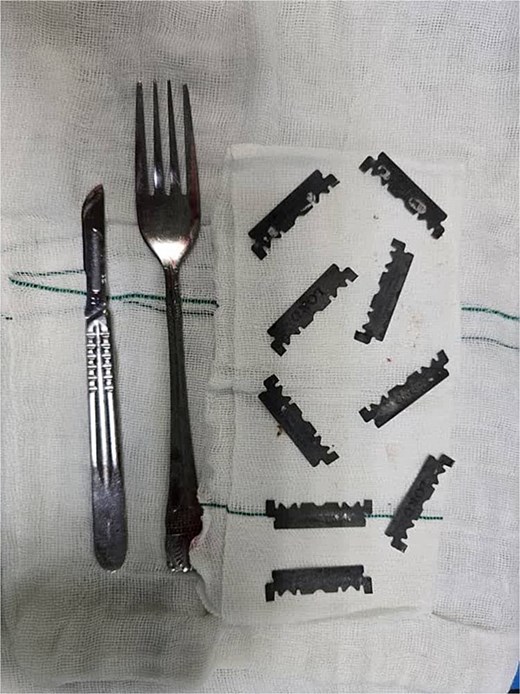
Postoperative photograph of extracted foreign bodies: Nine razor blades and one full-length table fork.
The postoperative course was uneventful. Oral intake was resumed on postoperative day 2, and the patient was discharged on postoperative day 5 in stable condition. A psychiatric consultation was arranged prior to discharge. At two-week follow-up, the patient remained asymptomatic with no postoperative complications.
Discussion
Foreign body ingestion is common in pediatric populations; however, in adults it is more often intentional and associated with psychiatric disorders, incarceration, or substance misuse [5]. Although most ingested objects pass spontaneously, sharp, elongated, or multiple foreign bodies frequently require intervention because of the increased risk of bleeding, obstruction, and perforation. Reported perforation rates for sharp objects range from 15% to 35%, substantially higher than for blunt objects. In addition, objects longer than 6 cm rarely pass the pylorus spontaneously and are prone to impaction at anatomical narrowing points within the gastrointestinal tract. Current guidelines therefore recommend urgent removal of sharp or long objects, particularly when multiple objects or distal migration are present [5–8].
The present case represents an unusual and high-risk pattern of ingestion involving both a full-length table fork and multiple razor blades located in different gastrointestinal segments. Most previously reported cases describe either a single elongated object or isolated sharp items managed with a single therapeutic modality. In contrast, the coexistence of a long rigid object extending into the stomach and multiple sharp blades within the proximal small bowel required a combined surgical strategy.
Endoscopic retrieval was considered but deemed inappropriate because of the size and rigidity of the fork, the multiplicity of sharp objects, and distal migration beyond the pylorus. Under these conditions, endoscopic extraction carries increased risks of mucosal injury, incomplete retrieval, and distal displacement of fragments. Exploratory laparotomy with combined gastrotomy and enterotomy enabled safe and complete removal of all foreign bodies. Intraoperative fluoroscopy further confirmed complete gastrointestinal clearance and may provide additional safety in selected cases involving multiple ingested objects [8, 9].
An additional notable feature was the absence of symptoms despite the presence of multiple sharp foreign bodies. The patient remained hemodynamically stable without signs of perforation or obstruction, highlighting the importance of early imaging in suspected ingestion. CT was particularly valuable in defining the number, size, and location of the objects and excluding associated complications.
Intentional foreign body ingestion is strongly associated with psychiatric comorbidity and a high risk of recurrence. Accordingly, management should extend beyond the acute surgical problem and include multidisciplinary psychiatric assessment and follow-up. Early recognition of high-risk features—including sharp morphology, length greater than 6 cm, multiplicity, and distal location—should prompt timely surgical consultation and individualized operative planning [10, 11].
As a single case report, this study is inherently limited by the inability to generalize outcomes or directly compare alternative management strategies. Nevertheless, this case highlights the importance of tailored surgical decision-making in complex foreign body ingestion involving multiple high-risk objects distributed across different gastrointestinal segments.
Conclusion
This case underscores that simultaneous ingestion of multiple sharp foreign bodies distributed across different GI segments is an exceedingly high-risk scenario requiring prompt, decisive management. We advocate for early multimodal imaging, multidisciplinary decision-making, and surgical intervention when endoscopic retrieval poses unacceptable risk. Behavioral health follow-up is critical to prevent recurrence and optimize long-term outcomes. This case highlights the importance of prompt imaging, timely surgical intervention, and integrated psychiatric care for intentional multiple sharp foreign body ingestion.
Acknowledgements
The authors would like to thank the Clinical Research Development Unit (CRDU) of Loghman Hakim Hospital, Shahid Beheshti University of Medical Sciences, Tehran, Iran for their support, cooperation and assistance throughout the period of study (43017781).
The authors also wish to extend special thanks to Mr. Masoud Dodangeh for his valuable guidance and dedicated support in improving this manuscript.
Author contributions
Milad Dodangeh: Investigation, Resources, Writing—original draft, and Writing—review & editing.
Omidreza Nikbakht Amirabad: Writing—original draft.
Setareh Mahmoodi: Conceptualization, Supervision, Project administration, Writing—review & editing.
Conflicts of interest
The authors report no declarations of interest.
Funding
Regarding the intent of conducting research, writing, and/or publishing this paper, the writers did not receive any funding or grants.
Ethical approval
Ethical approval for publishing this case report was granted by the Loghman Hospital Research Ethics Committee IR.SBMU.RETECH.REC.1404.854. Informed consent was obtained from the patient.
Consent
The patient provided written informed consent for the publication of this case study and the pictures accompanying it. The journal’s Editor-in-Chief could assess a copy of the written consent on request.
Guarantor
Milad Dodangeh.
Patient perspective
‘I was overwhelmed and not thinking clearly at the time I swallowed the objects. I didn’t realize the severity until I saw the images. After surgery, when I saw the removed objects, I understood how dangerous this was. I am grateful to the surgical team. I am now in psychiatric follow-up and working to prevent this from ever happening again.’
Provenance and peer review
Not commissioned, externally peer-reviewed.


