


 https://orcid.org/0009-0008-4861-733X

Abstract
Massive proximal humeral bone loss with concomitant rotator cuff deficiency is a rare and complex reconstructive challenge, particularly after high-energy trauma. Reverse shoulder arthroplasty (RSA) with an allograft–prosthesis composite (APC) restores humeral length and soft-tissue attachment, while tendon transfer addresses residual rotational deficits. We report a 35-year-old male who presented two weeks after a gunshot injury with an 8-cm open wound and extensive proximal humeral bone loss. Following serial debridement and culture-directed antibiotics, staged reconstruction was undertaken. Initial stabilization with intramedullary nailing and a cement spacer was followed by definitive RSA-APC 21 months post-injury. A structural proximal humeral allograft was fixed with an anterolateral plate, and a lower trapezius tendon transfer was performed using the allograft’s native soft-tissue attachment as a biologic anchor. At 2-year follow-up, complete graft incorporation was observed with meaningful functional improvement.
Introduction
Massive bone loss associated with open proximal humerus fractures and rotator cuff deficiency is exceptionally rare and represents a major reconstructive challenge. These injuries typically occur in younger patients following high-energy trauma and differ substantially from the more common low-energy, osteoporotic fractures seen in the elderly [1, 2]. Although proximal humerus fractures account for 4%–10% of all fractures, open injuries represent <1% and are frequently associated with severe comminution, extensive soft-tissue damage, and high complication rates, including infection, nonunion, and reoperation. As a result, management often requires individualized, multidisciplinary strategies in specialized centers, as conventional fixation techniques may be inadequate [1, 3].
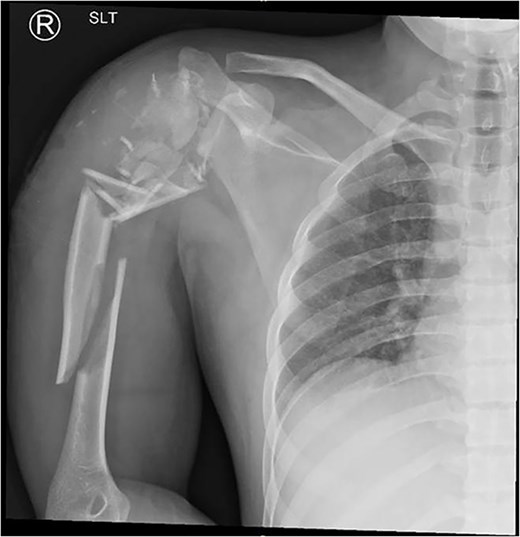
Initial X-ray showing a proximal humerus fracture with extensive bone loss and a butterfly segment of midshaft.
When proximal humeral bone is non-reconstructable, advanced reconstructive options such as reverse shoulder arthroplasty (RSA), RSA with an allograft–prosthesis composite (RSA-APC), or megaprosthetic replacement may be required, depending on the extent of osseous loss [4]. RSA-APC has emerged as an effective solution for massive humeral bone loss, including cases following failed arthroplasty or tumor resection, by restoring humeral length, maintaining deltoid tension, providing stable fixation, and facilitating soft-tissue reattachment [5–7]. Systematic reviews have reported postoperative improvements in forward flexion and abduction to 75°–105°, with patient satisfaction rates reaching 86% following RSA-APC [4–6].
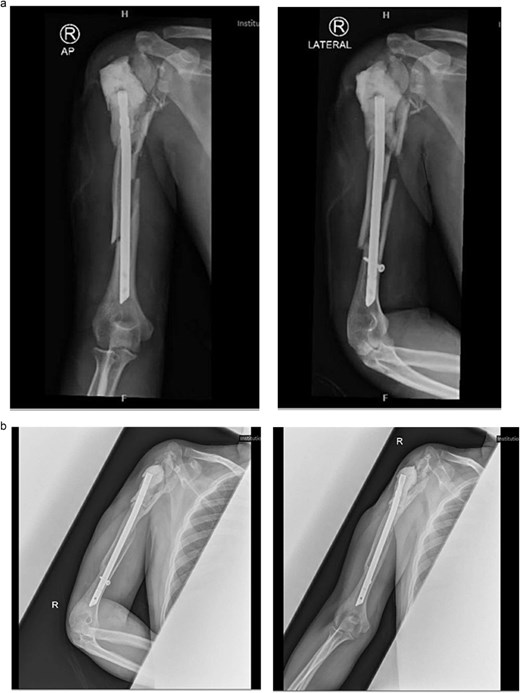
(a) Post IM nail and cement spacer X-ray showing restored length of humerus. (b) X-ray taken 7 months after intramedullary nail insertion, showing maintained length and alignment, and the antibiotic cement spacer in place.
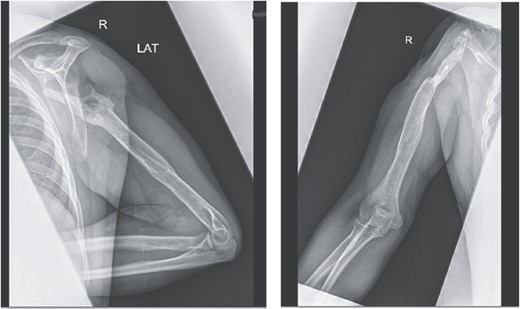
X-ray post IM nail and antibiotics cement spacer removal showing healed butterfly segment in mid shaft.
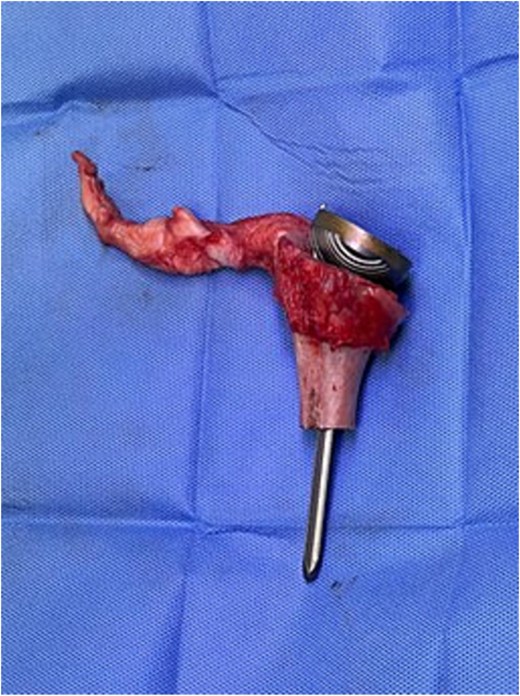
Intra op image showing APC with its proximal capsular and tendinous attachments prepared.
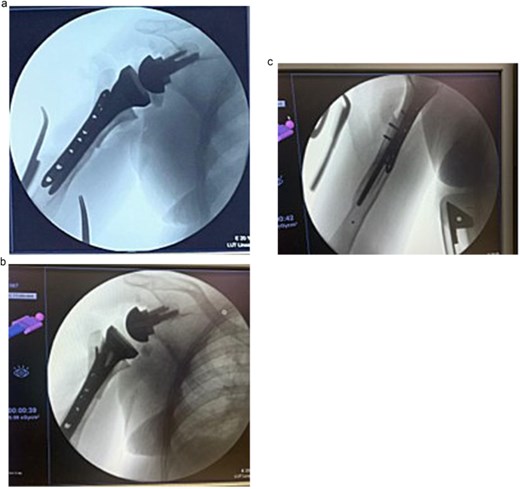
(a–c) Intra-op X-ray showing reduced shoulder with acceptable alignment and rotation.
Soft-tissue reconstruction is equally critical, particularly in the presence of irreparable rotator cuff deficiency, which may result in persistent pain, weakness, and limited range of motion. Tendon transfer procedures, including lower trapezius tendon (LTT) and latissimus dorsi (LD) transfers, are established techniques aimed at improving shoulder biomechanics by reproducing the line of pull of deficient rotator cuff muscles [7–9].
In open fractures, current guidelines emphasize urgent irrigation and debridement, staged reconstruction, and infection-prevention strategies [10, 11]. Two-stage protocols using antibiotic cement spacers followed by delayed RSA have demonstrated high infection-eradication rates and meaningful functional recovery, with reported spacer-to-RSA intervals of 7–9 months [10, 11].
This report describes a rare convergence of high-energy open proximal humeral fracture with massive bone loss in a young patient, managed through a staged approach incorporating definitive RSA-APC and concomitant LTT transfer using the allograft’s native soft-tissue attachments as a biologic anchor. The purpose is to highlight the surgical strategy, technical considerations, and 2-year functional outcomes.
Case presentation
A 35-year-old male with no significant medical history presented two weeks after sustaining a high-velocity gunshot injury to the right shoulder, complaining of pain and limited range of motion. Physical examination revealed an 8-cm open wound with necrotic edges over the anterolateral proximal arm. Active forward flexion, abduction, and external rotation were limited to 30°, 45°, and 0°, respectively, with a positive external rotation lag sign. Neurovascular examination, including axillary nerve function, was intact. Plain radiographs demonstrated a comminuted proximal humeral shaft fracture with extensive bone loss and a midshaft butterfly fragment, while the clavicle, glenoid, and scapula were intact (Fig. 1).
Intraoperatively, extensive bone and soft-tissue loss were confirmed. The patient underwent serial irrigation and debridement with culture-directed antibiotic therapy. One week after initial surgery, intramedullary nailing of the humerus with placement of an antibiotic cement spacer was performed (Fig. 2a and b). The spacer was exchanged at 5 months and subsequently removed with nail extraction at 9 months, with repeat bone and soft-tissue cultures obtained in preparation for definitive reconstruction (Fig. 3).
Definitive reconstruction was performed ~21 months after injury and consisted of Reverse Shoulder Arthroplasty with a Fresh-Frozen Proximal Humerus Allograft-Prosthesis Composite and LTT transfer. Using the previous incision, which was extended proximally and distally to healthy native tissue, the deltopectoral interval was developed. Soft-tissue exploration demonstrated the absence of the rotator cuff tendons, and the latissimus dorsi (LD) tendon could not be identified. The deltoid muscle, including all three segments, was intact. If the deltoid were deficient, a pedicled pectoralis major transfer would have been considered as a backup option. The glenoid was prepared and reconstructed using a 25-mm lateralized Tornier Perform® Reversed Glenoid baseplate (Stryker/Tornier, Mahwah, NJ, USA), which was fixed with a central screw. A standard 36-mm glenosphere was then implanted. The humeral bone defect was estimated preoperatively to measure 10 cm, based on comparison with the contralateral humerus, which was addressed using the structural proximal humeral allograft. The allograft was prepared at the back table to match the proximal humeral bone defect. The proximal soft-tissue attachments were preserved and prepared, resecting the allograft humeral head and preparing the canal using a trial cemented 170-mm AEQUALIS™ Reversed Fracture Long Stem (Tornier/Wright Medical Group N.V., Memphis, TN, USA) (Fig. 4). A 7 × 170-mm cemented AEQUALIS™ Reversed Fracture Long Stem was inserted into the allograft, achieving excellent fit and fixation. The remaining native humerus was then prepared and cemented to accommodate the long humeral stem, with careful attention to restoration of the native proximal humeral retroversion. The allograft–prosthetic composite was subsequently reduced to the native humeral shaft after acceptable rotational alignment had been achieved and was secured using a contoured 8-hole 3.5-mm limited-contact dynamic compression plate placed anterolaterally to bridge the allograft–host bone junction. Final reduction and stability were achieved using a 12-mm lateralized liner (Fig. 5a–c).
To restore posterior cuff function and provide soft-tissue encapsulation, an LTT transfer was performed. Through a medial horizontal incision parallel to the scapular spine, the LTT was identified and released from its attachment, followed by medial release of the muscle to enhance excursion (Fig. 6a and b). The previously prepared proximal capsular and tendinous attachments of the allograft were passed posteriorly through the subacromial space to receive the harvested tendon. With the arm positioned in 30° of abduction and maximal external rotation, the allograft soft-tissue sleeve was then secured to the harvested LTT using heavy, nonabsorbable braided sutures (Fig. 7a and b). The LTT transfer was confirmed to be secure and robust. The wound was then copiously irrigated, and vancomycin powder was applied. Layered closure was performed in the usual fashion.
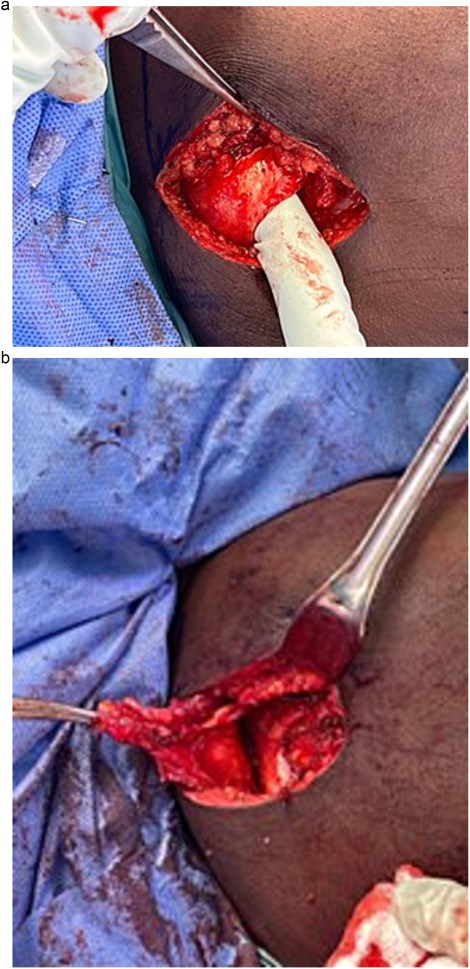
(a, b) Intra op imaging showing LTT graft harvesting and preparation for transfer.
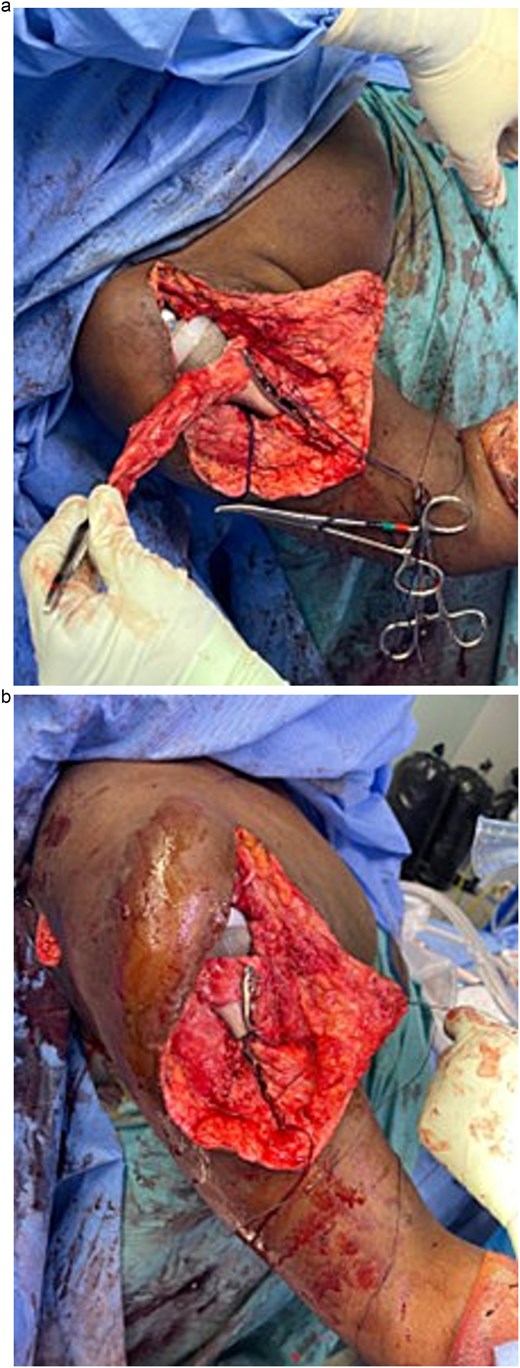
(a) Intra op imaging showing the proximal capsular and tendinous attachments of the allograft prepared to receive the harvested tendon. (b) Intra op imaging after the allograft soft-tissue sleeve is secured to the harvested tendon.
Postoperatively, the patient was immobilized in an abduction pillow with the shoulder positioned in maximal external rotation. A plain radiograph obtained two weeks after the procedure demonstrated a stable implant (Fig. 8). The shoulder was immobilized for six weeks, after which passive range-of-motion exercises, including pendulum movements, were initiated for two weeks, followed by active-assisted range of motion and deltoid strengthening for four weeks. At the 3-month follow-up, active forward flexion, abduction, and external rotation were 60°, 60°, and 30°, respectively; by six months, these improved to 75°, 90°, and 30°, respectively. At the two-year follow-up, radiographs showed a stable implant without evidence of fracture, instability, or loosening (Fig. 9). The allograft–host bone junction demonstrated complete incorporation with no signs of nonunion. Clinically, the patient achieved 90° of forward flexion, 100° of abduction, and 30° of external rotation, with a negative external rotation lag sign.
Patient-reported outcomes reflected substantial improvement. The American Shoulder and Elbow Surgeons (ASES) score increased from 16.7 preoperatively to 76 postoperatively, consistent with marked pain relief and restoration of functional mobility. The patient reported no residual shoulder pain and expressed satisfaction with the overall functional outcome.
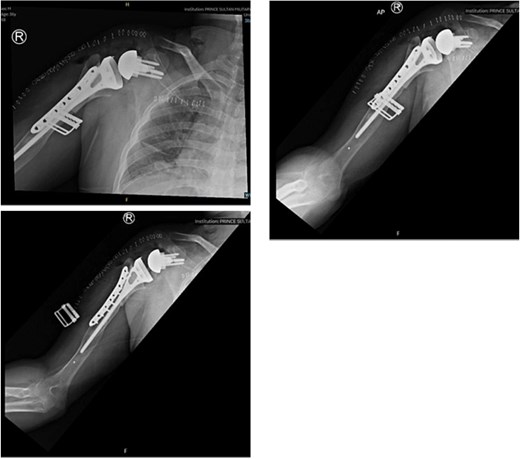
X-ray 2 weeks post-op demonstrating stable implant.
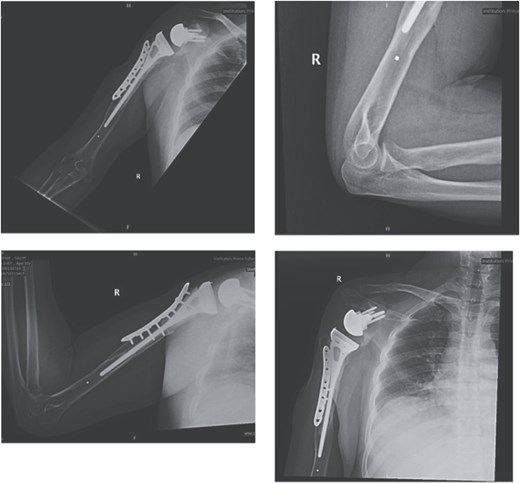
X-ray 2 years post-op showing a stable implant without evidence of fracture, instability, or loosening.
Discussion
Reconstruction of proximal humerus fractures with massive bone loss depends largely on the extent and location of the osseous defect, although no classification system has been universally validated to guide treatment [4]. In the present case, combined metaphyseal and diaphyseal involvement necessitated staged reconstruction with reverse shoulder arthroplasty and an allograft–prosthesis composite (RSA-APC). While smaller defects may be managed with RSA alone, extensive bone loss often requires RSA-APC or endoprosthetic replacement. The defect in this patient corresponded to type D according to the Boileau classification, type 2B in the PHAROS system, and type C in the PHBL-SCOR classification. RSA-APC restores humeral length, provides structural support, maintains appropriate deltoid tension, and offers a biologic surface for soft-tissue reattachment, collectively promoting joint stability and functional recovery [4, 5].
Clinical outcomes following RSA-APC have been favorable. Systematic reviews report satisfaction rates up to 86%, mean forward flexion approaching 100°, and reoperation-free survival exceeding 90% at 5 years [4]. Staged protocols further allow infection control, soft-tissue optimization, and improved incorporation at the host–graft junction, with union typically achieved within seven months [4, 5]. Nevertheless, RSA-APC is associated with complications such as nonunion, infection, instability, loosening, and graft resorption. Reported complication rates range from 10% to 19% in revision arthroplasty and may reach 61% in oncologic reconstructions [4–8]. Fixation strategy remains debated, as cemented long-stem techniques may be associated with higher revision rates compared with plate fixation [4].
In this case, a structural proximal humeral allograft restored humeral length, enabled stable plate fixation, and provided a biologic platform for soft-tissue reattachment. Concomitant LTT transfer addressed external-rotation deficiency and offers biomechanical advantages over LD transfer by more closely reproducing the infraspinatus vector [7, 12]. Using the allograft’s native soft-tissue attachment as a biologic anchor avoided interposed graft material and its associated risks. Two-stage reconstruction with antibiotic cement spacers remains well supported in infection-prone cases [10]. This case highlights that staged RSA-APC combined with LTT transfer can achieve durable radiographic and functional outcomes in young patients following high-energy trauma.
Conclusion
This case demonstrates that staged (RSA-APC) combined with LTT transfer can achieve satisfactory pain relief, structural stability, and functional recovery in young patients with massive proximal humeral bone loss following high-energy trauma. Using the proximal soft-tissue attachment of the structural allograft as a biologic anchor for the tendon transfer represents a practical and potentially advantageous technique for optimizing soft-tissue integration in complex reconstructive settings.
Conflicts of interest
None declared.
Funding
None declared.


