


 https://orcid.org/0009-0005-6682-7670

Abstract
Upper limb ischemia is rare complication of acute type A aortic dissection (ATAAD) with high morbidity and mortality. A 61-year-old male presented following 8-hour onset of severe chest pain and progressive right arm pain with motor-sensory deficits. Computed tomography angiography revealed ATAAD with brachiocephalic and right subclavian artery occlusion. He underwent successful ascending aortic and arch replacement with intraoperative right brachial perfusion and forearm fasciotomy. Proximal limb function was preserved, with gradual distal motor recovery at 5 months under intensive physiotherapy. Dissection-related arterial occlusion may mimic isolated thrombosis on imaging. Prompt central aortic repair with simultaneous intraoperative limb perfusion can preserve limb viability and obviate the need for peripheral revascularization.
Introduction
Upper limb ischemia is a rare presentation of acute type A aortic dissection (ATAAD) with a reported incidence of 1.6%–4%, and is associated with early hemodynamic instability and increased mortality [1, 2]. We present a case of successful limb salvage in a patient with prolonged right upper limb ischemia due to right subclavian artery occlusion secondary to ATAAD.
Case history
A 61-year-old male with history of chronic pulmonary obstructive disease and alcohol use disorder was transferred from a remote hospital with severe chest pain and progressive right arm pain with motor-sensory deficits. On arrival, approximately 8 hours after symptom onset due to prolonged transfer, his right arm appeared dusky, cold, and pulseless with absent brachial, radial, and ulnar Doppler signals. There was complete motor and sensory loss below the shoulder, and fixed flexion at rest, consistent with Rutherford class III ischemia. Duplex ultrasound showed collapsed axillary and brachial arteries with suspected thrombosis. Computed tomography angiography (CTA) revealed ATAAD with intimal tear at the left coronary ostium with brachiocephalic artery occlusion, near-occlusion of right carotid artery with distal recanalization, and complete right subclavian artery occlusion without distal flow (Fig. 1). Dissection extended to the left iliac artery with renal arteries arising from the false lumen.
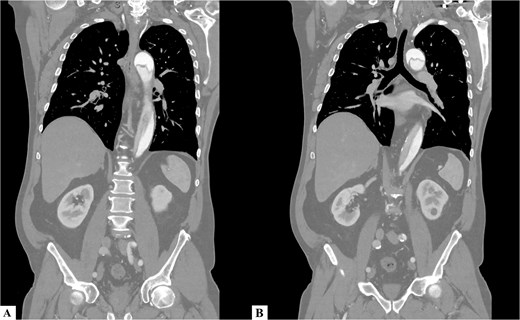
Right subclavian artery occlusion secondary to ATAAD on CTA.
Endovascular intervention for limb revascularization prior to central aortic repair, as well as central aortic cannulation to establish true lumen flow, were considered but deemed unsuitable due to suspected extensive right subclavian artery thrombosis. In joint approach by cardiac and vascular surgery, emergent right brachial artery antegrade cannulation via 5 French catheter with simultaneous ascending aortic and zone 0 arch replacement, and aortic root bovine patch repair were performed. The brachial catheter was connected to cardiopulmonary bypass (CPB) circuit, established via right femoral arterial and right atrial venous cannulation, to maintain intraoperative arm perfusion. He was cooled to 18°C with retrograde cerebral perfusion, and myocardial protection was achieved by retrograde cardioplegia. Following central aortic repair and weaning from CPB, pulsatile brachial flow was restored, with warmth and venous filling. Exploration by vascular surgery revealed dissection of right axillary artery with true lumen perfusion and palpable pulse, eliminating need for revascularization. This suggested occlusion from a dissection flap as etiology of limb ischemia, rather than thrombosis as initially suspected. On closure, all forearm and hand compartments were tense with absent radial and ulnar Doppler signals, necessitating emergent forearm fasciotomies. Postoperatively, the forearm remained in rigor mortis, but radial and ulnar arteries were palpable, and hand was warm with normal capillary refill.
His recovery was complicated by acute renal failure, likely secondary to renal malperfusion and rhabdomyolysis from prolonged limb ischemia, requiring continuous renal replacement therapy. Three weeks postoperatively, he underwent forearm debridement and split-thickness skin grafting. While right shoulder and elbow motor function were preserved, electrophysiologic studies confirmed denervation distal to wrist with trace wrist extension and partial ulnar sensation despite nerves remaining intact. He developed progressive neuropathic arm pain, suggesting early sensory recovery, and was discharged on Day 44. At 5 months, electromyography demonstrated interval nerve recovery with activation across all hand muscles and improved strength, with gradual functional recovery anticipated under ongoing physiotherapy.
Discussion
ATAAD is a life-threatening surgical emergency with in-hospital mortality approaching 17.8% despite intervention [3]. Peripheral malperfusion occurs in approximately one quarter of patients due to dynamic or static obstruction, thrombosis, dissection leak or rupture [1, 4]. Upper limb ischemia is a rare complication of ATAAD and remains poorly characterized [1]. Although CTA is the gold standard for diagnosing ATAAD, urgency of preoperative assessment may limit accurate diagnosis of ischemic etiology [5]. In our case, limb ischemia was initially attributed to thrombotic occlusion of right subclavian artery based on ultrasound and CTA findings, influencing our decision against endovascular revascularization. However, intraoperative restoration of brachial perfusion following central aortic repair confirmed occlusion by dissection flap rather than thrombosis. This case highlights that dissection-related occlusion can mimic isolated arterial thrombosis on imaging.
There is no clear consensus on whether peripheral revascularization should precede central aortic repair. Delayed aortic repair in favor of limb revascularization has been associated with mortality rates approaching 33% [4]. In 80% of patients, aortic repair restores true lumen perfusion and eliminates the need for revascularization, as observed in our case [4]. In patients with prolonged ischemia, we propose consideration of intraoperative brachial perfusion with simultaneous central aortic repair to preserve limb viability without delaying definitive treatment. This approach likely contributed to preservation of his proximal limb function and evidence of gradual distal recovery. A similar limb perfusion technique has been well-described in lower limb ischemia in ATAAD with favorable motor-sensory recovery [6]. Therefore, early involvement of vascular surgery and urgent extra-anatomic revascularization is indicated for optimal limb salvage [1, 4].
Conflicts of interest
The authors declared no potential conflicts of interest with respect to the research, authorship, and/or publication of this article.
Funding
The authors received no financial support for the research, authorship, and/or publication of this article.
Data availability
Non-identifying information may be provided by the corresponding author upon reasonable request.
Ethical considerations
Our institution does not require ethics IRB approval for case reports.
Consent to participate
Patient provided written informed consent for use of information.
Consent for publication
Patient provided written informed consent for publication.


