


 https://orcid.org/0000-0002-8383-4099

Abstract
Retained hemothorax is a complication of thoracic trauma caused by incomplete pleural drainage and early fibrotic organization, potentially progressing to trapped lung and functional impairment if untreated. A 60-year-old man sustained fractures of the eighth, ninth, and tenth right ribs after a fall, one associated with pulmonary injury. Without initial medical care, he presented 15 days later with progressive dyspnea. Chest radiography showed right lung collapse with massive hemopneumothorax. Closed thoracostomy drained 4000 ml of blood, but lung re-expansion failed due to organized hemothorax. Video-assisted thoracoscopic surgery revealed organized clots and pleuropulmonary adhesions causing trapped lung. Complete evacuation, adhesiolysis, and pleural lavage were performed. Postoperative drainage was 180 ml. With intensive respiratory physiotherapy, full lung re-expansion and satisfactory recovery were achieved. In stable patients with delayed retained hemothorax, video-assisted thoracoscopic surgery enables effective resolution, avoiding thoracotomy and restoring pulmonary function through a minimally invasive approach.
Introduction
Thoracic trauma remains a significant cause of morbidity and mortality in adult patients and accounts for up to 25% of trauma-related deaths [1]. Rib fractures are the most frequent injury in this context and are associated with intrathoracic complications such as pulmonary contusion, pneumothorax, and hemothorax [2]. Traumatic hemopneumothorax may progress to retained hemothorax when initial pleural drainage is insufficient or when rapid clot organization occurs within the pleural cavity [3].
Retained hemothorax is characterized by the persistence of significant intrapleural blood following tube thoracostomy placement and is associated with prolonged hospital stay, increased risk of empyema, fibrothorax, and trapped lung [4]. Recent trauma guidelines recommend video-assisted thoracoscopic surgery (VATS) as the intervention of choice in hemodynamically stable patients with retained hemothorax after failure of chest tube drainage, as it improves evacuation and reduces complications compared with conservative approaches [5].
Recent studies suggest that evacuation of retained hemothorax by VATS may be delayed when clinically necessary without increasing mortality, although it is associated with longer hospital stay and additional ventilator days for each day of delay [6]. Furthermore, controlled trials have shown that VATS, compared with open thoracotomy, provides better outcomes in terms of postoperative pain, reduced long-term drainage, and shorter hospitalization, reinforcing its utility as a minimally invasive technique for post-traumatic retained hemothorax [7].
More recently, a prospective randomized controlled trial compared VATS with chest tube reinsertion in retained hemothorax following penetrating trauma, demonstrating a lower rate of complications and need for additional procedures in the VATS group, although without a significant difference in overall hospital length of stay [8]. This recent evidence supports the efficacy, safety, and clinical utility of VATS in the management of retained hemothorax, even in cases of delayed presentation, as in the case reported.
Case presentation
A 60-year-old male patient with no relevant past medical history sustained a fall from standing height with direct impact to the left hemithorax. He subsequently developed mild chest pain without apparent respiratory compromise and therefore did not seek initial medical evaluation.
Fifteen days after the traumatic event, he developed progressive dyspnea associated with severe left-sided chest pain. Physical examination revealed markedly decreased breath sounds over the left lung field, dullness to percussion, and mild tachypnea.
Chest radiography demonstrated near-complete opacification of the left hemithorax with an air–fluid level and ipsilateral lung collapse, consistent with massive hemopneumothorax (Fig. 1).
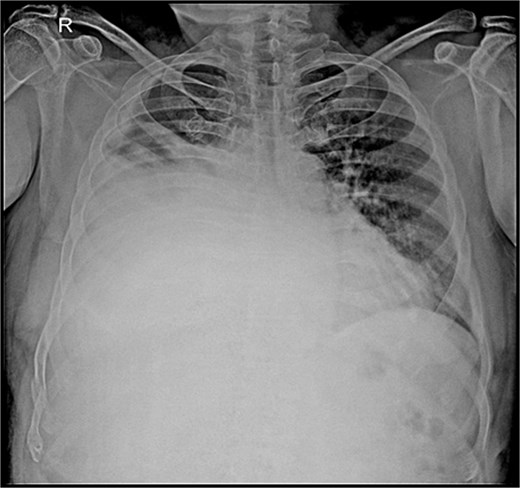
Chest radiograph demonstrating massive left hemopneumothorax with near-complete lung collapse and an air–fluid level.
Closed thoracostomy was performed at the fifth left intercostal space along the mid-axillary line, yielding an initial drainage of ~4000 ml of hematic content. Subsequently, the output decreased significantly; however, computed tomography (CT) showed persistence of residual pleural collection with incomplete lung re-expansion (Fig. 2).
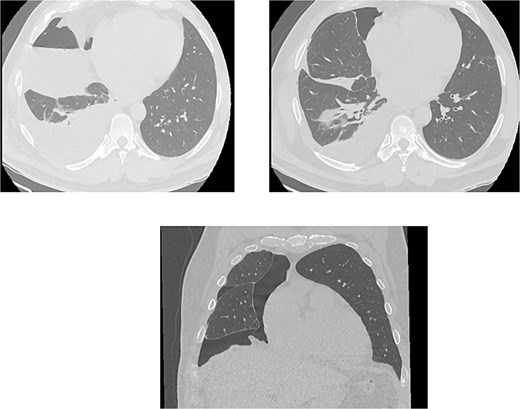
CT scan following closed thoracostomy showing persistence of pleural collection and incomplete lung re-expansion, consistent with retained hemothorax.
Given the suspicion of organized retained hemothorax, surgical intervention by video-assisted thoracoscopic surgery (VATS) was indicated.
During the procedure, abundant organized clots occupying the pleural cavity were identified, along with parietal and visceral fibrotic membranes, dense pleuropulmonary adhesions, and a partially trapped lung (Fig. 3).
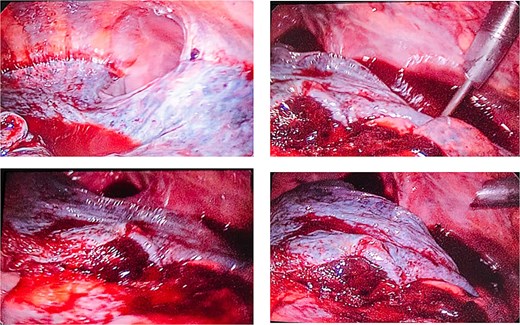
Intraoperative thoracoscopic view demonstrating organized clots and pleuropulmonary adhesions responsible for trapped lung.
Complete evacuation of the hematic material was performed, followed by meticulous adhesiolysis and lung release, and pleural lavage. Adequate lung re-expansion was confirmed under direct visualization. A chest tube was left in place connected to a water-seal drainage system.
In the postoperative period, an additional 180 ml of drainage was recorded over 48 h. The patient initiated intensive respiratory physiotherapy on postoperative day one and completed 15 days of pulmonary rehabilitation. Follow-up chest radiography demonstrated complete lung expansion with no evidence of significant residual collection (Fig. 4).
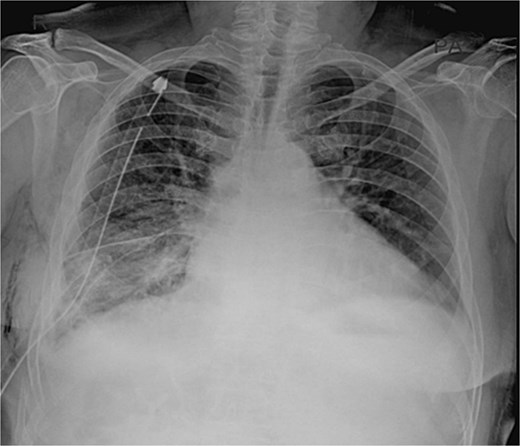
Postoperative chest radiograph demonstrating complete lung re-expansion following thoracoscopic release.
The patient was discharged in stable clinical condition without respiratory functional limitation.
Discussion
Retained hemothorax (RH) represents an evolutionary complication of thoracic trauma when initial pleural drainage fails to completely evacuate hematic content, promoting fibrin organization, septation formation, and lung entrapment [1–3]. Its reported incidence ranges from 2% to 20%, depending on the initial bleeding volume, time to drainage, and technique employed [4–6].
Residual blood within the pleural cavity triggers a local inflammatory response characterized by activation of the coagulation cascade, fibrin deposition, and fibroblastic proliferation, leading to pleural thickening and restriction of lung expansion [7, 8]. Persistent hemothorax is associated with an increased risk of empyema, prolonged hospital stay, and a higher rate of secondary surgical interventions [9, 10].
Contemporary thoracic trauma management guidelines recommend video-assisted thoracoscopic surgery (VATS) as the treatment of choice in hemodynamically stable patients with confirmed RH [11] [7],. Compared with open thoracotomy, VATS has demonstrated significant reductions in postoperative pain, systemic inflammatory response, infectious complications, and length of hospital stay [12].
The optimal timing of intervention remains a subject of ongoing analysis. Evidence supports early intervention (within the first 3–7 days following trauma), when blood has not yet undergone advanced fibrotic organization [13]. Nevertheless, recent studies have shown that delayed intervention (≥10–14 days) may be equally effective in selected patients, with low conversion rates to thoracotomy and satisfactory functional recovery [14].
In the present case, intervention was performed 15 days after the initial trauma, revealing organized clots, fibrotic membranes, and a partially trapped lung. Despite the delayed presentation, complete evacuation and lung release through a minimally invasive approach achieved full pulmonary re-expansion without complications. This outcome supports recent literature expanding the therapeutic window of VATS in subacute settings, provided that hemodynamic stability and adequate surgical expertise are present [14, 15].
The initial drainage volume (4000 ml) represents a relevant predictive factor for the development of RH and eventual need for secondary surgical intervention [6, 10]. Likewise, persistent radiographic opacities following thoracostomy should raise suspicion for organized retained hematic collections.
Finally, intensive respiratory physiotherapy plays a fundamental role in postoperative recovery, promoting complete lung expansion, improving ventilatory mechanics, and reducing the risk of residual atelectasis [15].
Overall, current evidence supports VATS as the therapeutic standard for retained hemothorax in stable patients, including carefully selected delayed scenarios, with clear benefits in terms of morbidity, hospital stay, and preservation of pulmonary function.
Conclusions
Retained hemothorax is a significant complication of thoracic trauma when initial pleural drainage is insufficient, favoring fibrotic organization and lung entrapment.
Video-assisted thoracoscopic surgery represents a safe and effective therapeutic strategy in hemodynamically stable patients, allowing complete evacuation of hematic content, lung release, and resolution of the condition through a minimally invasive approach.
Although early intervention remains the ideal scenario, this case demonstrates that VATS may provide satisfactory outcomes even in carefully selected subacute or delayed phases.
Timely identification of retained hemothorax and early implementation of intensive respiratory physiotherapy are crucial to optimize functional recovery and prevent pulmonary sequelae.
Conflicts of interest
The authors declare no conflict of interest.
Funding
None declared.
Ethical considerations
Written informed consent was obtained from the patient for publication of this case and accompanying clinical images.
Patient confidentiality was not compromised.
No additional ethics committee approval was required, as this is a case report without experimental intervention.


