


 https://orcid.org/0000-0001-7153-2424

Abstract
Free-floating gallbladder is a rare anatomic variant characterized by excessive mobility due to an elongated mesentery, predisposing it to torsion and vascular compromise. When torsion occurs, obstruction of the cystic duct and artery may rapidly progress to ischemia, necrosis, and gangrene, constituting a surgical emergency. Preoperative diagnosis is challenging because clinical, laboratory, and imaging findings often mimic uncomplicated acute cholecystitis. We report the case of an 87-year-old male with liver cirrhosis presenting with diffuse abdominal pain and elevated inflammatory markers. Ultrasonography and computed tomographic angiography were consistent with acute cholecystitis. However, laparoscopic exploration revealed a torsioned, necrotic, gangrenous free-floating gallbladder. Laparoscopic cholecystectomy was successfully performed, and recovery was uneventful. This case highlights the diagnostic limitations of imaging in rare anatomic variations and underscores the importance of early surgical intervention and intraoperative vigilance.
Introduction
Gallbladder torsion is an exceedingly rare in contemporary surgical practice. It typically occurs in the setting of a free-floating gallbladder, in which the organ is suspended by a long mesentery and lacks firm hepatic attachment. This abnormal mobility permits axial rotation along the cystic pedicle, potentially compromising both the cystic duct and cystic artery [1, 2].
When torsion progresses to vascular occlusion, rapid evolution to ischemia, necrosis, and gangrene may occur, necessitating urgent surgical intervention. Preoperative diagnosis remains challenging, as clinical, laboratory, and imaging findings often resemble those of uncomplicated acute cholecystitis.
We present a rare case of a torsioned, necrotic, gangrenous free-floating gallbladder discovered incidentally during laparoscopic cholecystectomy in an elderly cirrhotic patient, emphasizing diagnostic pitfalls and intraoperative considerations.
Case presentation
An 87-year-old male, non-smoker, with known liver cirrhosis on furosemide 20 mg daily, presented with a 3-day history of diffuse abdominal pain and nausea, without fever or vomiting. He was hemodynamically stable, and abdominal examination revealed diffuse tenderness without peritoneal signs.
Laboratory investigations showed normal leukocyte count (8.79 × 10³/μl) but markedly elevated inflammatory markers (CRP 190 mg/l, LDH 348 U/l), with mildly deranged liver function tests. Abdominal ultrasonography demonstrated a distended gallbladder with wall thickening (7 mm), sludge, and pericholecystic fluid, suggestive of acute cholecystitis. Given the cirrhotic background, computed tomography (CT) angiography was performed to exclude mesenteric ischemia and confirmed findings consistent with uncomplicated acute cholecystitis without vascular compromise.
The patient underwent laparoscopic cholecystectomy. Intraoperatively, a completely free-floating gallbladder was identified, suspended by an elongated mesentery and twisted along its cystic pedicle, appearing gangrenous (Fig. 1). Careful dissection allowed identification of critical structures, and the Critical View of Safety was achieved. The cystic duct and artery were clipped and divided (Fig. 2), followed by detorsion and cholecystectomy.
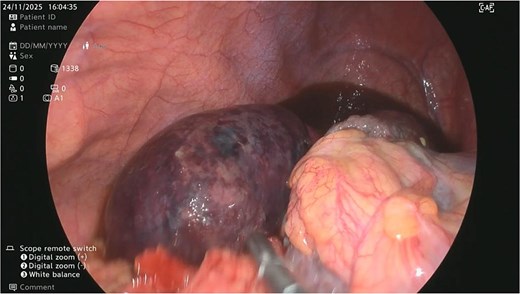
Floating torsioned necrotic gangreneous gallbladder found suspended near thoracic cavity upon laparoscopy.
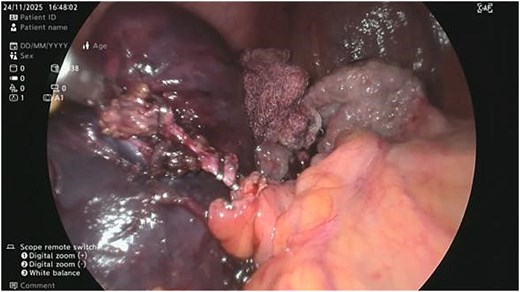
Clips at base of cystic duct.
Histopathology confirmed necrotic and gangrenous cholecystitis. The postoperative course was uneventful, and the patient was discharged on Day 5 in stable condition.
Discussion
Gallbladder torsion is a rare but potentially life-threatening surgical emergency, with fewer than 350 cases reported in the literature; most are diagnosed intraoperatively rather than preoperatively [3]. It classically affects elderly women and is associated with anatomical and age-related factors such as hepatic atrophy, loss of visceral fat, spinal deformities, and an elongated mesentery that allows excessive gallbladder mobility [4]. Although an incidence of 4.4%–4.6% has been cited, this estimate lacks robust epidemiologic validation and likely reflects limited institutional data rather than population-based studies [1]. Its rarity and nonspecific presentation contribute to delayed recognition and increased risk of ischemic complications.
In contrast, our patient was an elderly male with underlying liver cirrhosis. Chronic liver disease leads to architectural distortion, segmental atrophy–hypertrophy changes, and altered perihepatic attachments. These changes may reduce gallbladder fixation and create a permissive environment for abnormal mobility. While cirrhosis is not a recognized primary risk factor, it may act as a contributing anatomical substrate in selected patients.
Clinically, gallbladder torsion closely mimics acute cholecystitis, which is typically caused by cystic duct obstruction leading to inflammation [5]. Symptoms such as abdominal pain and systemic inflammatory response overlap with other intra-abdominal conditions, complicating diagnosis. In torsion, rotation around the cystic pedicle compromises vascular supply, resulting in ischemia, necrosis, and eventual gangrene if untreated [2]. Laboratory findings are nonspecific and do not reliably reflect the severity of vascular compromise.
Radiologic imaging frequently fails to detect the underlying volvulus. Ultrasonography and CT typically demonstrate findings consistent with acute cholecystitis, including gallbladder distention, wall thickening, and pericholecystic fluid. In our case, both ultrasound and CT angiography supported this diagnosis without identifying torsion. Although specific signs such as the “whirl sign” of the twisted pedicle have been described, they are infrequently observed and lack sensitivity [6]. Consequently, definitive diagnosis is most often established intraoperatively [7].
This case is notable for the presence of a free-floating gallbladder with advanced ischemic changes and a relatively subtle clinical presentation. A free-floating gallbladder, due to congenital or acquired mesenteric elongation, often remains asymptomatic until torsion occurs and is rarely detected preoperatively [8].
From a surgical standpoint, torsion presents significant technical challenges. Distortion of Calot’s triangle increases the risk of biliary misidentification and iatrogenic injury. Friable, ischemic tissue, and abnormal orientation further complicate exposure and safe dissection, making strict adherence to the Critical View of Safety essential [9].
Early surgical intervention remains the cornerstone of management to prevent complications such as perforation, bile peritonitis, and sepsis [5]. Postoperative care requires close monitoring, especially in elderly cirrhotic patients, with careful balancing of infection control and thromboembolic prophylaxis [10].
Overall, this case highlights the diagnostic challenges, operative risks, and importance of timely management in gallbladder torsion, emphasizing the need for heightened clinical suspicion in atypical presentations.
Conclusion
Gallbladder torsion is a rare but potentially fatal cause of acute abdomen that frequently masquerades as uncomplicated acute cholecystitis and is often diagnosed only intraoperatively. This case underscores the limitations of preoperative imaging in detecting vascular compromise, particularly in the presence of atypical anatomy such as a free-floating gallbladder and underlying cirrhosis. A high index of suspicion, meticulous adherence to safe cholecystectomy principles, and prompt surgical intervention are essential to prevent ischemic progression, perforation, and septic complications.
Author contributions
Oussama Shibly wrote the Introduction. Majd Bakkour and Tia Sarkis wrote the Case Presentation. Elissar Mansour and Elias El Hajj wrote the Discussion. Wissam Mohamad wrote the Abstract and the Conclusion. Majd Bakkour supervised the development of the manuscript. Ghassan Nabbout revised and edited the manuscript. All authors approved the final manuscript.
Conflicts of interest
The authors declare no conflicts of interest.
Funding
No funding was received for this study.
Data availability
The datasets used and/or analyzed during the current study are available from the corresponding author on reasonable request.
Ethics approval and informed consent
This study was approved by the ethics committee at Haykal hospital. Written informed consent was obtained from the patient.


