


 https://orcid.org/0000-0003-1793-8874

Abstract
Giant ovarian mucinous cystadenomas have become uncommon due to earlier detection, yet they may closely mimic malignancy on imaging. We report a 45-year-old woman with progressive abdominal enlargement and inability to lose weight, who remained otherwise asymptomatic. Imaging revealed a multiloculated right adnexal mass with thick septations and apparent solid components, associated with minimal ascites and right grade III hydronephrosis. Based on imaging features, the mass was classified as O-RADS 5, while serum tumor markers were within normal limits. Exploratory laparotomy demonstrated a 35-cm right ovarian mass with marked anatomical distortion and dense Zühlke grade IV adhesions. The tumor was removed intact to avoid spillage, and intraoperative frozen section analysis confirmed benign pathology, guiding continuation of the planned procedure. Final histopathology revealed a benign mucinous cystadenoma. Postoperative recovery was uneventful. This case highlights the limitations of imaging in giant ovarian tumors and underscores the importance of a safety-oriented surgical approach.
Introduction
Mucinous ovarian cystadenomas account for ~10%–15% of benign ovarian neoplasms. [1, 2] With widespread access to imaging, tumors exceeding 30 cm have become rare [2]. However, when they reach giant proportions, their radiologic appearance may mimic borderline or malignant epithelial tumors, frequently leading to high-risk classifications under systems such as O-RADS [3, 4] We report a giant mucinous cystadenoma presenting solely as failure to lose weight, highlighting diagnostic, and surgical challenges.
Case report
A 45-year-old woman presented with progressive abdominal enlargement and inability to lose weight. She denied abdominal pain, gastrointestinal symptoms, or urinary complaints. Her last gynecological evaluation had been performed ˃10 years prior to presentation. Past medical history included hysterectomy for uterine leiomyomatosis, bilateral salpingectomy, cesarean sections, childhood epilepsy, and migraine. Physical examination revealed a globose abdomen with a large palpable mass and a positive ascitic wave.
Ultrasound demonstrated a multiloculated adnexal mass measuring 23 × 16 × 9 cm (Fig. 1). Magnetic resonance imaging (MRI) revealed a 25 × 20 × 15 cm multiloculated right adnexal mass with thick enhancing septations, peripheral solid-appearing components, minimal ascites, and right grade III hydronephrosis secondary to tumor-related ureteral compression. Based on imaging features the mass was classified as ORADS-5 cm (Fig. 2). Serum tumor markers (CA-125, CA 19-9, CA 15-3, AFP, CEA, and HE4) were within normal limits.
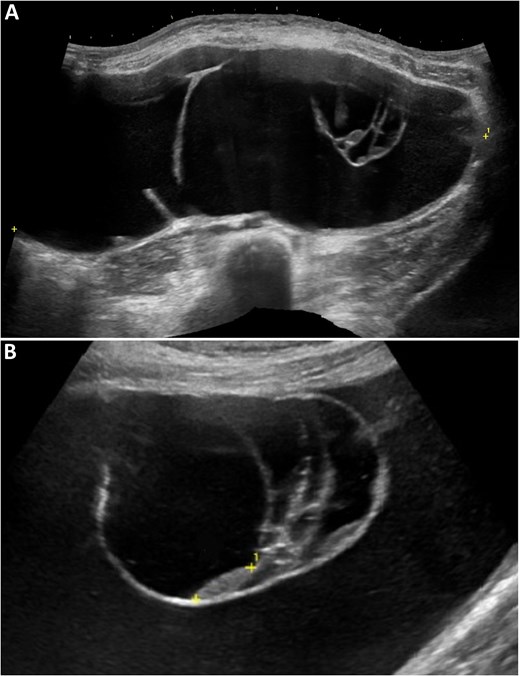
Transabdominal ultrasound. (A) Panoramic transabdominal ultrasound demonstrating a giant multiloculated cystic mass occupying the abdominopelvic cavity, with predominantly anechoic content. (B) Detailed view showing internal septations, some appearing thickened, without definite solid nodules or vascularized components.
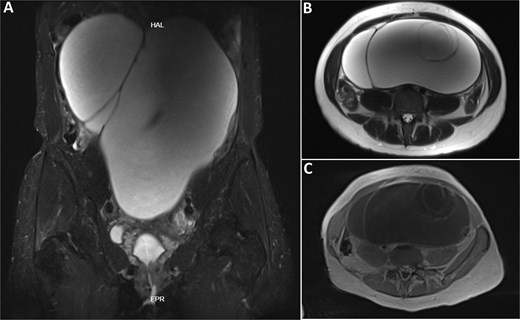
MRI of the abdominopelvic mass. (A) Coronal T2-weighted image with fat suppression (TIRM) demonstrating a giant multiloculated cystic lesion occupying most of the abdominal and pelvic cavity. (B) Axial T2-weighted (HASTE) image showing thick internal septations, consistent with a complex adnexal mass. (C) Axial T1-weighted post-contrast (VIBE-DIXON) image demonstrating enhancement of thick internal septations, findings consistent with a high-risk adnexal lesion (O-RADS MRI 5) and supporting the indication for surgical management.
A midline laparotomy was performed. Intraoperatively, normal anatomy was markedly distorted due to the massive size of the tumor and the presence of dense Zühlke grade IV adhesions. Careful identification of anatomical planes was undertaken, including localization of the right ureter, sigmoid colon, urinary bladder, and major vascular structures. The tumor pedicle was identified and securely clamped. Given the suspicion of malignancy, the mass was removed intact to avoid rupture and potential dissemination (Fig. 3). Intraoperative frozen section analysis revealed benign pathology, allowing continuation of the planned procedure. Dense adhesions required extensive enterolysis. Final procedures included bilateral oophorectomy, salpingectomy, and partial omentectomy. Estimated blood loss was 100 mL.
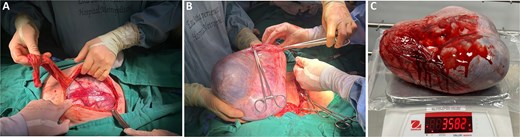
Intraoperative and gross surgical findings. (A) Intraoperative view demonstrating a giant ovarian cystic mass occupying the abdominal cavity, with intact capsule, prior to resection. (B) Gross appearance of the resected ovarian mass, removed intact, confirming complete surgical excision. (C) Gross specimen placed on a surgical scale, demonstrating a total weight of ~3.6 kg, highlighting the extreme size of the lesion.
Final histopathology confirmed a mucinous cystadenoma lined by single-layer mucin-secreting columnar epithelium without atypia or stromal invasion (Fig. 4). The postoperative course was uneventful, and the patient was discharged on postoperative day two. Follow-up imaging demonstrated complete resolution of the right-sided hydronephrosis, confirming its secondary nature due to tumor-related ureteral compression.
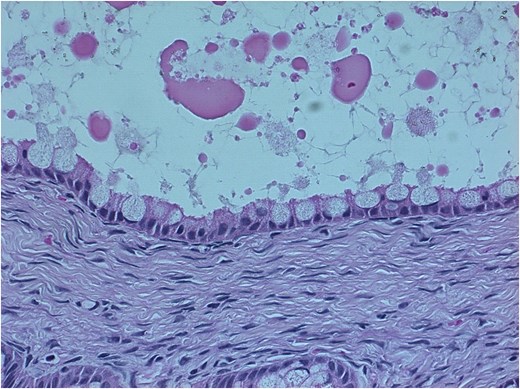
Histopathological examination of the resected ovarian mass (hematoxylin and eosin stain, ×40) demonstrating a benign mucinous ovarian cystadenoma, characterized by a single layer of mucin-secreting columnar epithelium lining the cyst wall and resting on a fibrous stroma, without cytologic atypia or stromal invasion.
Discussion
Giant mucinous ovarian cystadenomas remain clinically relevant despite their rarity, as they may grow silently to extreme sizes [5–7]. Slow expansion allows progressive adaptation of surrounding structures, explaining the absence of symptoms despite significant anatomical distortion and hydronephrosis [8, 9].
Radiologic evaluation of giant mucinous tumors is challenging. Features such as multilocularity, thick septations, and heterogeneous signal intensity overlap with borderline and malignant ovarian neoplasms [2, 3]. In large masses, compression of septations and distortion of anatomy may generate pseudo-solid areas, leading to high-risk ORADS classifications [10]. MRI specificity decreases significantly for adnexal masses exceeding 20–25 cm [3, 11, 12].
From a surgical perspective, giant ovarian tumors pose substantial technical challenges. In our case, marked anatomical distortion and dense Zühlke grade IV adhesions necessitated meticulous dissection and identification of critical structures. Intact removal of the mass was prioritized to minimize the risk of intraperitoneal spillage [13]. Intraoperative frozen section analysis was pivotal in guiding surgical management and avoiding unnecessary radical procedures [2, 14].
Laparotomy remains the preferred approach for giant ovarian tumors when malignancy cannot be excluded [13]. This case highlights the potential discordance between imaging-based risk stratification and final histopathology, as radiologic features consistent with a high-risk lesion (O-RADS 5) ultimately corresponded to a benign mucinous cystadenoma. Such discordance appears to be more frequent in giant ovarian masses, where size and structural complexity may overestimate malignant potential on imaging [4, 11]. Additionally, the absence of symptoms and the unusual presentation as failure to lose weight further contributed to the diagnostic challenge.
Conclusion
Giant mucinous ovarian cystadenomas may remain clinically silent and closely mimic malignancy on imaging studies. Surgical excision is essential for definitive diagnosis and treatment. Careful intraoperative assessment, intact tumor removal, and frozen section analysis are critical for safe and effective management.
Acknowledgements
A special acknowledgment to the staff of this journal for the opportunity to publish this research in this prestigious journal, and to contribute to the scientific and surgical community through it.
Author contributions
Eduardo Román (Conceptualization, Data curation, Investigation, Writing—Original Draft, Writing—Review & Editing, Visualization), Paula Castellanos (Investigation, Data curation, Writing—Review & Editing), Diego Cornejo (Investigation, Validation, Formal analysis, Visualization, Writing—Review & Editing, Supervision), Miguel Rueda Mesías (Investigation, Validation, Formal analysis, Visualization, Supervision), and Santiago Muñoz (Methodology, Validation, Formal analysis, Visualization, Writing—Review & Editing)
Conflicts of interest
The authors declare that we have no personal, financial, intellectual, economic or corporate conflict of interest with the members of the journal.
Funding
No funding was provided for the preparation of this article.


